Haplogroup I2a1b2a2b2

– 5 min read


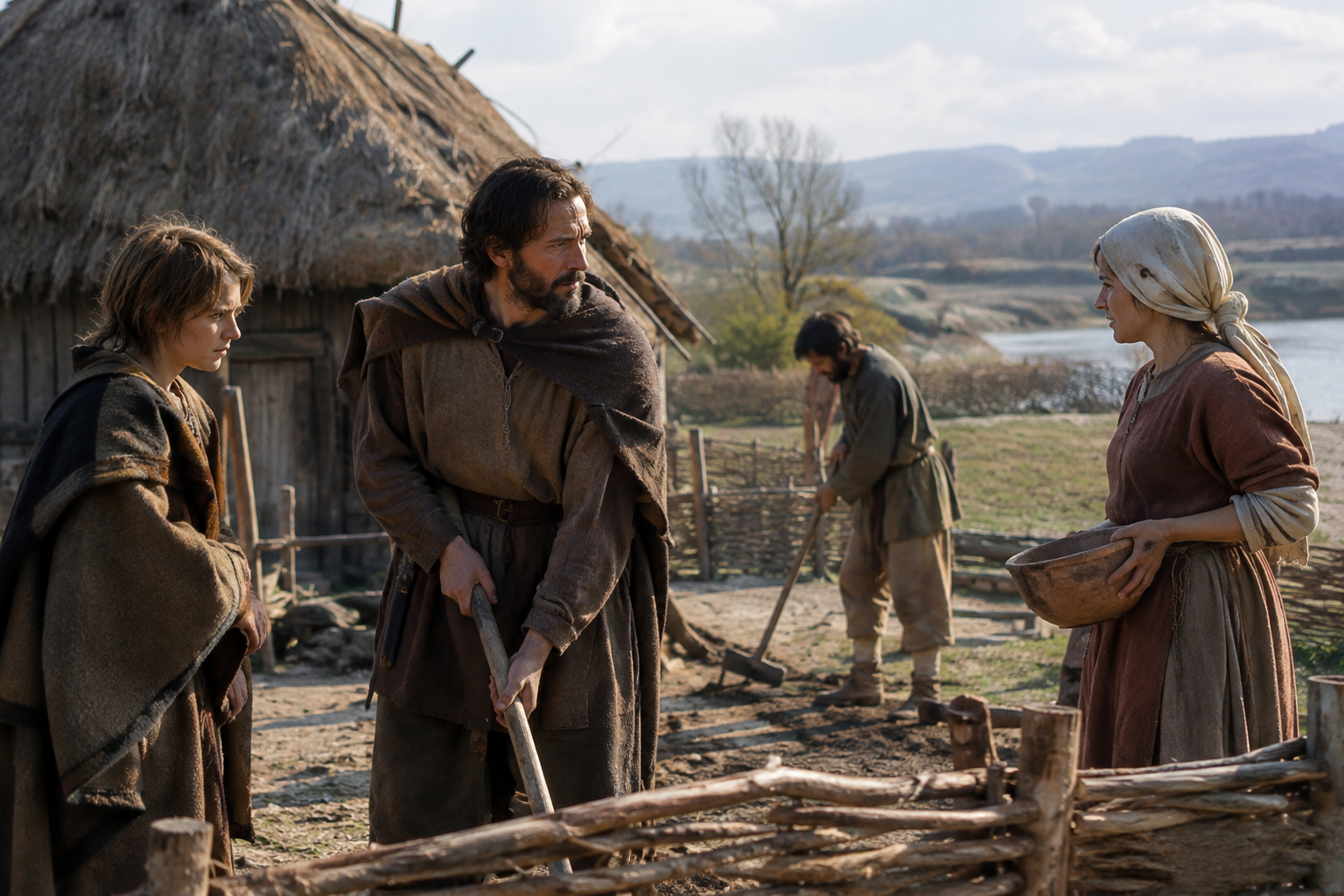
At Velim-Velistak on the Dalmatian coast of early medieval Croatia, one excavated man has become a useful signpost for a very specific paternal line. The individual labeled VEM029, dated to about AD 775, is associated here with the Y-DNA haplogroup I2a1b2a2b2. That may look like a string of code, but in historical terms it places one direct male line inside a landscape where Roman provincial legacies, Slavic-speaking communities, and Adriatic connections were all meeting and being remade.
The interest of VEM029 is not that he can stand for all of Croatia, still less for all early medieval men. It is that he gives us one securely named archaeological person in one known place and period. Y-DNA follows only the direct paternal line, not a person's whole ancestry, but even that narrow thread can be revealing when it turns up in a region whose population history was changing in very visible ways.
Velim-Velistak lies in a part of Croatia that had already lived many historical lives before VEM029 was buried there. This was once the world of Roman Dalmatia, then the fractured post-Roman Adriatic, and by the 8th century a zone shaped by new political formations and new local identities. A single Y-chromosome result cannot name an ethnicity, but it can anchor discussion in a real community rather than a vague map of later nations.
That matters because the eastern Adriatic is often talked about in blunt historical blocks: Roman, Slavic, Byzantine, Croatian. Actual cemeteries are much messier and much more interesting. A site like Velim-Velistak belongs to the lived transition between those labels, where people were not abstractions but families, neighbors, and burial communities with both local roots and wider connections.
Croatia's shifting paternal lines
The haplogroup named for this article, I2a1b2a2b2, is a very narrow branch within the wider haplogroup I2 family, one of the long-established paternal lineages of Europe. It is important not to collapse those different scales. Broad I2 has a deep prehistoric history in Europe, but that does not mean every much narrower downstream branch can be assigned the same route, date, or historical role without specific evidence.
In the case of VEM029, the safest point is the simplest one: by the later 8th century, a man associated with this branch was present in early medieval Croatia. That tells us that this paternal line had become part of the human landscape of the eastern Adriatic by that time. It does not by itself prove whether that line arrived there in prehistory, late antiquity, or the early medieval period, and it certainly does not identify VEM029 as the founder of anything grander than his own direct male line.
Still, narrow haplogroups become historically valuable precisely when they are attached to excavated individuals. They stop being just tree positions and start becoming evidence with a place, a date, and a burial context. For family historians, that is often the crucial shift.
Recent archaeogenetic work on Croatia has stressed an important pattern: some lines and ancestries show continuity across long periods, while others change markedly, especially on the paternal side. That is a useful background for understanding why a sample like VEM029 matters. He belongs to a period when the social map of the region was changing, and male-line turnover or reshaping is exactly the sort of process that early medieval cemeteries can begin to document.
A related ancient DNA discussion on the region has highlighted how long-term maternal continuity can sit alongside more shifting Y-chromosome patterns. In other words, communities may remain locally rooted while male-line representation changes through migration, alliance, marriage practice, or social reorganization. VEM029 fits neatly into that broader historical question, even if one sample cannot resolve it alone.
Research infrastructure associated with these Croatian ancient genomes can be traced through genetic work on ancient individuals from the region, which helps place named burials like VEM029 into a larger scientific effort to understand population history on the eastern Adriatic.
The 8th century is awkward for anyone who wants clean historical categories. By around AD 775, the old Roman order was long gone, but its towns, roads, coastlines, and habits of life had not simply vanished. At the same time, the populations of the hinterland and coast were participating in the formation of early medieval Croatian society under conditions shaped by both local development and wider Adriatic politics.
This is exactly why a Y-lineage from Velim-Velistak is interesting. It belongs not to a neat origin story, but to a world of entanglement. A paternal branch such as I2a1b2a2b2 may today be tempting to read as straightforwardly "native," "Slavic," or "Balkan," yet archaeology warns against such easy labels. Human groups inherit landscapes as much as they replace one another, and male lines can persist through major cultural shifts without carrying a single ethnic meaning.
That caution is not a disappointment. It is the real historical value of ancient DNA. Instead of confirming old myths, it shows how local populations were assembled over time, often from ingredients that do not fit later political identities very neatly.
Deep Balkan roots and medieval admixture
Because only one ancient individual is supplied here, the responsible story is not to inflate the evidence but to ask the right-sized question. VEM029 shows that a direct paternal line classified here as I2a1b2a2b2 was present in early medieval Croatia at Velim-Velistak. The broader question is how often closely related lines appear in neighboring regions and periods, and whether they cluster with particular settlement histories or burial communities.
This is where archaeology and genetics have to work together. The Y-chromosome gives one narrow line of descent; the cemetery, the dating, and the regional history tell us what sort of world that lineage inhabited. In the eastern Adriatic, that world included the afterlife of Rome, the emergence of medieval polities, and ongoing contact across the Balkans and the sea.
For readers following the wider question of how language, migration, and ancestry interact in early medieval Europe, the debate is larger than Croatia alone. Genetic studies across the continent keep showing that languages and political identities spread through mixed processes rather than a single demographic event.
How language spread meets genetics
What makes I2a1b2a2b2 distinctive in this case is not a sweeping migration legend but a concrete attachment to one excavated man, VEM029, in early medieval Velim-Velistak. For someone researching this paternal line today, that is the meaningful takeaway: at least one branch-bearer stood within the reshaping societies of 8th-century Croatia, in a region where deep local roots and historical change were tightly interwoven. It is a modest conclusion, but a valuable one, because it rests on archaeology rather than fantasy.






Comments