Haplogroup I2a1b1a2b1a2a1
– 5 min read


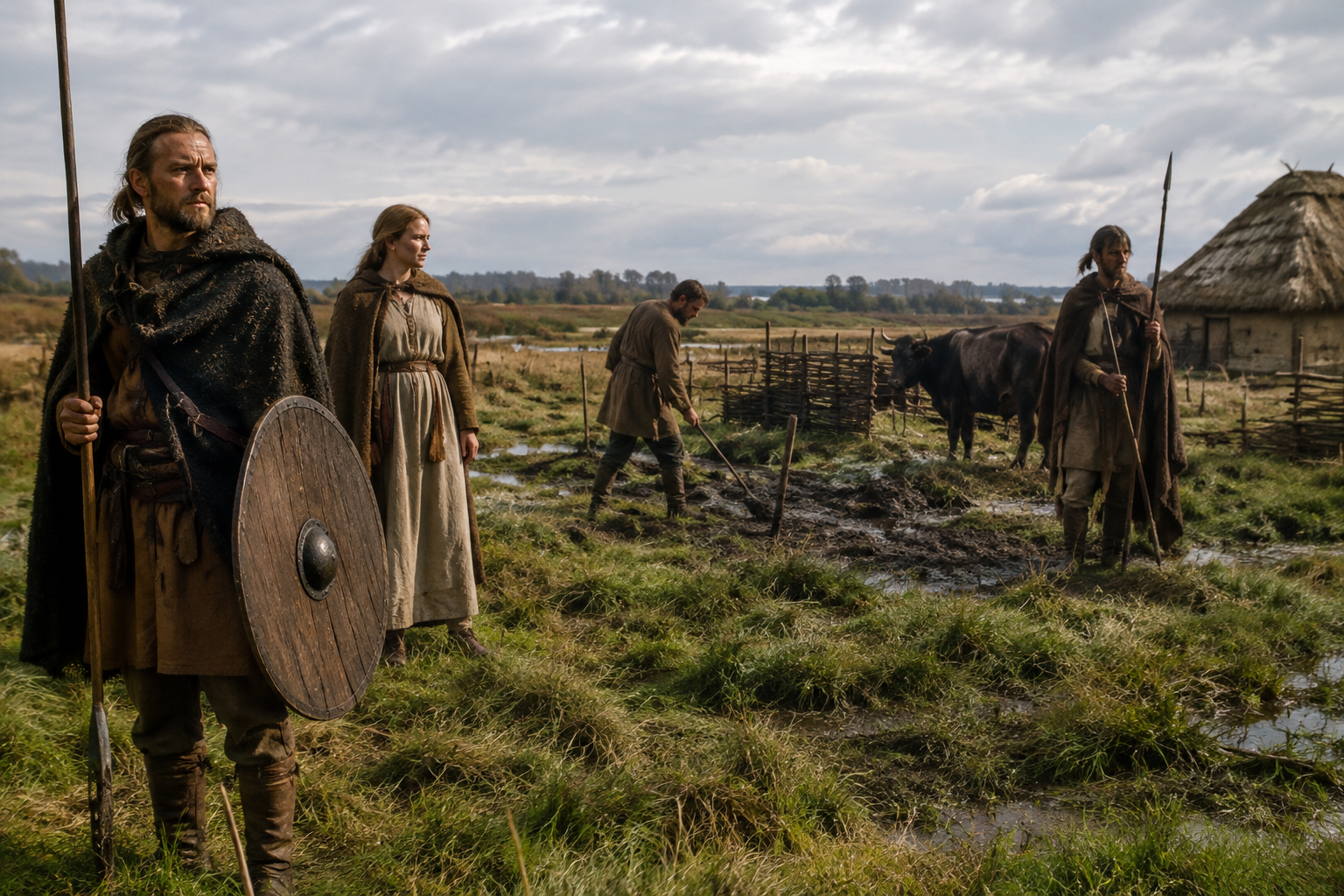
At Alken Enge in Jutland, archaeologists uncovered one of the most unsettling deposits in Roman-period northern Europe: the remains of large numbers of men placed in a wetland after a violent event, usually dated to the early 2nd century AD. Among the ancient individuals associated with this landscape is sample CGG019212, listed here as a Jute from Early Roman Era Denmark, around AD 115. For anyone exploring the Y-DNA haplogroup I2a1b1a2b1a2a1, that is a striking place to begin, because it ties this paternal line to a real and highly specific moment in Scandinavian history rather than to vague stories about "ancient Europe."
A second clue comes from another Danish individual, CGG107532, described as connected with the Danii and dated to around AD 175 at Forevejlegard in Denmark. Two finds do not make a dynasty, a tribe, or a single family. But they do place this branch, or a reported association with it, in eastern Jutland and its neighboring cultural world during the Roman Iron Age, when southern Scandinavia was neither isolated nor simple, but tightly bound into North Sea and continental networks of war, exchange, and identity.
Y-DNA traces one direct paternal line: father to son, back through time. That makes a lineage such as I2a1b1a2b1a2a1 especially useful for studying continuity and male-line connections, but it does not describe a person's whole ancestry, language, or ethnic identity. In other words, a man carrying this haplogroup in Roman-period Denmark was not "nothing but" that lineage; he was also part of a wider community shaped by local kinship, regional alliances, and the broader world of Iron Age Scandinavia.
The long string of letters and numbers matters too. I2a1b1a2b1a2a1 is a very narrow branch within the wider I haplogroup family, which has deep roots in Europe. It would be careless to project every claim ever made about haplogroup I2 onto this precise terminal branch. What the present evidence does support is more modest and more interesting: this lineage appears in Roman-period Denmark, in contexts linked with conflict and with named historical populations from the Danish world.
Alken Enge is famous because it is not an ordinary cemetery. It is a wetland deposition site where human remains, mostly from adult males, seem to preserve the aftermath of large-scale violence. The context belongs to a period when Roman power loomed to the south, yet Jutland remained outside the empire. That liminal position matters. Southern Scandinavia was close enough to the Roman world to feel its pull, but distant enough to develop its own military and political dynamics.
In that setting, sample CGG019212 becomes more than a code. It marks the presence of the article's featured paternal branch in a community caught up in organized conflict. We should not overstate the point: one individual cannot stand for every man at Alken Enge, nor does one Y-line explain the violence. Yet a haplogroup found in such a site immediately places paternal ancestry inside the hard realities of the Roman Iron Age, where power was negotiated not only through trade and prestige goods but also through lethal confrontation.
There is new regional genetic work connected to these Danish materials in research on ancient populations from Denmark and neighboring areas. Without pretending to squeeze more from the paper than can be verified here, the broader importance is clear enough: Roman-period Scandinavian graves and depositional sites are increasingly being studied not just as archaeological curiosities, but as genetically readable communities.
The second sample, CGG107532, is listed as a Danii individual from Forevejlegard in Denmark, around AD 175. The label is tantalizing because the Dani, or Danes, are among the most historically resonant names in early Scandinavian history. But labels like this need handling with care. A burial in Denmark from the 2nd century AD can be placed in the cultural orbit later associated with the Danes, yet archaeology and genetics do not allow us simply to lift a tribal name from later texts and staple it onto every excavated man.
Still, the sample is valuable. It suggests that the same reported Y-DNA branch appears not only in an extraordinary conflict assemblage like Alken Enge, but also in another Roman-period Danish context. That broadens the picture. Instead of seeing I2a1b1a2b1a2a1 only in an exceptional setting of violence, we glimpse it in the wider social landscape of Iron Age Denmark.
That is often how ancient DNA becomes historically useful. Not through grand slogans, but through repetition in the right place and period. One sample may be accidental; two samples in related regional settings begin to indicate that a paternal line was part of the human fabric of Jutland and the early Danish world.
It is easy to imagine Roman-era Denmark as a remote fringe beyond the empire's map, but that would miss the point. Jutland sat in a strategic zone linking the Baltic and the North Sea. Goods, ideas, and probably people moved through it. The societies of this region were not Roman, but they were entangled with Roman demand, Roman prestige, and the shifting politics of the continental frontier.
That context helps explain why the two Danish samples matter. A lineage like I2a1b1a2b1a2a1, appearing in this period, belongs to populations participating in a complicated northern world: not static "tribes" frozen in time, but communities dealing with war bands, alliances, mobility, and local competition. Y-DNA can be particularly revealing in such settings because male-line structures often intersect with inheritance, leadership, and the organization of armed groups, even when the exact social rules remain archaeologically invisible.
There is also a useful caution here for family historians. Roman-period Denmark was already a place of mixture and movement. So finding a paternal line in Denmark does not mean every later carrier stayed put, nor that all modern descendants belong to one uninterrupted local village story. North Sea history rarely works like that.
Ancient DNA articles can be tempted by spectacular single finds, but here the real interest lies in pattern. CGG019212 from Alken Enge and CGG107532 from Forevejlegard are both situated in Denmark within a fairly tight Roman-period horizon. They do not prove a royal house, and they do not license a tidy story about one tribe marching across history. What they do offer is something more reliable: a glimpse of this paternal branch embedded in the Scandinavian peninsula's southern gateway during a formative age.
That matters because later northern European history, from the Migration Period to the Viking Age and beyond, grew out of these earlier Iron Age societies. The people of 2nd-century Jutland were living before the famous saga age, before the great Viking kingdoms, and before medieval dynasties. Yet they inhabited the same broad landscapes where later Scandinavian power would emerge. A paternal line present here belongs to that deeper prehistory of the Danish world.
Readers who want a wider sense of how genetics is reshaping the study of these centuries may find a useful comparison in work on Roman and early medieval Britain, where the same broad question arises in another North Sea setting: how much continuity, how much migration, and at what scale?
For I2a1b1a2b1a2a1, the distinctive insight is not a mythical founder or a glamorous dynasty, but a grounded archaeological signal in Roman-period Denmark. At least in the evidence presented here, this branch is associated with men from Jutland and its historical orbit around AD 115 to AD 175, including one from the grim wetland context of Alken Enge and another from Forevejlegard. That places the lineage in a northern European setting shaped by conflict, regional identity, and strong North Sea connections long before the Viking Age.
For someone researching this paternal ancestry today, that is a worthwhile clue. It suggests that one meaningful chapter in the history of this line lies in Iron Age Denmark, among communities who stood at the edge of Rome's world but very much at the center of their own.
Comments