Haplogroup I2a1b1a1b1a1a4

– 5 min read


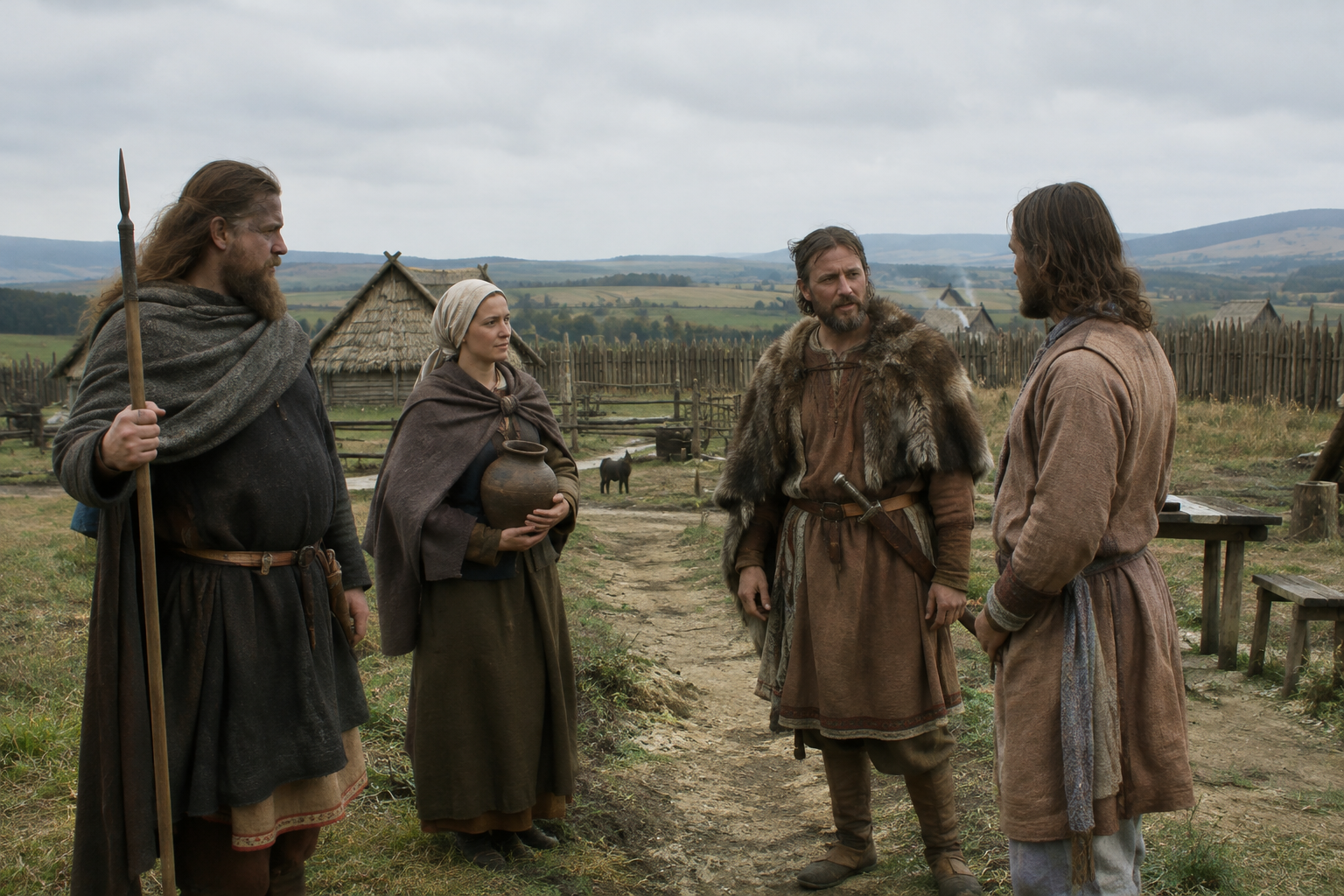
At Szeleste in western Hungary, one man from the post-Roman centuries has become a small but telling witness to a much bigger historical upheaval. Sample SZL043, dated to around AD 525 and found in the Savaria-Szeleste area of Pannonia, belongs to the paternal line I2a1b1a1b1a1a4 as reported in MyTrueAncestry's ancient matching framework. That may look like an intimidating string of letters and numbers, but its importance lies in where and when it appears: in the old Roman world just after imperial power in the West had fractured.
This is exactly the kind of period where ancient DNA becomes most useful. Written sources for the sixth-century Middle Danube are patchy, political labels are slippery, and terms like "Roman" and "barbarian" often conceal more than they reveal. A Y-DNA branch traces only one direct paternal line, not a person's whole ancestry or identity, yet even that narrow line can anchor us in the real human geography of a changing frontier.
Szeleste lay within the orbit of ancient Savaria, a Roman town in Pannonia that had once been firmly integrated into imperial administration, military logistics, and provincial life. By the early sixth century, however, this was no longer a stable Roman province in the old sense. Power in the region had passed through several hands, and communities in the former frontier zone were living amid the aftershocks of empire, migration, alliance, and resettlement.
That makes SZL043 interesting not because he can be neatly assigned to a famous people, but because he belongs to a real burial population in a real landscape where identities were being renegotiated. Pannonia in this period was not empty territory waiting for newcomers; it was a lived-in zone with local survivals, incomers, mixed households, and shifting political loyalties. A lineage like I2a1b1a1b1a1a4 turns up here not as a slogan, but as evidence that paternal lines associated more broadly with southeastern and central Europe were still part of the human fabric of the Middle Danube after Rome's retreat.
An ancient DNA study examining post-Roman communities in the region has helped clarify just how mixed and locally complex these burial groups could be, even when archaeology once encouraged sharper ethnic labels. The broader research context is linked through this Science publication, which has been central to current discussion of post-Roman population structure in the Carpathian Basin.
The immediate challenge with a very specific Y-DNA label like I2a1b1a1b1a1a4 is that the fine branch is much narrower than the ancient historical patterns usually visible in archaeology. We must be careful here. The wider haplogroup I2 has deep European roots and appears in many different populations over long periods, but that does not mean every sub-branch shares the same exact story.
So what can be said responsibly? First, the Szeleste result places this direct paternal line in western Hungary around AD 525. Second, because this is a late and very derived branch label, it should not be projected backwards without evidence into every earlier I2-bearing population in the Balkans, central Europe, or the forest zone. In other words, the value of this sample is not that it tells us where the branch "began," but that it securely places one bearer of this paternal line in a frontier society formed after the collapse of Roman rule.
That matters for modern testers as well. If you belong to I2a1b1a1b1a1a4, the Szeleste man is not "your ancestor" in the genealogical sense merely because he shares a paternal branch. But he is a historically documented carrier of the same paternal line in a region where old provincial populations and new power structures were meeting face to face.
The phrase Barbaricum Hungary in ancient-DNA cataloguing reflects one of the enduring oddities of late antiquity: Roman ways of describing a world that no longer obeyed Roman boundaries. For centuries, the empire had divided the map into the governed world and the lands beyond. By AD 525 those distinctions were politically unstable, but they still shadow modern interpretation.
Archaeology across the Carpathian Basin increasingly shows that the fifth and sixth centuries were not simply a matter of one people replacing another. Cemeteries can contain individuals with different ancestry profiles, different dietary histories, and different likely family backgrounds, all within the same broad cultural horizon. That is why a sample like SZL043 is best read as part of a regional mosaic. He may represent local persistence, mobility from a nearby zone, or ancestry formed over generations of interaction. The evidence does not license a neat tribal badge.
This broader caution is useful because the Middle Danube has often been claimed, retrospectively, by many national and ethnic origin stories. Ancient DNA has complicated those tidy narratives. Instead of clean blocks of population, we see communities built out of mixture, continuity, and selective mobility.
Western Hungary was not peripheral in the sixth century. It sat at a hinge-point between the former Roman provinces, the eastern Alpine world, the Balkans, and the wider Danubian corridor. Armies moved through it, federate groups settled in or near it, and local populations adapted to each fresh rearrangement. If you want to understand how a paternal lineage survived and spread, this is precisely the sort of region to watch.
One reason is simple demography. Frontier zones are often places where lineages persist not because they are politically dominant, but because communities endure through instability. Another is that Pannonia linked several cultural worlds at once. A man carrying I2a1b1a1b1a1a4 in this setting could belong to a population shaped by generations of contact across the Roman-limes divide, rather than to a single sharply bounded group.
This is also why comparisons with neighboring regions are so valuable. Ancient results from Croatia, the Balkans, and other parts of central Europe increasingly underline that paternal continuity and turnover did not happen uniformly. Some maternal lines remain remarkably stable over long periods, while Y-chromosome patterns can shift more dramatically, often reflecting changing social structures, war bands, inheritance systems, or elite formation.
Croatia's Shifting Paternal Lines
With only one directly cited ancient individual here, the temptation would be to overstate the case. Better to do the opposite. SZL043 does not prove that I2a1b1a1b1a1a4 was common in post-Roman Hungary, nor that every later bearer of the branch descends from the same local population without interruption. Ancient DNA rarely works like that.
What it does give us is a firm archaeological foothold. The branch was present in a documented man buried in the Savaria-Szeleste region around AD 525, at a time when the old Roman province had become a contact zone of remarkable social complexity. That is already historically rich. It places this paternal line not in legend, but in a sixth-century community living through one of Europe's great transitions.
For readers interested in how such frontier communities could blur once-familiar categories, the wider picture is worth exploring in studies of late antique interaction zones such as the German frontier and the Danubian basin, where the old opposition between Roman and non-Roman increasingly breaks down under archaeological and genetic scrutiny.
The most distinctive thing about I2a1b1a1b1a1a4, on present evidence, is not grandeur or royal glamour but placement. It is a paternal line attested in a man from post-Roman Pannonia, in a landscape where imperial institutions had weakened but human communities carried on, adapted, mixed, and buried their dead. For anyone researching this haplogroup today, that makes the Szeleste sample valuable as a rare fixed point: a reminder that your direct paternal line was already part of the lived history of the Middle Danube in the sixth century, when Europe was being remade on the ground.



Comments