Haplogroup I2a1b1a1b1a1a

– 5 min read


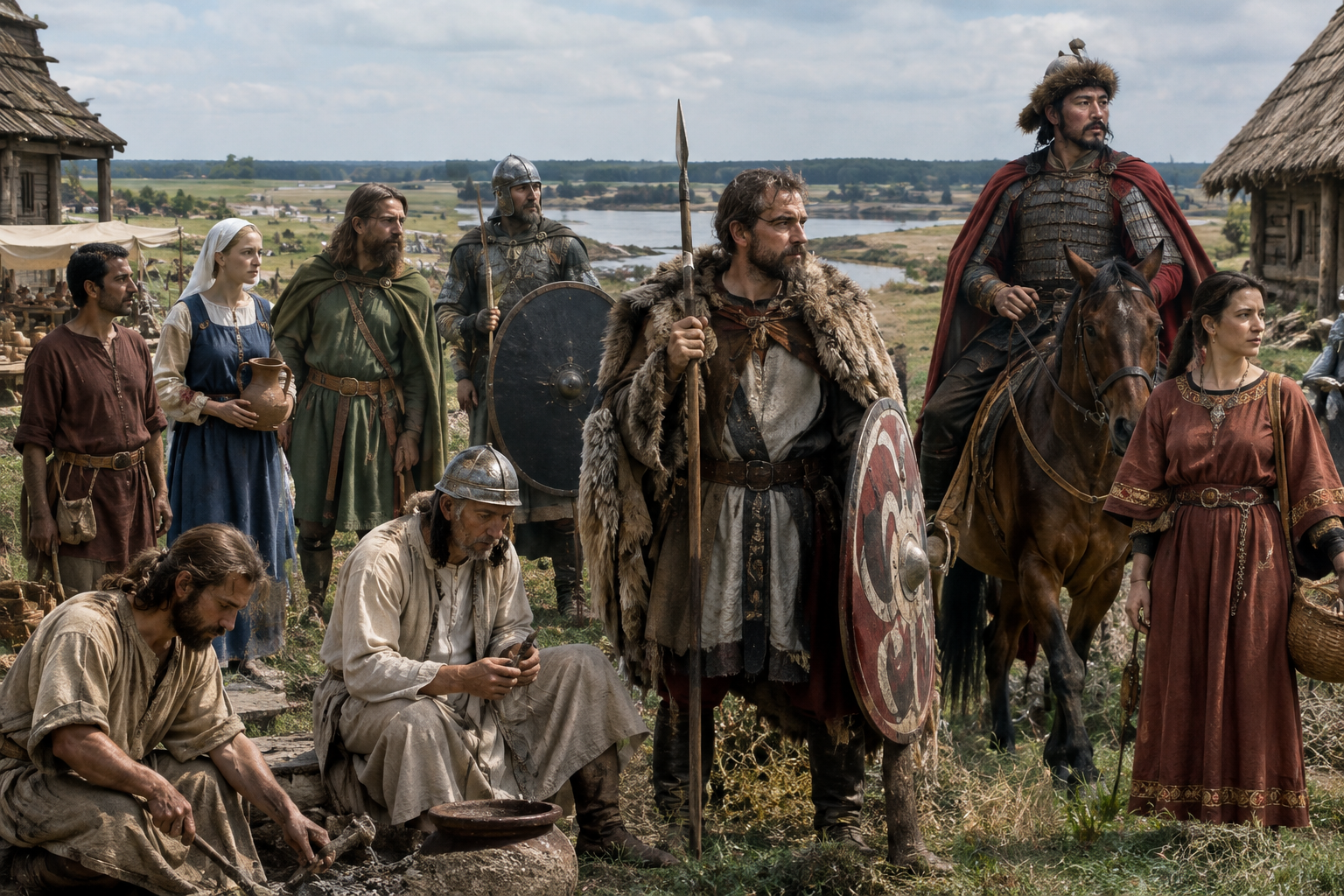
At Han Krum village in Bulgaria, one late antique grave has become an unexpectedly useful marker for tracing a paternal line through a turbulent stretch of European history. The individual known as I40932, described as a Gothic grave from around AD 400 and associated with the Aul of Kan Omurtag area, belongs to the set of ancient finds linked here to Y-DNA haplogroup I2a1b1a1b1a1a.
That matters because this is not a lineage appearing in just one neat historical box. In the material gathered for this branch, it turns up in contexts as different as a Bronze Age battlefield in northern Germany, an Iron Age burial ground in Slovenia, migration-period graves in the Carpathian Basin, and a medieval town cemetery in Belgium. Y-DNA follows one direct paternal line only, not a person's whole ancestry, but even that narrow line can reveal something quite striking: persistence across very different societies and historical moments.
The most vivid place to begin is that Bulgarian grave, I40932. The label "Gothic grave" immediately invites the usual public imagination of migrating peoples moving across the late Roman world, but the real value of ancient DNA is that it complicates the old picture. A community identified archaeologically or historically as Gothic was not necessarily a biologically uniform tribe marching intact from one homeland to another.
That is exactly why this sample is so useful for thinking about I2a1b1a1b1a1a. Its presence in late antique Bulgaria places the lineage within the shifting human landscape south of the Danube at a moment when imperial frontiers, federate groups, and regional populations were all interacting. A MyTrueAncestry article on mixed origins in Gothic communities in late antique Bulgaria is a helpful companion here, because the broader lesson is that "Gothic" was a historical identity carried by genetically varied people, not a single bloodline.
Late Antique Goths in Bulgaria
One should also be careful with the precision of haplogroup labels. The article branch is given as I2a1b1a1b1a1a, but ancient assignments are sometimes more secure at a broader parent level than at the finest terminal twig. For readers tracing their own paternal ancestry, that means the important point is not a fantasy of direct descent from one named Goth, but the documented appearance of this wider paternal stream in late antique populations of the Balkans.
Long before Goths entered the written record, the same branch is represented by two men from the Tollense Valley battlefield in Mecklenburg-Vorpommern: WEZ51 and WEZ15, dated to around 1250 BC. Tollense is one of the most arresting prehistoric discoveries in Europe, because it preserves the remains of a large violent event in the northern European Bronze Age. These are not legendary warriors from epic poetry; they are excavated dead from a real battlefield.
For I2a1b1a1b1a1a, the significance is simple and important. The lineage was present in north-central Europe roughly one and a half millennia before the Roman Empire and nearly two thousand years before the medieval sample from Belgium. That does not mean an unbroken local dynasty can be drawn from Tollense to later periods. It does mean the branch belongs to a deep European paternal background rather than appearing suddenly in the written-age record.
An ancient DNA study of the Tollense material, published in Current Biology, helped establish the broader biological context of the battlefield. For this haplogroup article, those two men matter because they anchor the lineage in a concrete Bronze Age event rather than in vague talk of "prehistoric Europe."
The northern setting is worth noting too. I2 lineages are often discussed in very broad terms across Europe, but the sample set here warns against over-simplifying any one sub-branch. This particular branch appears not only in southeastern Europe but also in a Bronze Age conflict zone far to the north.
Another useful stop is I5689 from Grofove njive in present-day Slovenia, dated to around 575 BC. This is a different world again: not migration-period politics, not medieval urban life, but the Iron Age eastern Alpine and western Balkan zone. The site has been discussed in archaeological work on the cemetery and its local context, including material available at this site publication.
Why does this matter for I2a1b1a1b1a1a? Because Grofove njive sits in a region that has long been a corridor rather than an isolated pocket. Communities here were connected to the Danube world, the Adriatic sphere, and central Europe. A paternal line found in this setting may reflect continuity, mobility, or both; what it definitely shows is that the branch was present in the southeastern European landscape before the great historical confederations of late antiquity.
This is the sort of evidence that keeps historians honest. It stops us from lazily attaching every later Balkan or Carpathian occurrence to one famous migration. Sometimes a lineage is already there, embedded in regional populations centuries earlier.
Deep Balkan Genetic Background
The branch also appears in two migration-period settings tied to the Carpathian Basin: CGG021899 from a Celto-Gepid context at Madaras, dated around AD 375, and HNF019, described as a Hun invader from the Danube-Tisza region around AD 450. Here again, one must resist the temptation to turn labels into certainties about ethnicity. "Gepid" and "Hun" are historical and archaeological designations; a Y-chromosome does not by itself prove language, political loyalty, or self-identity.
Still, together these samples are revealing. They place I2a1b1a1b1a1a in the very heart of the post-Roman world where steppe-derived elites, local provincial populations, and incoming military groups interacted intensely. If the Bulgarian Gothic grave shows the branch inside a late Roman frontier society, the Hungarian material shows it in the neighboring zone where several powers and peoples overlapped.
This makes the haplogroup a particularly good example of how ancient Europe worked in practice. Lineages did not respect the neat categories that older textbooks loved. The same paternal branch could pass through communities later described as Celtic, Gepid, Gothic, or Hun-associated without needing to belong exclusively to any one of them.
A related MyTrueAncestry piece on frontier diversity in the steppe-border world gives a useful sense of how mixed such zones could be, even if it concerns a later context.
Frontier Diversity on the Steppe Edge
By around AD 1100, the branch is represented again by ST2000 from Sint-Truiden Groenmarkt in Belgium. That shift is almost comically instructive. We move from Bronze Age violence, Iron Age cemeteries, and migration-period power struggles into the world of a medieval Low Countries town.
Urban cemeteries are often where genetics becomes most socially interesting, because they show how mobility and settlement had already been absorbed into ordinary life. ST2000 suggests that the paternal line associated here with I2a1b1a1b1a1a was not confined to borderlands or warrior contexts. By the central Middle Ages, it was part of the fabric of settled western European populations as well.
That fits neatly with broader discussions of medieval urban population structure in the region. The accompanying MyTrueAncestry article on medieval Sint-Truiden offers context for how such towns could draw in people from surrounding districts while also smoothing local differences over time.
The most distinctive thing about I2a1b1a1b1a1a in this evidence is not a single origin myth or one glamorous people. It is range. This paternal line appears in an Iron Age cemetery in Slovenia, among the dead of the Tollense battlefield, in late antique Bulgaria, in migration-period Hungary, and in a medieval Belgian town. That is the pattern to notice: a branch with deep roots in Europe, turning up repeatedly in places shaped by movement, conflict, and re-settlement.
For someone researching this haplogroup today, the responsible takeaway is that your direct paternal line may connect to a very old European background that persisted through major historical upheavals rather than belonging neatly to one named tribe or kingdom. In other words, the interest lies not in a single badge of identity, but in the durability of one male line across very different worlds.






Comments