Haplogroup I2a1b1a1a
– 6 min read


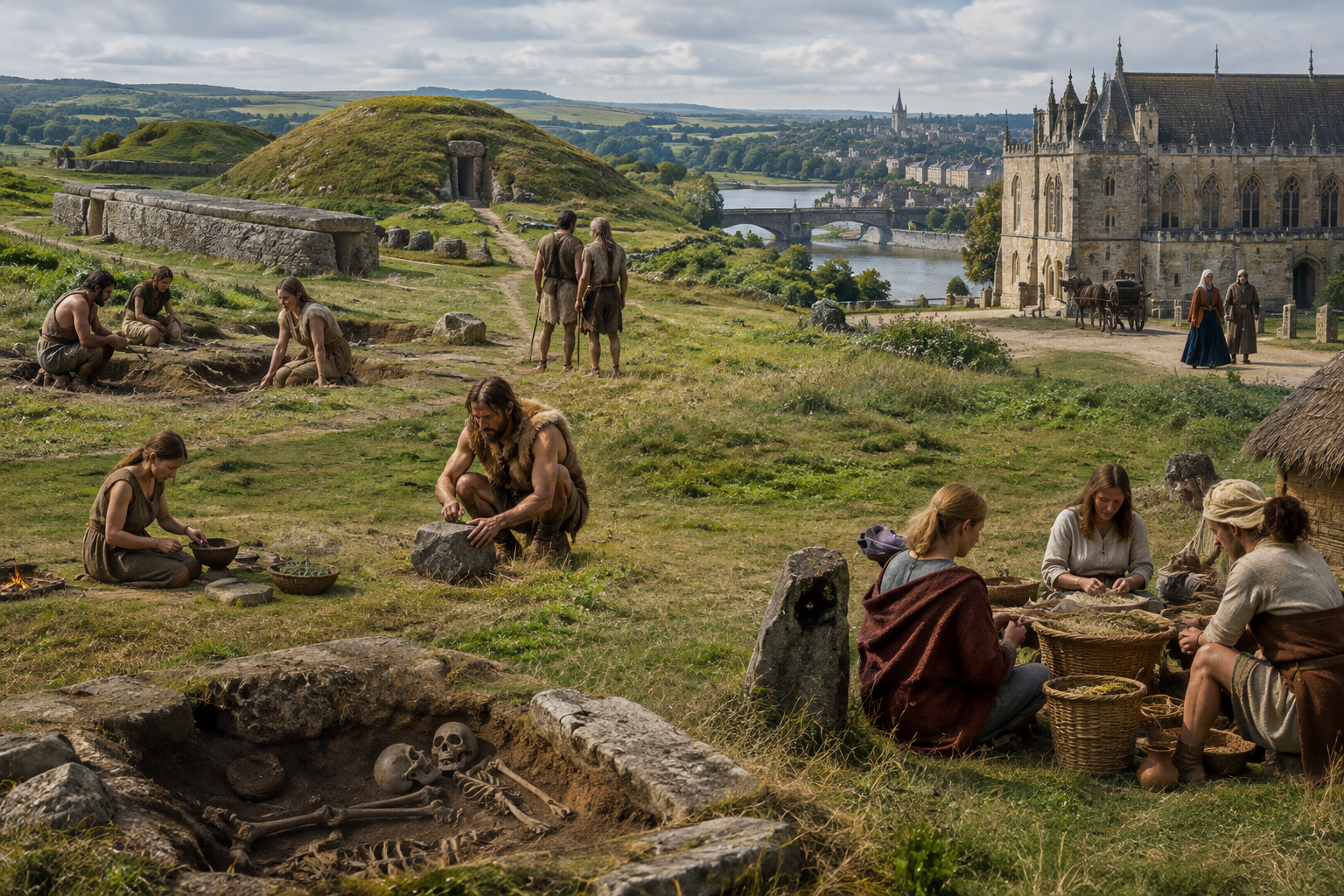
Haplogroup I2a1b1a1a is the sort of Y-DNA lineage that reminds us how stubbornly the male line can persist through enormous historical change. Kingdoms rise, languages shift, dynasties appear and disappear, but a paternal branch can still be detected in burials thousands of years apart. That is what makes this lineage so interesting: not that it belongs to one people, one kingdom, or one family, but that it offers a narrow, highly specific thread through a very broad human story.
It is also worth stating clearly what a Y-DNA haplogroup can and cannot do. A haplogroup traces one direct paternal line only: father to father to father. It does not describe a person's full ancestry, culture, language, or identity. Still, when ancient DNA places related paternal branches in real graves, at real sites, in real landscapes, the result is powerful. In the case of I2a1b1a1a, the supplied evidence points us above all toward Neolithic communities in Britain and Ireland, with a much later appearance in medieval Paris that hints at the long and complicated afterlife of old European paternal lines.
I2 is a major branch within haplogroup I, one of the old European Y-chromosome lineages. But we should be careful here: the broad history of haplogroup I or even I2 cannot automatically be pasted onto the narrower branch I2a1b1a1a without qualification. What the evidence in hand does support is that this lineage, or a very close paternal branch, appears repeatedly in Neolithic contexts on both sides of the Irish Sea.
That matters because the Neolithic in Britain and Ireland was not simply a change in tools or pottery. It was a transformation in settlement, farming, monument building, burial practice, and kinship. Long barrows, family tombs, and communal burial places were not just heaps of earth and stone; they were claims on land and memory. When the same paternal branch appears in several such contexts, it suggests that some male lines were embedded in those communities over generations.
If you want broader context for how archaeologists and geneticists reconstruct these early farming worlds, MyTrueAncestry readers may also enjoy this overview of The Neolithic Expansion: A Genetic and Archaeological Journey Through Ancient Europe.
The strongest impression from the sample set is geographic as much as genetic. Dorset appears again and again. So does Ireland. These are not abstract datapoints on a phylogenetic tree; they are people buried in some of the most evocative Neolithic landscapes in Europe.
At Chedworth Down Barrow in Dorset, sample che002 is dated to 3500 BC. Not far away in the Cranborne Chase landscape is lot005 from Sales Lot, also dated to 3500 BC. Cranborne Chase is one of those places where prehistoric Britain feels densely inhabited by the dead: barrows, ritual sites, boundaries, and long-lived ceremonial landscapes. To find the same paternal branch in multiple burials from this region suggests that I2a1b1a1a was not an isolated curiosity there.
The same is true at Sisters Long Barrow, again in Dorset Cranborne Chase, where both slb001 and slb004 are dated to 3500 BC. Two individuals from the same long barrow carrying this paternal signal immediately raise interesting questions about kinship and burial structure. They are not proof of a simple father-son line, and we should resist that temptation. But in a monument built for repeated burial, the recurrence of the same Y-line is exactly the kind of clue that makes archaeogenetics so useful.
Then there is muw002, from a Neolithic Family Burial at Monkton Up Wimborne in England, dated to 3233 BC. Even the description "family burial" invites us to think about inherited status, local descent groups, and how communities organized the dead. Ancient DNA does not replace archaeology here; it sharpens it. The Y-chromosome gives us one line of continuity inside a burial tradition that was already telling us these people cared deeply about ancestry.
For readers interested in how tomb architecture and kinship fit together in prehistoric Britain and nearby regions, there is an excellent companion piece on Bronze Age Reuse of Neolithic Tombs in Southwestern Britain.
Discover Neolithic Tombs in Britain
The Irish evidence is just as striking. At Primrose Grange, sample prs012 is dated to 3700 BC, while another individual from the same site, prs010, is dated to 3572 BC. Add to that CAK534 from Neolithic Ireland, dated to 3000 BC, and a pattern begins to emerge: this paternal lineage was present in early farming communities across Ireland over a long span of time.
That does not prove uninterrupted male-line descent from one site to another, nor does it mean the whole island shared one dominant paternal identity. But it does place I2a1b1a1a firmly in the world of Irish Neolithic monumentality and settlement. In other words, this is not merely a lineage that drifted into the islands late in prehistory. It appears among some of the people building the earliest agricultural societies there.
What is especially interesting is the sea. The Channel, Irish Sea, and western coasts were not barriers in the modern sense. They were movement corridors. The Dorset and Irish samples do not prove a single migration route, yet together they fit comfortably into a picture of interconnected Neolithic communities linked by coastal travel, exchange, and marriage networks.
Readers who want to stay with that Irish story should look at Neolithic Irish Kinship: Social and Genetic Insights, which explores how DNA can illuminate family and community structure in prehistoric Ireland.
Read About Neolithic Irish Kinship
Then, suddenly, the chronology jumps. The latest supplied sample is PRS010 from Medieval France Paris Hopital de la Croix de la Reine, dated to 1337 AD. At first glance it seems a world away from barrows in Dorset and early burials in Ireland. And culturally, of course, it is. This is not the Neolithic Atlantic facade but medieval urban France, with all the population mobility, social layering, and political complexity that implies.
Yet that is precisely why the Paris sample matters. It shows how ancient paternal branches can survive into historical periods utterly different from the worlds in which we first detect them. It does not mean the Paris man was descended from any particular Neolithic individual in the sample list. That would be far too strong. But it does show that a lineage present in northwestern Europe in the 4th millennium BC could still be part of the paternal landscape of western Europe in the 14th century AD.
And this is where genetics and written history meet, though not always neatly. Medieval records can tell us about hospitals, parishes, guilds, lords, and kings. Y-DNA tells us that beneath all that paperwork, some paternal lines ran very deep indeed.
For a related look at how ancient DNA complicates easy assumptions about medieval communities, see Ancient DNA reveals diverse origins at a 7th-century Madrid burial site.
Explore Medieval DNA Diversity
In this case, the supplied field for associated noble families and castles is empty. That absence is worth acknowledging rather than decorating with guesswork. Too often, haplogroup history is hurried toward castles and coats of arms, as if every paternal lineage must end in a lordly great hall. Sometimes the evidence simply does not support that move.
Still, the medieval Paris sample reminds us that lineages like I2a1b1a1a did not vanish when the age of megaliths ended. They passed through Roman provinces, post-Roman societies, and medieval towns, and quite possibly through noble households as well as peasant ones. But without specific family or castle data, the responsible thing to say is this: a haplogroup can provide historical context for later noble lineages, yet it does not by itself identify a dynasty, prove aristocratic descent, or attach a modern tester to a named house.
That caution is not a disappointment. It is part of what makes archaeogenetics so valuable. It keeps us honest. The real drama lies not in forcing a lineage into a heraldic fantasy, but in seeing how a paternal branch can bridge megalithic tombs, island farming communities, and medieval city burials without ever needing a fabricated noble pedigree.
So what does this haplogroup reveal? First, that some paternal lines in western Europe have impressive time depth in the archaeological record. Second, that the Neolithic landscapes of Dorset and Ireland were not only cultural frontiers of farming and monument building, but also homes to lineages that endured for millennia. Third, that ancient DNA gives us a different sort of ancestry from written genealogy: less flattering perhaps, less full of titles and portraits, but older, stranger, and often more revealing.
If your own Y-DNA points toward I2a1b1a1a or a nearby branch, the most exciting possibility is not that you have proved descent from a barrow builder or a medieval Parisian. You have not. But you may have uncovered a paternal line that belonged to the same broad historical world as these ancient individuals. That is already remarkable.
Upload your DNA to MyTrueAncestry and explore whether your results show links to ancient populations and archaeological samples like che002, slb001, muw002, prs012, or PRS010. These matches do not prove direct descent from a specific ancient person or entry into a noble family tree, but they can open an extraordinary window onto your deeper past.






Comments