Haplogroup I2a1a2b1a1a1

– 5 min read


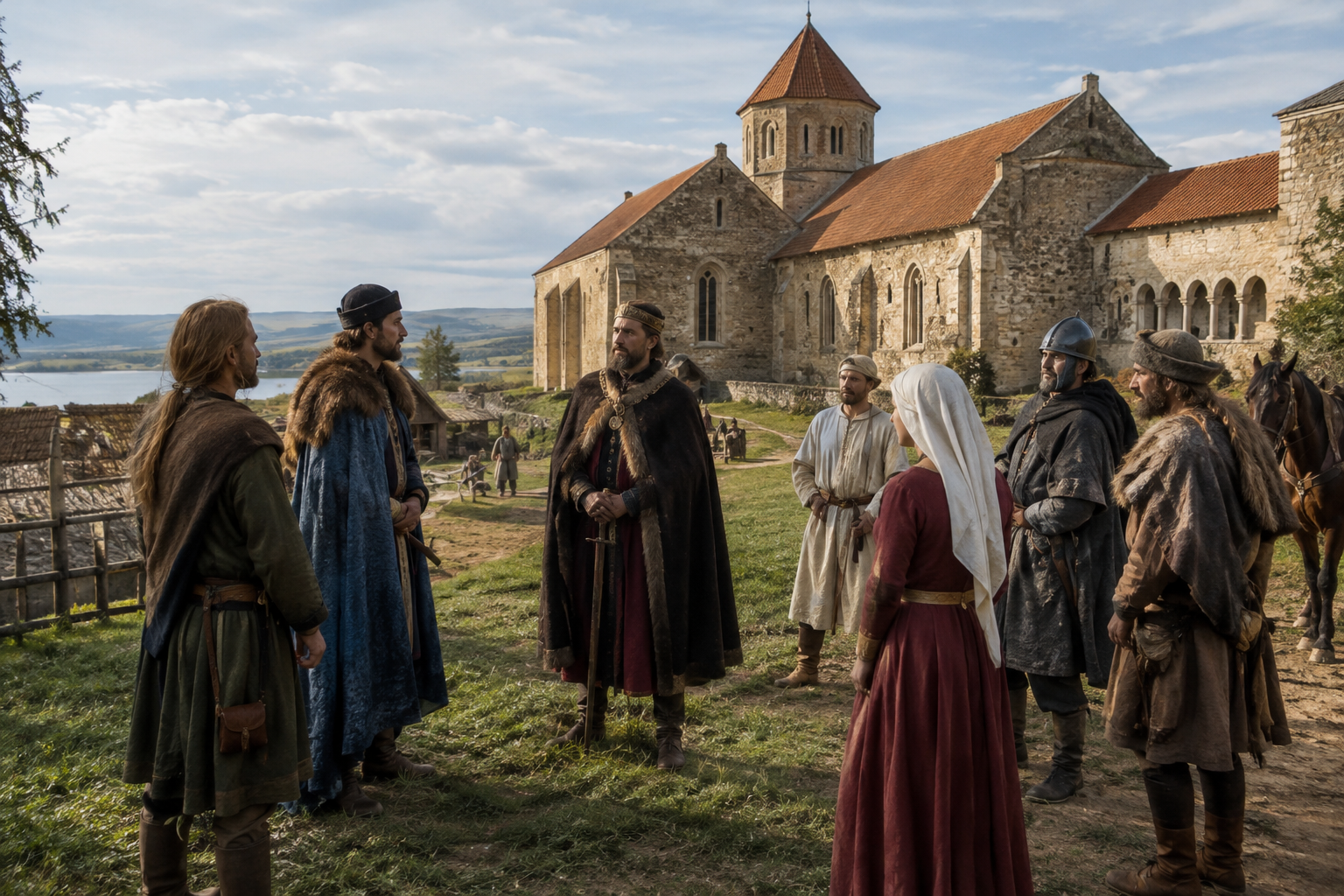
One of the more arresting appearances of haplogroup I2a1a2b1a1a1 in the current ancient record comes from medieval Hungary, where sample HUASper85 is associated with the Royal House of Aba and dated to around 1405 AD in a Gothic vault at a Benedictine monastery. That is already enough to catch the eye. Not because one burial can magically explain a dynasty, still less because a Y-chromosome can tell the whole story of a noble house, but because it places this paternal line inside a documented medieval elite context in the Carpathian Basin.
And yet the more interesting point is that HUASper85 is not alone. The same article branch also appears in earlier medieval contexts across Hungary and northern Croatia, and even in a Viking Age outlier from Denmark. Taken together, these samples suggest that I2a1a2b1a1a1 belongs to a paternal history that is best understood not as a single ethnic badge, but as part of the densely connected world of the early and high medieval European frontier zones.
I2a1a2b1a1a1 is a very specific sub-branch within the broader haplogroup I2, one of the long-established Y-DNA families of Europe. Y-DNA follows one direct paternal line only: father to son to son. That makes it powerful for tracing a single male-line ancestry, but it does not stand in for a person's entire ancestry, language, or historical identity.
With this branch, the ancient evidence in hand is not spread across every period of prehistory. It is concentrated instead in the early and medieval centuries of south-central Europe, especially around the Carpathian Basin. That matters, because this was one of Europe's great contact zones: Roman frontier afterlives, Avar and Slavic landscapes, Carolingian expansion, Hungarian state formation, and later aristocratic consolidation all passed through the same region.
An ancient DNA study examining medieval and conquest-period Hungary has helped sharpen that wider background by placing elite and non-elite burials into a more precise genetic frame, including the mixture of local and incoming ancestries visible in the region over time here. That broad setting is more useful than any tidy origin myth.
HUASper85 is the latest-dated sample in this cluster, and its setting is plainly significant: a Hungarian noble burial linked with the Aba kindred in a Gothic vault. The Aba family occupied an important place in medieval Hungarian history, and this sample shows that the branch I2a1a2b1a1a1 was present within that aristocratic world by the early 15th century. That is a historically grounded observation; anything more sweeping about the entire house would need stronger line-by-line genealogical proof than one burial can supply.
Earlier evidence comes from AHPS103, dated to around 1050 AD from Visegrád-Sibrik domb Ispánesi in Árpád-period Hungary. Visegrád was no obscure hamlet on the margins. It was one of the strategically important Danube sites in the kingdom's early history, tied to fortification, administration, and the consolidation of royal power. Finding the same branch here suggests that this paternal line was already established in the region during the first century of the Christian Hungarian kingdom.
Other Hungarian samples broaden the picture rather than simply repeating it. AHS54 from Zalavár-Vársziget, dated around 850 AD, comes from a Carolingian imperial context, while AHPS202W from Bodajk-Proletárföldek, around 950 AD, belongs to a borderland setting in the century before or during early Hungarian state formation. Then there is AHPS221W from Előszállás-Bajcsihegy, around 750 AD, described as an early medieval outsider in Transdanubia. The label itself is revealing: early medieval cemeteries often contain people whose ancestry or burial context marks them as less typical of the local majority, reminding us that this region was never simple.
What these Hungarian finds show is continuity of presence across very different political landscapes: late Avar or post-Avar worlds, Carolingian influence, frontier communities, Árpád-period settlement, and later nobility. That is not the same as continuity of one family, but it is certainly continuity of one paternal branch in the same broad historical theatre.
The branch is not confined to Hungary. Sample TOR004, dated to around 750 AD, comes from Torčec in northern Croatia. That is an important addition because it places I2a1a2b1a1a1 in the Drava region just south of the Hungarian plain, in another early medieval borderland shaped by post-Roman change, Slavic settlement patterns, and shifting Frankish influence.
Torčec has become increasingly useful in archaeogenetics because Croatia preserves a long and complicated record of continuity and change. A broader study of the region's ancient DNA has underlined exactly that point: maternal continuity can stretch across long periods, while paternal patterns often shift more abruptly in this research on Croatia. That makes TOR004 especially interesting. It hints that this particular paternal branch participated in the remaking of early medieval communities south of the Drava, not just north of it.
It would be far too much to call TOR004 "Croatian" in any timeless national sense, or to assign him neatly to a named medieval people on Y-DNA alone. But as an archaeological data point, he helps anchor the branch in a regional corridor linking Pannonia, Slavonia, and the western Balkans.
Then there is the sample that stops the reader short: CGG106791 from Langeland Kågården in Denmark, dated to about 975 AD and described as a Viking Age Baltic outlier. Outlier is the key word. It means the significance of this burial lies precisely in not looking fully typical for its local setting.
That does not mean we should instantly turn this man into a wandering mercenary, a trader from afar, or a saga hero. Archaeology is littered with those over-eager stories. What we can say is more measured and, in its way, more interesting: by the late 10th century, the same paternal branch seen in the Carpathian and Croatian record also appears in a Danish context marked as unusually Baltic-facing. That places I2a1a2b1a1a1 inside the web of movement linking Scandinavia to the Baltic and beyond during the Viking Age.
In other words, this is not a haplogroup trapped within one modern map. Its ancient appearances fit the sort of Europe the archaeology already shows us: connected by rivers, warfare, marriage, commerce, service, and political expansion.
If we stand back from the individual burials, the best-supported pattern is a medieval concentration around the middle Danube world and its adjoining regions. The Hungarian and Croatian samples are the core. The Danish Viking Age outlier expands the map, but does not erase that core.
That pattern suits the archaeology rather well. Early medieval central Europe was not built out of sealed populations. It was a zone of forts, monasteries, river crossings, military service, resettlement, and elite formation. A branch like I2a1a2b1a1a1 could persist locally in some places, appear in mixed frontier communities in others, and enter elite contexts without ever representing a single kingdom, language group, or "tribe."
For someone researching this haplogroup today, that is the real value of the ancient record. It does not hand you a romantic costume identity. It places your direct paternal line into documented medieval landscapes stretching from northern Croatia through Hungary and, at least once, into a Viking Age Baltic-linked setting in Denmark. That is a serious and rather vivid historical footprint.






Comments