Haplogroup I2a1a2a1b

– 5 min read


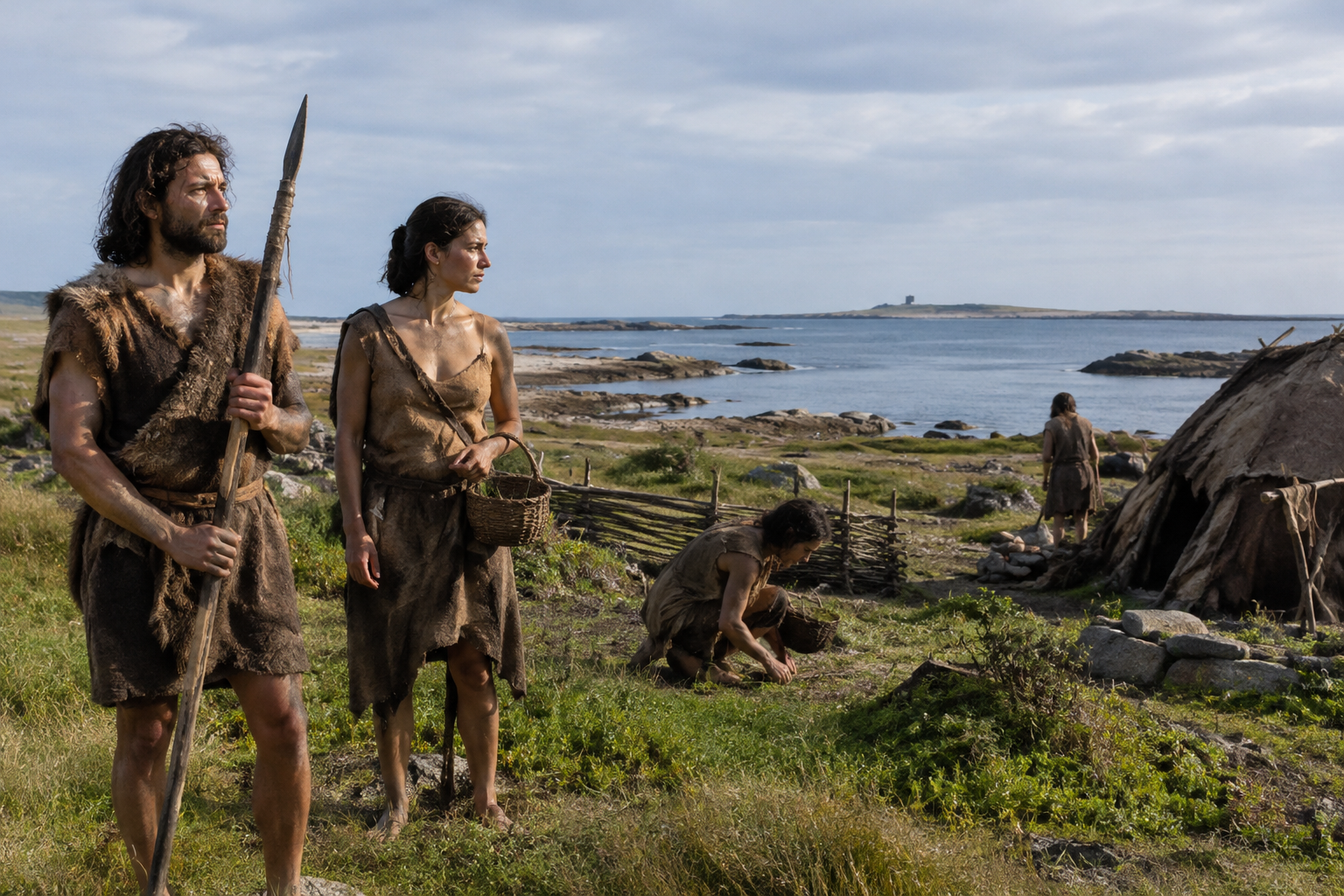
At Els Trocs, high in the Spanish Pyrenees, archaeologists uncovered the remains of some of the earliest farming people known from Iberia. One of those men, sample I0412, dates to around 5206 BC. He matters here because he places the Y-DNA haplogroup I2a1a2a1b in a very early western European setting, at a moment when farming communities were still new arrivals in much of the peninsula and were living alongside, and sometimes mixing with, older hunter-gatherer populations.
That is the useful thing about this haplogroup article: the evidence is sparse, but it is strikingly placed. Another ancient man associated with this branch, I15026, appears much later in Bronze Age Brittany at Ile Thinic, Saint-Pierre-Quiberon, around 1700 BC. So the available trail for I2a1a2a1b is not a neat dynastic tale, but a harder and more interesting archaeological one: a paternal line turning up in two very different worlds of prehistoric western Europe.
Els Trocs is one of those sites that keeps cropping up in discussions of Europe's Neolithic because it sits in a frontier landscape: mountain country, movement routes, and early farming expansion all meeting in one place. Sample I0412 belongs to that early phase. Even without embellishing the burial context beyond what is securely given here, the sample anchors this paternal line in an exceptionally early Iberian farming horizon.
That point deserves a little care. Y-DNA follows one direct male line only, not the whole ancestry of a person or community. So I0412 does not mean that all early farmers in Iberia carried I2a1a2a1b, nor that the haplogroup itself was "Spanish" in any simple sense. What it does show is that this paternal branch, or a reported association with it, was present among people living in the western Mediterranean Neolithic world very early on.
A landmark ancient DNA study on early European farmers and hunter-gatherers brought sites like Els Trocs into sharper focus, showing how the spread of farming across Europe was not just a matter of pots and seeds but of real population movement and mixture over time. For the wider background to that early farming world, see research published on ancient European populations.
Readers who know a little ancient DNA may recognize the broader I2 family as one often associated with European hunter-gatherer ancestry. But broad family resemblance is not the same thing as a proven history for a narrow subclade. We should be cautious here: the article's haplogroup is specifically I2a1a2a1b, and the deeper story of all I2 branches cannot simply be pasted onto it wholesale.
Still, the setting of I0412 is historically suggestive. Early Neolithic Iberia was not populated by one tidy, genetically uniform block. It was a zone where incoming farming traditions, local geography, and surviving forager ancestry interacted in different ways from region to region. A paternal lineage in this environment may reflect continuity from earlier western European male lines, incorporation of local ancestry into farming groups, or more complex population histories that a single sample alone cannot fully resolve.
In other words, this is precisely the sort of case where ancient DNA is most valuable when it stays modest. A single Y-chromosome result does not hand us an ethnic label, but it does place a paternal line inside a real archaeological moment: one of the earliest centuries of farming life in Iberia.
The second sample, I15026, comes from a very different landscape and a much later age: Ile Thinic, Saint-Pierre-Quiberon, Brittany, around 1700 BC. By then, western Europe had long since moved beyond the first Neolithic frontier. Communities in Atlantic France were living in a Bronze Age world of metalworking, coastal exchange, inherited monument landscapes, and regional identities that were already centuries deep.
The significance of I15026 is not that he proves a direct line from Els Trocs. He does not. The chronological gap is enormous, and no honest article should turn two separated finds into a family tree. But together, the two samples show that this paternal branch was not a one-off curiosity trapped in a single Neolithic valley. It appears again in Atlantic western Europe more than three millennia later.
Brittany is especially interesting because it often preserves long local histories rather than fitting neatly into simplistic migration stories. Ancient DNA work from France has repeatedly shown how regional populations could absorb new ancestry while also retaining older threads. For a related discussion of prehistoric France and its changing communities, MyTrueAncestry readers may enjoy the post on Neolithic France.
The man from Ile Thinic belongs to a period when Bronze Age societies along the Atlantic facade were connected, but not identical. Brittany had its own deep prehistoric background, famous megalithic traditions behind it, and strong maritime horizons around it. A Y-lineage like I2a1a2a1b appearing there is a reminder that the Bronze Age did not erase every earlier paternal strand.
That matters because later prehistoric Europe is sometimes described too mechanically, as though one wave simply replaced another everywhere. In reality, western Europe often shows a messier picture: some paternal lines expanded dramatically, others contracted, and some survived in scattered regional pockets. Sample I15026 fits that more human pattern of uneven survival and reshaping.
The broader data framework for ancient individuals from regions including prehistoric France is represented in the Harvard-hosted ancient DNA resource linked here: a genetic study resource for ancient western Eurasian populations. It is useful less for grand claims than for situating finds like I15026 within a much wider prehistoric map.
If we stand back from the sample codes for a moment, the pattern is quite elegant. One association with I2a1a2a1b appears in an early farming context in northeastern Iberia; another appears in Bronze Age Atlantic France. That does not prove a single migration route, a named prehistoric people, or a continuous elite pedigree. But it does place this paternal branch within the long western European story rather than on its margins.
It also shows why regional archaeology matters. The Pyrenean Neolithic and the Breton Bronze Age were not versions of the same society. They had different economies, different local histories, and different positions in wider exchange networks. Yet a paternal lineage linked to this haplogroup is reported in both settings, suggesting longevity across very different social worlds.
Neolithic to Bronze Age Catalonia
For someone researching I2a1a2a1b today, the most responsible takeaway is also the most interesting one: this is a paternal line with credible ancient appearances in western Europe at two very different prehistoric moments, from early Neolithic Iberia to Bronze Age Brittany. That does not tell you everything about your ancestry, but it does place your direct male line in landscapes where some of Europe's oldest farming and Atlantic Bronze Age communities lived, adapted, and endured.
Comments