Haplogroup I2a1a1b

– 5 min read


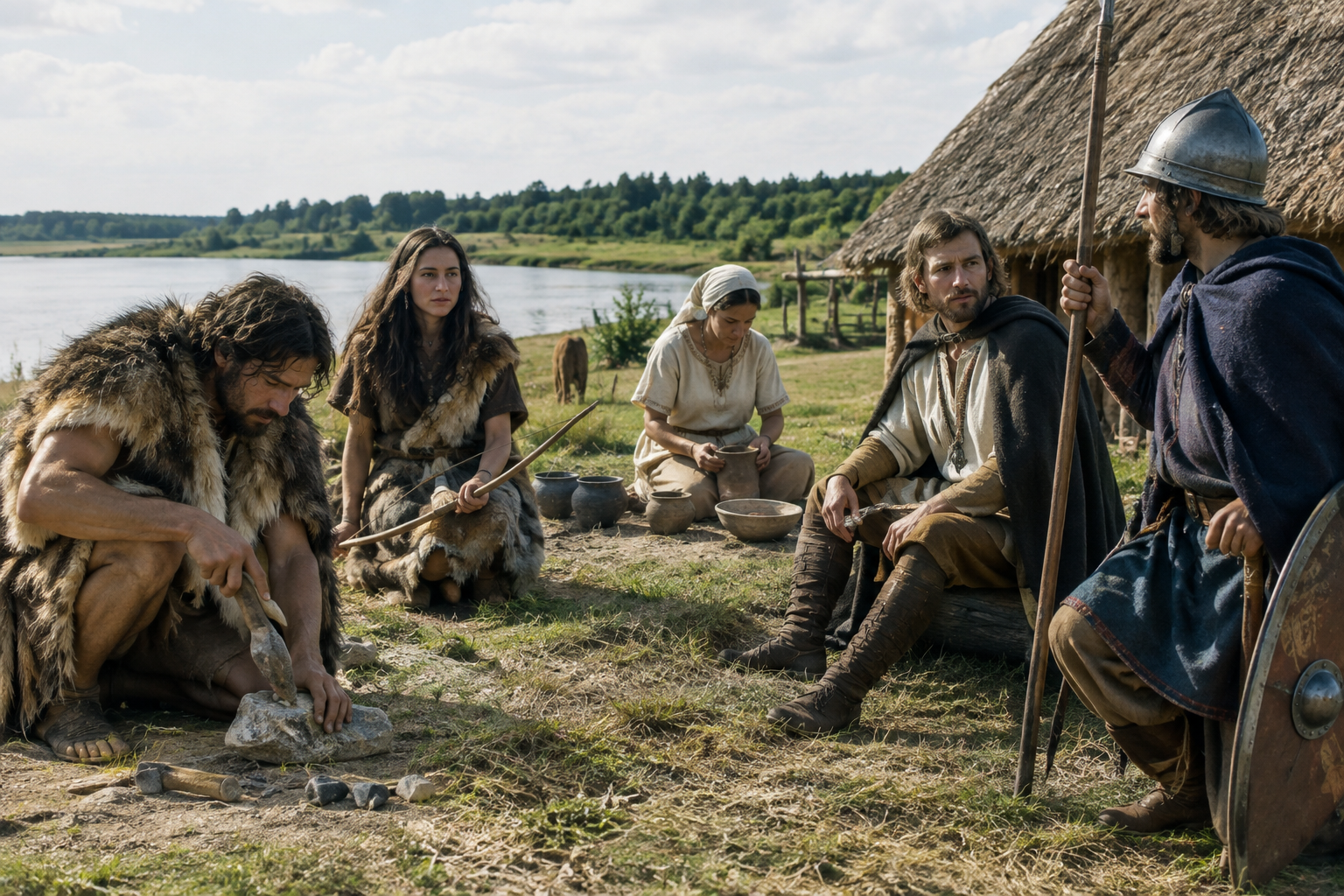
At Grotte Rousseau in Belgium, a Mesolithic man identified as I7018 lived around 8405 BC, in a Europe still dominated by hunter-gatherer ways of life. He matters here because he places the Y-DNA haplogroup I2a1a1b - or at least a lineage reported within that branching neighborhood - very early in the archaeological record of northwestern Europe, long before metal, kingdoms, or written history.
That is the first useful thing to say about this lineage. I2a1a1b is a paternal line, meaning it tracks one narrow line of descent from father to son. It does not describe a person's whole ancestry. But when the same branch appears in very different settings - Mesolithic cave contexts, later farming-period burials, and an early medieval Saxon burial in Germany - it offers a rather striking reminder that some male lines endured through enormous cultural change.
The Belgian sample I7018 comes from a world before farming had remade most of Europe. In archaeological terms, this is the deep post-Ice Age landscape of foragers, riverine movement, woodland economies, and local regional traditions. A reported I2-related paternal line in that context fits a broader pattern often seen in Mesolithic Europe, where branches of haplogroup I2 recur among hunter-gatherer males.
That broader pattern matters, but it is also where caution is needed. The article haplogroup here is I2a1a1b, a narrower label than haplogroup I2 as a whole. Ancient reports are sometimes more secure at the parent-branch level than at a very fine terminal subclade, so the safest reading is that this Belgian Mesolithic individual helps place the lineage within an old European paternal landscape rather than proving a neat, uninterrupted family tree from cave foragers to later populations.
A genetic study of Stone Age and later populations in the wider region, published in Science, helped clarify how dramatically ancestry shifted in parts of northwestern Europe over time. Yet paternal continuity and paternal replacement did not always move in lockstep with total ancestry. That is exactly why a lineage like I2a1a1b is interesting: it can persist through societies that otherwise changed a great deal.
Fast forward to 2548 BC, and another Belgian individual appears: I13635 from Abri Sandron. By this point, Europe was no longer Mesolithic. Farming had long since arrived, communities were more settled, and the later Neolithic in the Low Countries sat within a complicated world of local persistence, incoming influences, and the social changes that would lead toward the Bronze Age.
The significance of I13635 is not that he lets us tell a simple story of one tribe or one people. He does something more useful than that. He shows that a paternal line associated with I2a1a1b was still present in Belgium thousands of years after the Mesolithic sample from Grotte Rousseau. That is a long span, and it crosses one of the great demographic upheavals in European prehistory: the spread of farming and the later transformations of the third millennium BC.
Belgium and the neighboring Rhine-Meuse zone are especially revealing here because ancient DNA has shown both continuity and disruption across different periods. Some lineages vanished locally; others survived in reduced or reshaped form. An occurrence like I13635 suggests that at least some I2-derived male lines remained embedded in these later communities rather than disappearing entirely with the spread of new ancestry profiles and archaeological cultures.
The sample I15621, dated to around 4000 BC, comes from Bodrogkeresztur, Urziceni in Romania. This setting is geographically and archaeologically different from Mesolithic and late Neolithic Belgium. We are now in the Chalcolithic Carpathian world, where copper use, regional exchange, and increasingly elaborate social distinctions were beginning to matter in new ways.
That change of setting is important because it warns us against treating I2a1a1b as a strictly northwestern European curiosity. Its appearance in a Chalcolithic Romanian context suggests a wider distribution of related paternal lines across parts of prehistoric Europe. Not everywhere, not uniformly, and not as a badge of a single archaeological culture - but clearly across more than one region.
Here again, Y-DNA is at its most useful when handled modestly. A man buried in Bodrogkeresztur-associated territory is not automatically evidence for language, ethnicity, or a direct migration into Belgium or out of it. What he does show is that the paternal landscape of Copper Age Europe included lineages later found far to the northwest as well. In other words, I2a1a1b belongs to a European story with both regional depth and broad geographic spread.
The latest sample in this group is the early medieval individual DUN008 from Dunum in Lower Saxony, Germany, dated around AD 800. This is a very different historical world again: Christianization was advancing unevenly, older regional identities remained strong, and Saxon territories had become entangled in the politics of the Carolingian age.
DUN008 is useful because he brings I2a1a1b into a documented early medieval population rather than a purely prehistoric one. By AD 800, paternal lines in northern Germany reflected many centuries of local continuity, interaction across the North Sea zone, and earlier Iron Age and Migration Period reshaping. An ancient DNA study on the Anglo-Saxon migration and the early English gene pool, available at ResearchGate, is relevant here not because it proves anything specific about DUN008, but because it shows how closely connected the North Sea world could be when populations in northern Germany and early medieval England are studied genetically.
That does not turn I2a1a1b into an exclusively "Saxon" haplogroup. Far from it. What it shows is that one paternal branch with roots extending back into prehistoric Europe was still present in a society that later written history would finally allow us to name more precisely. The lineage had not stayed frozen in one ancient identity; it had passed through many.
Put the samples together and the picture is quite elegant. I7018 anchors the branch in Mesolithic Belgium. I15621 shows related paternal ancestry in Chalcolithic Romania. I13635 places it in late Neolithic Belgium after farming had transformed society. DUN008 carries it into the early medieval Saxon world of northern Germany.
That is not a royal pedigree or a single migration route. It is something archaeologically better: a long record of survival across different social orders. Hunter-gatherers, farming communities, Copper Age populations, and early medieval societies were not the same people in any simple sense, but this paternal line - or closely related reporting within this branch - appears among them nonetheless.
Mesolithic-Neolithic Transition
If you belong to I2a1a1b, the strongest supported insight is not a glamorous claim about one famous dynasty. It is that your direct paternal line sits within a very old European framework and is visible in the ancient record across sharply different periods and regions. The most interesting thing about it is durability: this is a lineage that can be found in prehistoric foragers, later farmers, and early medieval northern Europeans alike, surviving while the societies around it changed almost beyond recognition.
Comments