Haplogroup I1a3

– 5 min read


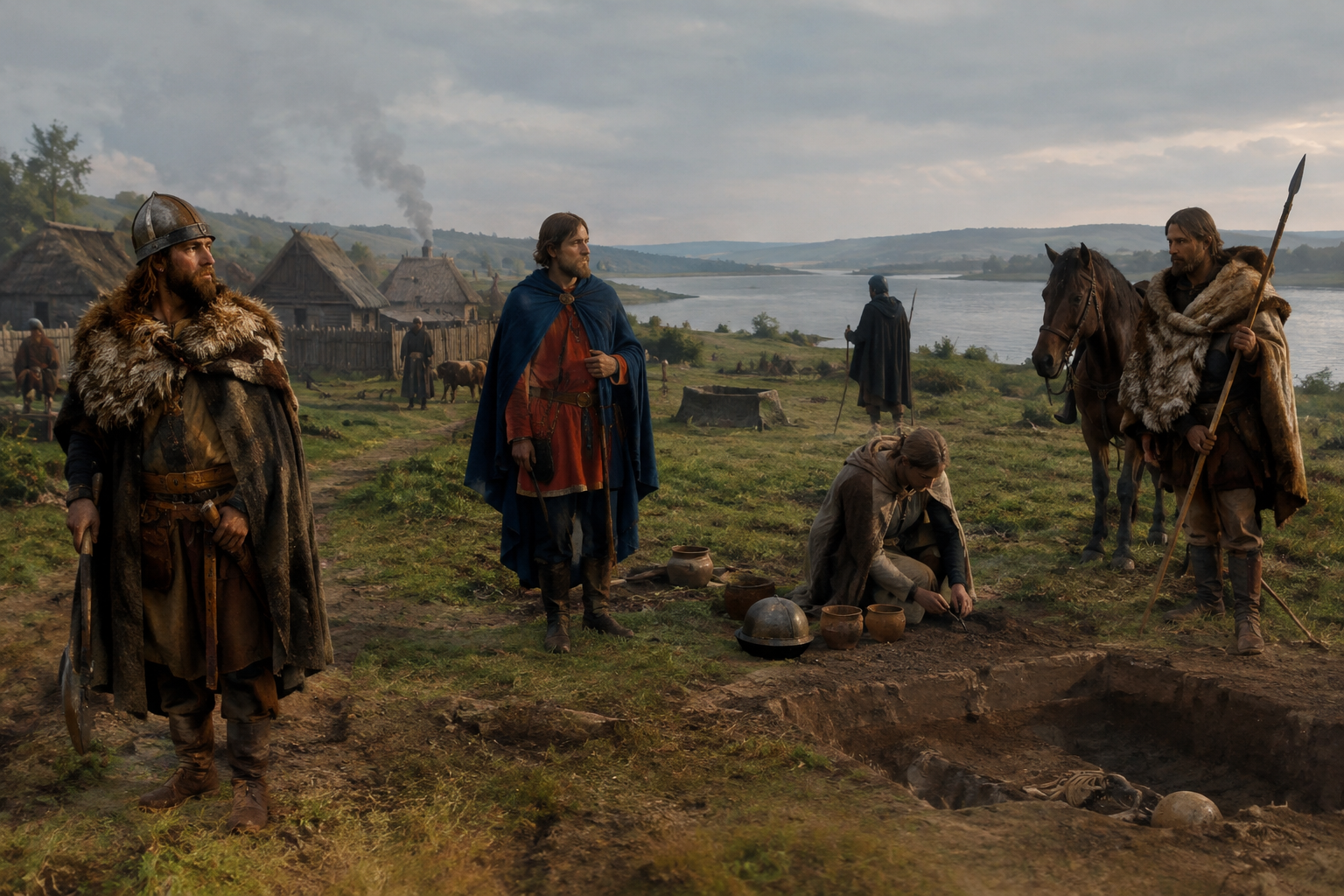
At Arrabona, near modern Gyor in Hungary, one sixth-century burial from the Longobard period has become a useful marker for tracing the paternal branch I1a3. The individual recorded as GHD021, dated around AD 550, belonged to the post-Roman world of Pannonia, where imperial frontiers had collapsed and new political groupings were taking shape. On its own, one Y-chromosome result is only one paternal line, not a whole people. But set beside comparable finds in England and northern Germany, it begins to show where this branch was present during the Migration Period and its aftermath.
That is what makes I1a3 interesting. Rather than appearing in one isolated corner, the supplied ancient evidence places men associated with this lineage in a broad northern and central European zone stretching from Lower Saxony to Anglo-Saxon England, and as far southeast as Pannonia. The pattern is not proof of a single tribe marching across the map. It is, however, exactly the sort of distribution we would expect for a paternal line moving within the social networks of early medieval Germanic-speaking communities.
I1a3 is a sub-branch within the wider Y-DNA haplogroup I1, a lineage long associated in ancient DNA studies with parts of northern Europe. The important point is not to blur the levels. A man classified as I1a3 belongs to a much narrower paternal branch than someone identified only as I1, and the broader history of I1 cannot simply be pasted onto every descendant line below it.
For family historians, Y-DNA follows one direct male line: father to son to son. That makes it unusually powerful for studying surnames, paternal clusters, and line-specific deep ancestry, but it does not describe all of a person's ancestors. Ancient DNA becomes most useful when that narrow paternal signal can be placed in a real archaeological setting, as it can here.
The sample GHD021 comes from Longobard Period Pannonia Arrabona Gyirmot Barbaricum in Hungary, dated to about AD 550. This was a moment of extraordinary instability in the Carpathian Basin. Roman administration had vanished, the old frontier system was broken, and groups identified in historical sources as Longobards were active in the region before their better-known move into Italy.
What matters here is not an overconfident ethnic label for one skeleton, but the setting. A paternal lineage linked to I1a3 appearing in Pannonia fits a wider picture in which northern-derived male lines were part of the population mix in post-Roman frontier regions. Research on early medieval populations in this part of Europe has repeatedly shown that these communities were not simple biological blocks. They could be locally rooted, mobile, and mixed at the same time.
A broader ancient DNA study of the period, published in Science, has helped sharpen this picture of movement and population interaction across post-Roman Europe. For I1a3, GHD021 is valuable because it places the lineage inside that turbulent central European zone rather than leaving it as a purely later northern or British signal.
A second key data point is LBU010, from Liebenau, Lower Saxony, Germany, also dated around AD 550. Lower Saxony matters because it lies in one of the core regions often connected with continental Saxon populations in the Migration Period. Here, I1a3 appears not on a distant frontier but in a northern German context closer to the North Sea world.
This does not mean every carrier of I1a3 was "a Saxon" in any rigid sense. Early medieval identities were political and cultural as much as biological. But when a paternal branch appears in both Lower Saxony and early Anglo-Saxon England, the comparison becomes historically suggestive. It places I1a3 within the same broad arena as the peoples who linked the continental coast and eastern Britain in the fifth to seventh centuries.
Liebenau therefore acts as a useful anchor. It reminds us that the English examples are not floating in isolation. They belong to a wider North Sea corridor in which people, alliances, households, and burial customs crossed water more easily than a modern map might imply.
The English material is especially revealing because it comes from two different settings. At West Heslerton, Yorkshire, the sample I20674 is dated to about AD 550 and comes from an Early Anglo Saxon Cemetery. West Heslerton has long been important to archaeologists as a site illuminating settlement and burial in the centuries after Rome's withdrawal from Britain. A lineage associated with I1a3 here places this paternal branch squarely inside the formative centuries of early English society.
The second English case, I16508, comes from Wolverton, Buckinghamshire, in the Kingdom of Mercia, dated around AD 690. By then, we are in a different political world. The early migration period had given way to established Anglo-Saxon kingdoms, with Mercia emerging as a major power in the English midlands. The significance of I16508 is chronological as much as geographical: it shows the persistence of this paternal branch into the later seventh century within a recognisably kingdom-based landscape.
An ancient DNA study on the formation of the early English gene pool, available at ResearchGate, helped frame exactly these questions of migration, admixture, and continuity in early medieval England. Without claiming more than the evidence allows for each individual sample, the English finds suggest that I1a3 was among the paternal lines carried into, and then maintained within, Anglo-Saxon communities.
If we line the samples up chronologically and geographically, a pattern appears. LBU010 in Lower Saxony and I20674 in Yorkshire belong to roughly the same mid-sixth-century horizon. GHD021 in Pannonia shows the same branch present in a very different but still post-Roman Germanic-associated setting. I16508 in Mercia then shows continuity into a later English kingdom.
This does not give us a tidy origin story. It gives us something more archaeologically honest: a lineage distributed across the very networks that tied together northern Germany, eastern Britain, and parts of central Europe in the centuries after Rome. That is a world of federate armies, migrating households, frontier settlements, elite retinues, and local communities adapting to new political realities.
There is a useful parallel here with broader discussions of Britain's early medieval transformation. Y-chromosome lineages such as I1a3 can help identify one thread within that process, but the societies themselves were mixtures of ancestry, culture, and local survival. A man with this paternal line in Mercia was not simply a walking tribal label. He was part of a population already shaped by generations of interaction.
Roman to Early Medieval Britain
For someone researching haplogroup I1a3, these ancient cases suggest a paternal line with real visibility in the Migration Period and early medieval North Sea world, with an added appearance in post-Roman Pannonia. The strongest historical impression is not of one famous dynasty or a single dramatic trek, but of a branch embedded in the male-line networks that linked northern Germany, Anglo-Saxon England, and parts of central Europe around the sixth and seventh centuries.
That is, in its way, more interesting than a legend. I1a3 appears here as the sort of lineage carried by actual communities living through the collapse of Roman rule and the making of early medieval Europe.
Comments