Haplogroup I1a2b1c

– 5 min read


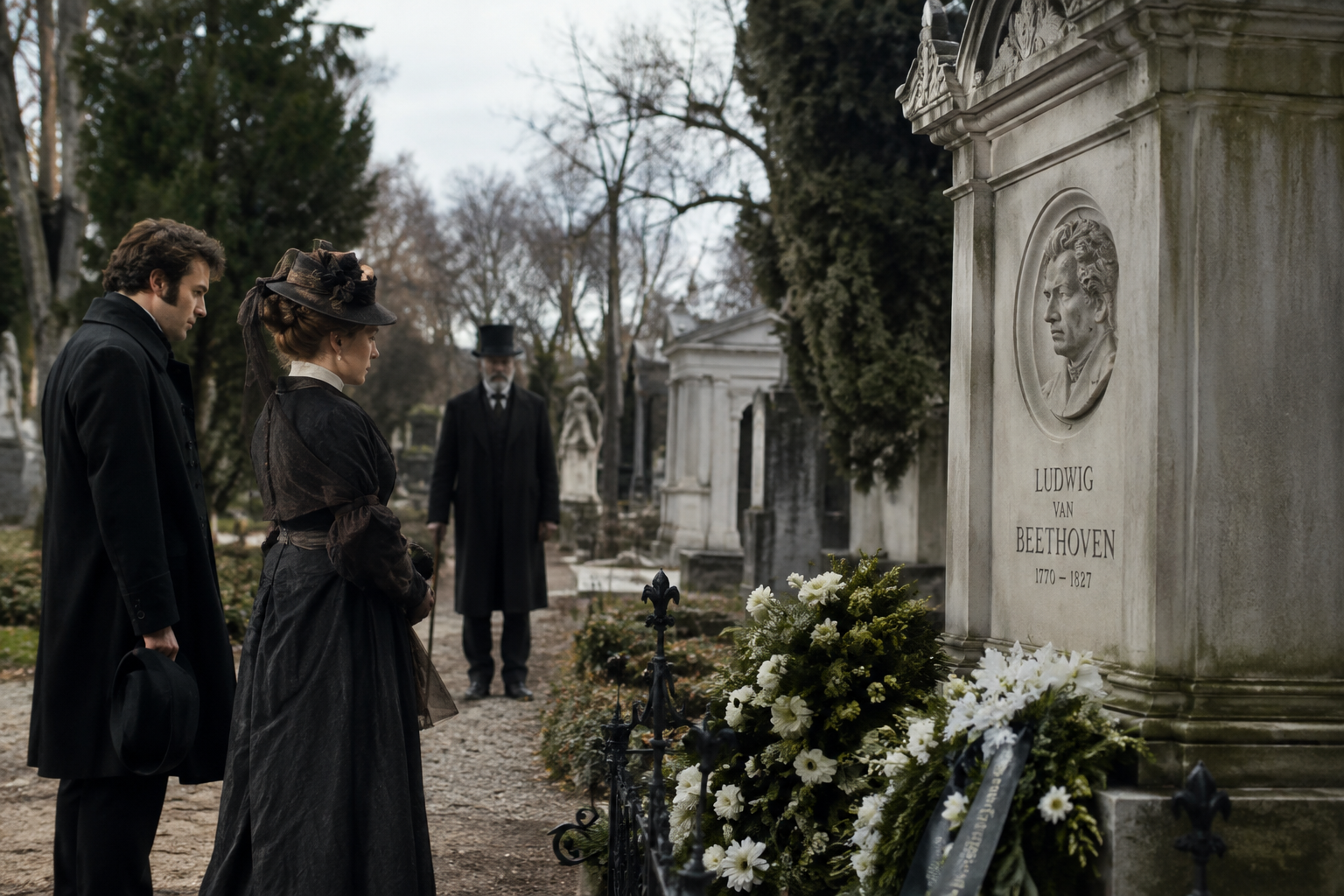
In this case the most arresting evidence for haplogroup I1a2b1c does not come from a Bronze Age barrow or an early medieval cemetery, but from a man whose music is almost impossibly famous: Ludwig van Beethoven. The sample listed here, lvb, is associated with Beethoven's remains in Vienna's Wiener Zentralfriedhof and dated to 1827 AD, the year of his death. That alone makes the lineage interesting, because it brings Y-DNA out of the misty realm of remote prehistory and into the world of documented biography, family memory, and forensic scrutiny.
Beethoven is an unusual anchor for a Y-chromosome article because his life is so richly recorded while his direct paternal line has also become a subject of genetic investigation. Y-DNA traces one direct male line only, not a person's whole ancestry, but even that narrow line can be historically revealing. With I1a2b1c, the key point is that we are dealing with a branch inside the wider haplogroup I1, a lineage strongly associated in broad terms with northern Europe and often discussed in studies of Germanic-speaking populations, though the exact history of any one sub-branch must be treated far more carefully than the parent haplogroup.
Beethoven died in Vienna in 1827, after years of illness that have provoked endless medical speculation. Modern genetic work on authenticated hair associated with him drew attention not only because of questions about disease and death, but because it opened a window onto his paternal line as well. A widely read report on that work can be found here: https://www.smithsonianmag.com/smart-news/dna-from-beethovens-hair-reveals-clues-about-his-death-180981870/.
What gave the story particular bite was not some grand claim about ancient ethnicity, but a much more human and historically grounded problem: the mismatch between Beethoven's Y chromosome and that of living men descended through the documented paternal line from his wider family. That suggests a break somewhere in the recorded male line between the 16th century in the Low Countries and Beethoven's own generation. Historians have long worked with awkward discontinuities in archives, adoptions of identity, illegitimacy, and family reinvention; genetics does not abolish those complications, it simply gives them a new form.
Paternal-line DNA and historical paternity
That makes lvb more than a celebrity datapoint. It is a reminder that Y-DNA can illuminate the history of families in a very specific way: not by supplying romance, but by testing whether documentary father-to-son transmission matches biological father-to-son transmission over centuries. In Beethoven's case, the result was striking precisely because the paper trail is comparatively good.
The temptation with a lineage attached to a famous Central European figure is to start drawing thick arrows across the map. Better not. The exact subclade here is I1a2b1c, but the deepest and best-known historical discussions usually concern the broader haplogroup I1. That parent branch appears today at notable frequencies in parts of Scandinavia and across regions shaped by movements of northern European populations over the last two millennia.
But a subclade is not the same thing as the entire parent lineage. The presence of I1a2b1c in Beethoven cannot by itself tell us that his direct paternal ancestors were "Vikings," "Saxons," or members of any single historically named people. What it can do is place his paternal line within a wider northern European Y-chromosomal framework that fits, in broad outline, the historical geography of the Low Countries and the German-speaking lands where his known family lived.
This is where archaeogenetics becomes genuinely useful. Large-scale ancient DNA work has helped show how northern and central Europe were repeatedly reshaped by migration, language spread, and local continuity, without making those processes identical. One helpful MyTrueAncestry discussion of that wider background is here.
Germanic languages and ancient genomics
Beethoven's family name points back to the Low Countries, and the documented paternal ancestry of the family leads to the Flemish-Brabant region before later generations moved into the Rhineland sphere. Historically, that is a perfectly plausible corridor for a branch like I1 to appear, not because one Y lineage belonged to one nation, but because the North Sea world and the inland German-speaking regions were tightly connected by migration, military service, church careers, trade, and urban life.
This matters because people often imagine lineages as though they sit still. They do not. By the early modern period, the cultural map of the Holy Roman Empire and the Low Countries was criss-crossed by movement. A paternal line such as I1a2b1c could pass through Dutch-speaking, French-influenced, and German-speaking environments without changing its Y-DNA label at all. The historical interest lies in that mismatch between stable biological inheritance and very mobile social identity.
For Beethoven, then, the paternal story is less about remote tribal labels than about the making of early modern northwestern Europe: cathedral towns, court chapels, urban careers, and family lines that can be traced in writing until genetics reveals a hidden interruption. It is almost a textbook example of how documentary history and genetic history can complement, and occasionally contradict, one another.
Many haplogroup articles are driven by clusters of ancient burials. This one is different. With only the Beethoven-associated sample supplied here, the interest lies not in quantity but in the quality of historical context. We know where and when the individual lived, we know a great deal about his family background, and we know that genetic analysis triggered a very specific historical question about paternal descent.
That kind of case is valuable for the public understanding of archaeogenetics. It shows that Y-DNA is not only about assigning distant prehistoric origins; it can also be used to test lineages in named families, much as work on dynasties, medieval burials, and early modern remains has increasingly done elsewhere in Europe. Readers interested in that broader central European and dynastic setting may enjoy this related piece on genetically authenticated rulers.
Ottonian rulers and ancient DNA
There is also a useful caution in Beethoven's case. A famous bearer of a haplogroup can make a lineage feel unusually personal, but one individual does not define the whole branch. Nor should celebrity distract from the fact that Y-DNA studies sometimes expose breaks in genealogy that are socially sensitive but historically common. In that sense, the Beethoven result is not bizarre at all; it is simply unusually visible.
Although this article rests on a modern-historical individual rather than a prehistoric excavation, the broader context of I1 still matters. Ancient DNA has increasingly shown that the paternal landscape of northern Europe changed over time, especially from the Bronze Age onward, and that later Iron Age and early medieval societies often carried lineages that became prominent in Scandinavian and Germanic-speaking zones. That does not let us assign Beethoven's precise subclade a neatly packaged ancient origin story, but it does help explain why an I1-derived branch in his family is historically unsurprising.
Readers who want the deeper Scandinavian side of that background can compare this with work on post-Viking and early Christian burials in the north, where ancient DNA helps connect lineages, conversion, and regional continuity.
Post-Viking Christian DNA in Scandinavia
The real lesson is one Mary Beard would probably appreciate: the past is rarely tidy, and the most revealing findings are often the ones that disturb a comforting story. Beethoven's paternal genetics do exactly that. They place him within a broad northern European Y-chromosome tradition while also showing that even well-documented families may conceal an undocumented turning point.
For someone researching haplogroup I1a2b1c, the Beethoven connection offers a grounded and rather elegant insight. This branch can sit comfortably within the historical world of the Low Countries, the Rhineland, and the wider northern European sphere shaped by Germanic-language expansions and centuries of regional mobility. At the same time, its most famous example here is a warning against overconfident storytelling: paternal lines are precise, but family history is messy, human, and full of surprises.






Comments