Haplogroup I1a2a2

– 6 min read


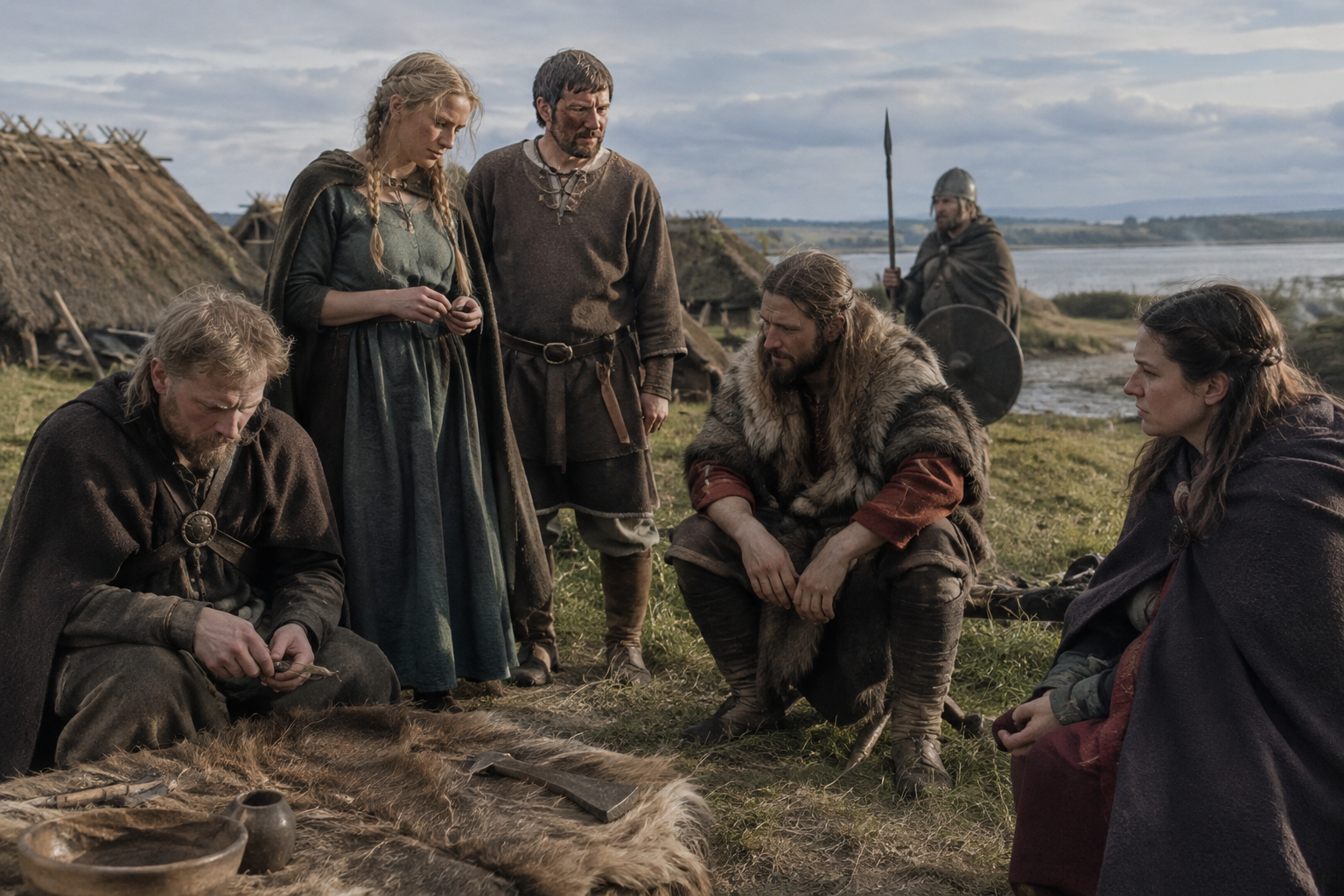
At Gevninge Overdrev on the Danish islands, one man dated to around AD 57, sample CGG107535, offers a useful starting point for thinking about Y-DNA haplogroup I1a2a2. The date places him in the Nordic Iron Age, well before the Viking Age, and the location matters just as much as the calendar. Zealand and the Danish islands sat in a strategic zone of movement, exchange, and political experimentation long before the better-known royal centres of later centuries.
What makes this sample interesting is not that it solves everything, but that it anchors a paternal line in a very specific North Sea world. Y-DNA tracks one direct male line only, not a person's whole ancestry, yet when the same branch appears again in later graves from Denmark, Germany, and Anglo-Saxon England, it begins to sketch a historical pattern: a lineage present in southern Scandinavia in the Roman Iron Age, visible in the Migration Period south of the Baltic, and still turning up in England and Denmark in the early medieval centuries.
I1a2a2 is a sub-branch within the wider Y-haplogroup I1, a lineage strongly associated in ancient-DNA work with northern Europe, especially Scandinavia. That broader background is useful, but the narrower label matters here. We should not simply pour the whole history of I1 into I1a2a2 as if every branch behaved the same way. The value of this article's evidence is that it gives us a modest but concrete archaeological trail for this particular branch or for samples associated with it.
That trail is concentrated around the western Baltic and the North Sea. It does not point to a single tribe, kingdom, or language community in any simplistic sense. Instead, it fits a region where identities changed over time while family lines could persist through major cultural shifts: from the Roman-period societies of southern Scandinavia to the Migration Period, the Anglo-Saxon settlements in England, and the elite landscapes of Viking Age Denmark.
A broad genetic study of ancient Britain and neighboring North Sea populations has helped sharpen this wider setting by showing how closely connected these coastal worlds could be in the early medieval period. For readers interested in that larger background, see research on ancient genomes from early medieval England and adjacent regions.
CGG107535, from Gevninge Overdrev and dated around AD 57, is the earliest of the supplied examples. That date falls in a period when Denmark was not yet the land of rune stones and longships familiar from popular history, but it was hardly quiet or isolated. Communities on the islands were tied into exchange networks reaching across the Baltic and into the Roman world, while local hierarchies were already taking shape.
In that light, I1a2a2 appears here not as a Viking signature in advance, but as part of an older Scandinavian paternal landscape. This is important because later medieval identities can easily distort our view of earlier centuries. The sample suggests that at least one line connected with this haplogroup was already established in island Denmark centuries before the political formations of the Viking Age became visible in written history.
It also helps that the geography is so suggestive. The Danish islands were not a dead centre between larger lands; they were the hinge between Jutland, Scania, the Baltic, and the sea route toward Britain. A paternal line present here in the first century AD is sitting exactly where later mobility would matter most.
The next important appearance is R11875, from a Migration Era grave at Hassleben in Thuringia, Germany, dated around AD 450. This is a very different setting from island Denmark. Thuringia is inland, and AD 450 belongs to the unsettled centuries around the end of Roman imperial power in the west, when military service, shifting alliances, and new political groupings reshaped central Europe.
That does not mean this man can be neatly labelled as a migrant from Denmark, still less that one haplogroup can identify an ethnicity. But the comparison is valuable. A line associated with I1a2a2 is no longer confined to southern Scandinavia in the evidence supplied here; it also appears in a central German context during the Migration Period. That suits what archaeology and history already tell us about the period: people, objects, and allegiances were moving across considerable distances.
Recent ancient-DNA work on the centuries after Rome has repeatedly shown that "Germanic" worlds were not biologically uniform blocks. They were mixed, mobile communities shaped by recruitment, marriage, and political change. Hassleben is therefore useful not because it proves a tidy migration route, but because it places this paternal line in exactly the kind of historical frontier where northern connections and local developments met.
Sample SED007, from Anglo-Saxon Sedgeford in Norfolk and dated around AD 600, brings the story across the North Sea into England. Norfolk is one of the classic regions for studying early Anglo-Saxon settlement, and Sedgeford has become well known as an archaeological landscape where early medieval life can be examined in unusually close local detail.
Here the significance of I1a2a2 is not that it marks an "Anglo-Saxon gene" in any crude sense. Rather, it sits comfortably within a body of evidence showing that eastern England in the 5th to 7th centuries drew substantial ancestry from North Sea populations, especially those linked to regions around present-day Denmark, northern Germany, and the Low Countries. In other words, this paternal line appears in one of the very places where those long-discussed continental connections can be studied directly in graves rather than guessed from chronicles.
That matters for family historians because it offers a realistic scale of interpretation. If your paternal line falls within I1a2a2, the ancient evidence does not identify a named ancestor who sailed to England. What it does show is that this branch belonged to the population world from which part of early medieval England was formed.
For a wider look at this transformation, MyTrueAncestry has also explored the genetic legacy of the Anglo-Saxon migration.
The latest sample in this set, VK445, comes from Viking Age Gammel Lejre on Sealand, dated around AD 900. Lejre is one of those places where archaeology and later tradition have long tugged at each other. It occupies a famous position in the historical imagination of Denmark, associated with an important early power centre, and that makes any ancient DNA from the site especially resonant.
What the haplogroup evidence can say is restrained but still interesting. A line associated with I1a2a2 appears at a major Danish site in the Viking Age, after we have already seen the same branch or associated branch in Roman Iron Age Denmark and in early medieval England and Germany. That continuity across centuries is striking. It suggests persistence, not as a royal badge or a marker of one elite house, but as part of the enduring male-line fabric of southern Scandinavia.
A preprint on ancient DNA from Denmark and surrounding regions has helped expand exactly this kind of long view, tracing how individuals from key Scandinavian contexts fit into broader population history across changing periods. Used carefully, such research strengthens the impression that Viking Age Denmark was built on much older regional foundations rather than appearing out of nowhere.
Put these samples together and a clear pattern emerges. CGG107535 places the lineage in island Denmark around the first century AD. R11875 shows it in Migration Period central Germany. SED007 places it in Anglo-Saxon Norfolk by around AD 600. VK445 returns us to a major Danish centre in the Viking Age.
This is not a grand empire of one paternal line. It is something more historically believable: a North Sea and western Baltic distribution that fits centuries of contact between southern Scandinavia, northern Germany, and eastern England. Ships, settlements, fosterage, warfare, trade, and marriage all linked these coasts and inland corridors. A Y-line could move with some men, stay rooted with others, and persist through entirely new political worlds.
That broader setting also helps explain why the same haplogroup branch can appear under different cultural labels. Nordic Iron Age, Migration Era, Anglo-Saxon, and Viking Age are archaeological or historical frames, not biological containers. The people in them were related in many different ways, and paternal lines were only one thread among many.
The most distinctive thing about I1a2a2 in this evidence is its repeated appearance in a historically connected maritime zone stretching from Denmark to early medieval England, with a Migration Period appearance in Germany along the way. That does not turn the branch into a tribal label or guarantee descent from any famous Viking or Anglo-Saxon founder. But it does place this paternal line in a real and well-documented historical arena: the long-lived network of populations around the North Sea and the western Baltic.
For someone researching a present-day paternal line, that is already valuable. It suggests that your direct male ancestry may belong to a branch with documented roots in the Scandinavian and North Sea world before, during, and after the upheavals that reshaped early medieval Europe.


Comments