Haplogroup I1a2a1a1d1a1a
– 5 min read


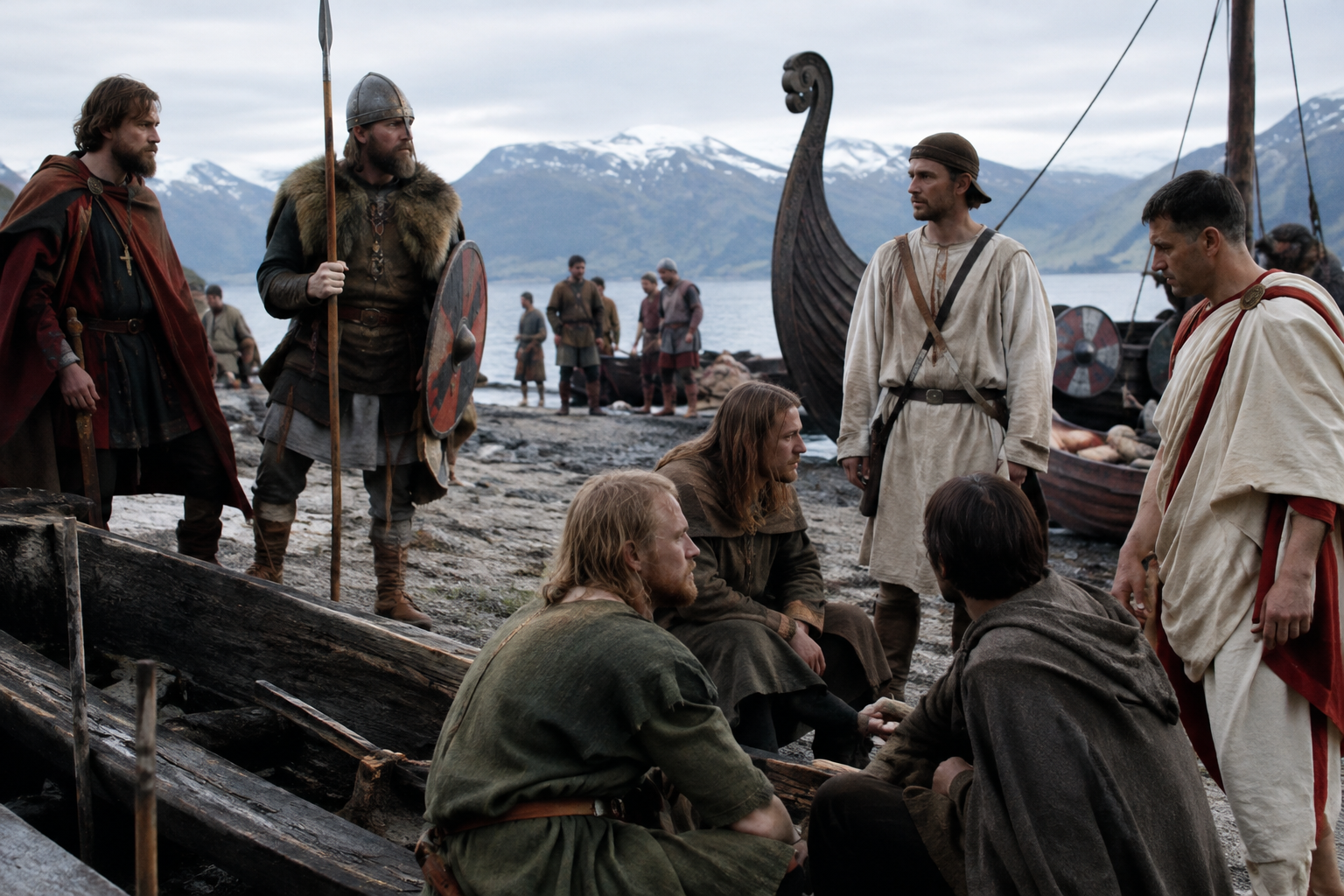
Some Y-DNA branches are historically interesting because they turn up once in a while in the ancient record. Others are interesting because they appear in precisely the sorts of places historians already argue about: raiding fleets, boat burials, massacres, frontier ports, and the long corridor between Scandinavia and the wider European world. Haplogroup I1a2a1a1d1a1a belongs to that second category.
To be clear at the outset, a Y-DNA haplogroup traces only one line of descent: the direct paternal line, father to son to son. It does not describe a person's whole ancestry, culture, language, or identity. But that one line can still be illuminating. In this case, the supplied ancient DNA points strongly toward a northern European, especially Scandinavian, context for this branch, while also hinting at wider mobility through the Viking world and even into the Roman Mediterranean.
The wider haplogroup I1 is well known in northern Europe and is often discussed in connection with later Scandinavian populations. A very narrow subclade such as I1a2a1a1d1a1a must be treated more carefully. We should not simply pour the entire history of broad I1 into this tiny twig of the family tree. What we can say is that the evidence supplied here places this branch in a remarkable series of burials stretching from Roman-era Empuries to Vendel and Viking Age Scandinavia, and then into England at the moment of one of the most notorious anti-Viking killings in medieval history.
The most eye-catching feature of the sample list is chronological spread. Most of the ancient men linked here belong to the Vendel and Viking periods in Scandinavia and the Baltic, which fits what many readers would expect from a branch of I1. But there is also I10865, a Roman-Era Empuries individual dated 47 BC. That matters because Empuries, on the Mediterranean coast of Iberia, was a place of movement: Greek foundations, Iberian communities, and Roman expansion all met there.
Now, one Roman-era individual in northeastern Iberia does not prove that this exact paternal branch originated there, nor that it was common there. It does, however, remind us of a basic archaeological truth: people moved around the ancient world more than tidy national histories like to admit. A northern-associated paternal line appearing in a Mediterranean setting can reflect trade, soldiering, migration, or family histories now lost to writing.
So the safer picture is this. The narrower branch I1a2a1a1d1a1a is best understood, from the evidence supplied, as a line strongly represented in later Scandinavian-associated contexts, while its deeper background may have involved earlier movements around Europe that we still only glimpse in fragments.
If you want to see this haplogroup come alive archaeologically, the most striking cluster is from Salme on Saaremaa in present-day Estonia. Several Vendel Age men from the Salme II ship burials carry this line: VK491, VK483, VK485, VK490, and VK497, all dated 725 AD. These are not dry database entries. They come from one of the most dramatic early Scandinavian war-burial discoveries ever found: armed men laid in ships across the eastern Baltic.
Salme is historically important because it belongs to that period just before what we conventionally call the Viking Age, when Scandinavian seaborne violence, elite retinues, and long-distance movement were already very much underway. The repeated appearance of this paternal branch among the Salme dead does not prove they were all close kin, but it certainly places the lineage in a martial and mobile Baltic environment at an early date.
Then there is northern Norway. VK524, from a Viking Age Boat Burial Nordland Norway dated 950 AD, and VK515, a Viking Age Warrior Ronvik Nordland Norway dated 990 AD, anchor the branch in the Scandinavian north itself. Boat burial and warrior burial are not casual labels. They point to societies where status, mobility, and maritime identity mattered deeply. In other words, this is exactly the sort of landscape in which a northern paternal lineage might endure, diversify, and spread.
And then the story turns grim. VK146, from the Viking St. Brice Massacre Oxford, dated 1002 AD, places the same paternal branch in England at the time King Aethelred ordered the killing of Danes in his kingdom. The Oxford massacre victims have become central to discussions of Viking presence in England because they show that the Viking world in Britain was not a literary abstraction from the sagas, but a community of actual men, women, and families living - and dying - there.
Taken together, Salme, Nordland, and Oxford sketch a very plausible historical arc: this branch was part of the Scandinavian world before, during, and beyond the conventional opening of the Viking Age, and it traveled along the same sea-roads that linked Norway, the Baltic, and England.
It is tempting to call a lineage like this simply "Viking." But that can be too blunt. "Viking" was an activity, a social world, and in some contexts a profession, not a Y-chromosome category. What the ancient DNA supports more firmly is a connection with Scandinavian male lines involved in the eastern Baltic, coastal Norway, and the Norse presence in England.
This is where Y-DNA is so useful and so limited at once. It can show continuity in a paternal branch across regions and centuries. It cannot tell us what language every carrier spoke, whether all of them thought of themselves as Norse in the same way, or whether two men with the same broad haplogroup would have recognized one another as kin. Shared haplogroup is not the same thing as a known family tree.
Still, the historical pattern is hard to miss. The line appears in elite-seeming or martial contexts, in seaborne settings, and in zones of intense contact across the North Sea and Baltic. This fits neatly with wider MyTrueAncestry work on northern European population history, from pre-Viking Scandinavia to the settlement patterns of the early medieval north.
In this case, the supplied field for associated noble families and castles is effectively blank. Oddly enough, that is useful in its own way, because it forces us to avoid the usual temptation to leap from ancient graves to medieval heraldry. No responsible historian should look at a Viking burial in Nordland or a massacre victim in Oxford and announce a proven link to some later noble house unless the evidence is extraordinarily specific. Here it is not.
That does not mean castles and dynasties are irrelevant to the story. Quite the reverse. The world in which lineages like I1a2a1a1d1a1a persisted would later be the world of Norwegian royal consolidation, Baltic strongholds, English fortification, and aristocratic line-building. Medieval castles often preserve the memory of regions where older paternal lines had circulated for centuries before the first stone keep was ever raised.
But memory is not proof. A castle tells us about power in a place; a Y-chromosome tells us about one paternal line. Sometimes those stories converge. Often they merely run alongside one another. Good history lies in knowing the difference.
What makes I1a2a1a1d1a1a so compelling is not just its name, which admittedly sounds like a clerk dropped a box of numbers down a staircase. It is the company it keeps in the ancient record. A Roman-era man at Empuries. A cluster of dead warriors at Salme. Boat burials and martial graves in Nordland. A victim of the St. Brice massacre in Oxford. This is a paternal line found in places where European history was being made through movement, conflict, settlement, and exchange.
For anyone who carries a related lineage today, that does not mean descent from a specific Viking warrior, still less from any noble dynasty. It means something both more modest and more interesting: your direct paternal line may belong to a branch that has already been seen among real men from the Scandinavian and North Sea world of the first millennium. Ancient DNA gives us those glimpses where written genealogy usually falls silent.
If you want to explore whether your own DNA shows connections to ancient individuals like VK146, VK524, VK491, or I10865, MyTrueAncestry can help place your results beside the archaeological record. Those matches do not prove direct descent or membership in any historical family, but they can offer an unusually vivid view of the past your ancestors moved through.






Comments