Haplogroup I1a2a1a1d1

– 5 min read


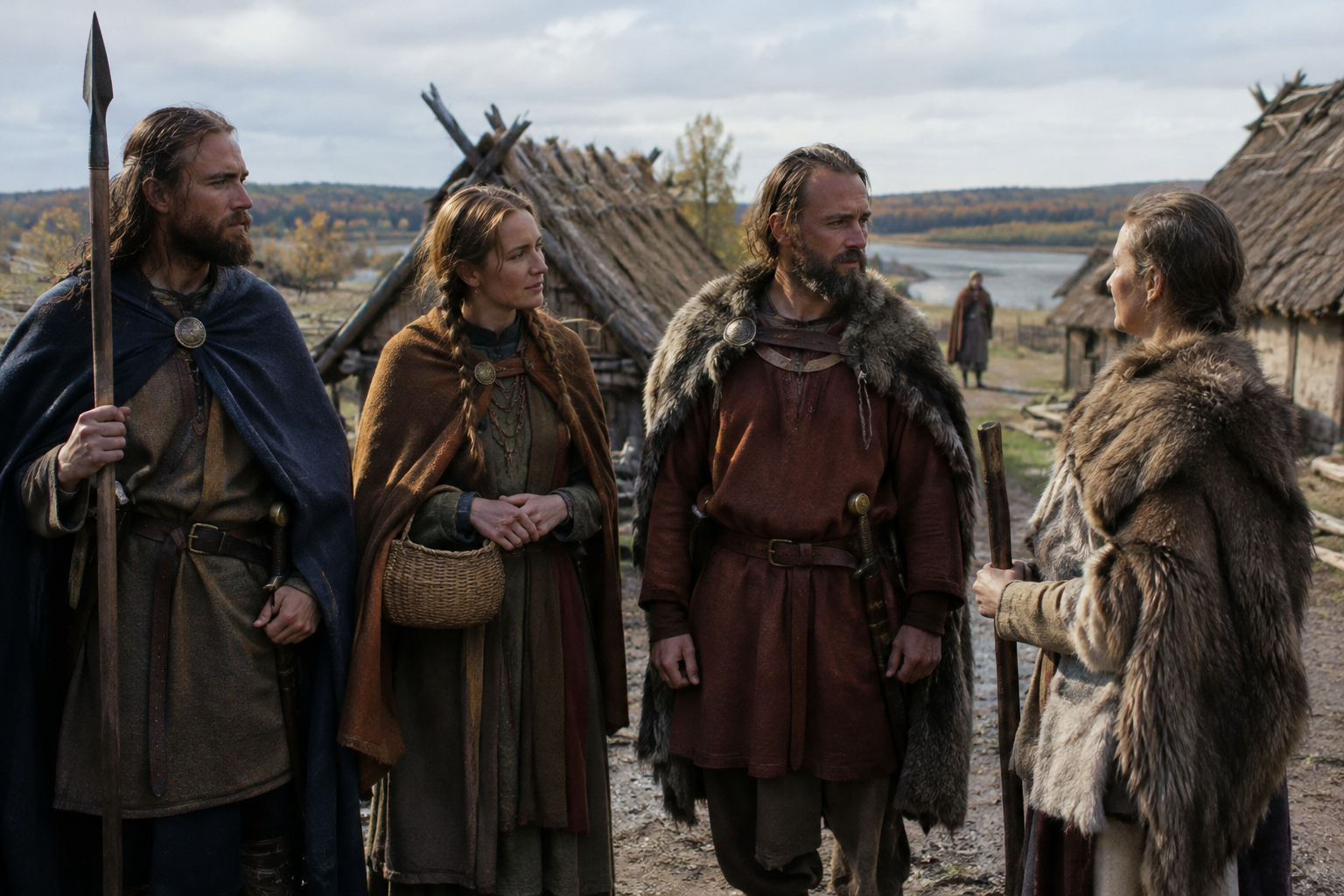
At Altheim in Bavaria, three men buried in the Merovingian period around AD 600 - Alh_117, Alh_132, and Alh_150 - have been associated with the Y-DNA haplogroup I1a2a1a1d1. That is already a striking pattern. One burial can be a curiosity; three men from the same early medieval community start to look like a local paternal thread, preserved in a cemetery used during the centuries when the old Roman world had given way to new kingdoms, new loyalties, and new ways of being Christian in western Europe.
The interest of this haplogroup here is not that it tells us everything about these men. It does not. Y-DNA tracks one direct paternal line only, not a person's whole ancestry, language, or social identity. But when the same branch appears several times at one site, and when another related ancient sample turns up further east in Migration Period Poland, it gives us something rather valuable: a small but tangible map of male-line continuity and movement across the post-Roman world.
The Altheim cluster is the firmest anchor for this article because it is not a single isolated result. Alh_117, Alh_132, and Alh_150 all come from Merovingian-period Bavaria in what is now southern Germany, dated here to about AD 600. That matters historically. Bavaria in this period stood within a frontier-like zone of the early medieval west: shaped by late Roman legacies, tied into Frankish power, and connected to wider networks running north toward Germanic-speaking regions and east toward the Danube world.
When three men from one cemetery are linked to the same narrow paternal branch, the simplest responsible reading is that this lineage was present in that community in a meaningful way. That does not automatically make them close relatives, let alone a ruling family. Cemeteries can hold distant kin, unrelated men from the same wider lineage, or simply the accumulated remains of a community over generations. Still, repetition is the point: I1a2a1a1d1 was not just passing through as a one-off signal at Altheim.
An ancient DNA study examining this broad regional setting has helped illuminate how varied early medieval cemeteries could be, and how the political labels we use - Bavarian, Frankish, Alemannic, Gothic - do not map neatly onto a single biological profile. That is a useful backdrop for thinking about Altheim without forcing the site into a simplistic tribal story. For readers interested in the wider genetics of such frontier communities, see this related discussion of Roman-Barbarian blending on the German frontier, 400-700 CE.
The parent haplogroup I1 is well known in European population history, especially in northern Europe, but that larger fame can be misleading if handled carelessly. I1a2a1a1d1 is a far narrower branch than I1 as a whole, and the evidence here is not enough to write a grand origin myth for it. What we can say is more modest and more useful: this branch appears in early medieval central Europe and in at least one Migration Period burial further east, which places it squarely in the human landscape of the centuries when populations, armies, households, and loyalties were being reshuffled after Rome.
That is often how ancient Y-DNA becomes historically interesting. Not because one branch equals one people, but because certain paternal lines appear again and again in the zones where archaeologists already see contact, movement, and local continuity mixed together. A lineage like this may have been carried by men whose families had been established in a region for generations, by newcomers, or by descendants of earlier migrants who had long since become local. The genetics alone cannot choose between those possibilities, but it can show us where the line was living.
The other important sample here is GRK018 from Gródek nad Bugiem in Poland, dated to about AD 400. Chronologically, this is earlier than the Bavarian cluster. Geographically, it sits well to the east, in a region that belonged to the highly mobile world of the Migration Period, when communities in what is now Poland were linked to wider developments stretching from the Baltic to the Black Sea and into the former Roman provinces.
GRK018 matters because it prevents the story from becoming purely local. If Altheim showed only one cemetery in Bavaria, we might suspect an entirely regional pattern. The Polish sample instead hints that the paternal branch associated with I1a2a1a1d1 was present within a broader belt of central and east-central Europe during late antiquity and the early Middle Ages.
One should be cautious with labels here. A burial in Migration Period Poland is not automatically "Gothic," "Vandal," or any other historically famous name. Archaeology and ancient DNA have repeatedly shown that such communities could be mixed, shifting, and locally rooted even when material culture seems to point toward larger supra-regional identities. But this is exactly why the sample is so interesting: it belongs to that restless zone where identities traveled, merged, and were reassembled.
That wider setting is explored from another angle in MyTrueAncestry's discussion of genetically diverse Gothic-era communities in Poland and neighboring regions.
Put the evidence together and the dates become the real story. GRK018 appears around AD 400 in Poland; Alh_117, Alh_132, and Alh_150 appear around AD 600 in Bavaria. This is not a straight line from one named ancestor to another, and it would be absurd to pretend otherwise. But it does suggest that the paternal branch linked here to I1a2a1a1d1 belonged to the same broad historical world that connected the Middle Danube, southern Germany, and the north-central European plains during the age of migrations and kingdom-building.
That is a world archaeologists know well: cemeteries reorganized around new political powers, communities absorbing outsiders, and local populations adapting to changing rulers and religions. Genetic evidence fits that picture rather well. Rather than neat replacement by one people after another, the early medieval record often shows overlapping ancestries and multiple male lines persisting within the same settlement zone.
Research published on these ancient populations is part of that larger shift in understanding. A recent ancient DNA study contributes to the growing picture of how post-Roman and early medieval European communities were formed through both continuity and mobility, not through a single tidy migration event.
There is always a temptation, when a haplogroup has a northern-European reputation, to tell a sweeping saga of warrior migrations and leave it there. But the Altheim evidence resists that kind of melodrama. Three men at one Bavarian site show us something more grounded and, in a way, more historically convincing: a paternal line embedded in a functioning community two centuries after the western Roman Empire had collapsed.
That is a reminder that early medieval Europe was not made only by marching bands of migrants. It was made by villages, burial grounds, family lines, and local societies negotiating change over generations. A lineage survives not because it starred in a famous chronicle, but because fathers had sons, communities endured, and some cemeteries were eventually excavated and sampled.
There is a nice parallel here with broader work on early medieval mobility around the North Sea and adjacent regions, where ancient DNA keeps showing that "local" and "migrant" are often too blunt as categories.
For someone researching a modern paternal line assigned to I1a2a1a1d1, the strongest ancient signal here is not a claim to one famous tribe or dynasty. It is something subtler and better supported: this branch is visible in the human landscape of Migration Period Poland and Merovingian Bavaria, and in Bavaria it appears more than once within the same early medieval cemetery. In other words, this was a living paternal line within the communities that helped remake central Europe after Rome.
That may not sound as glamorous as a legendary pedigree, but it is better history. It places your line among real excavated men - GRK018, Alh_117, Alh_132, and Alh_150 - whose burials belong to one of the most formative periods in European history, when old imperial structures gave way to new regional worlds whose descendants would shape medieval Europe.






Comments