Haplogroup I1a2a1a1a1b
– 5 min read


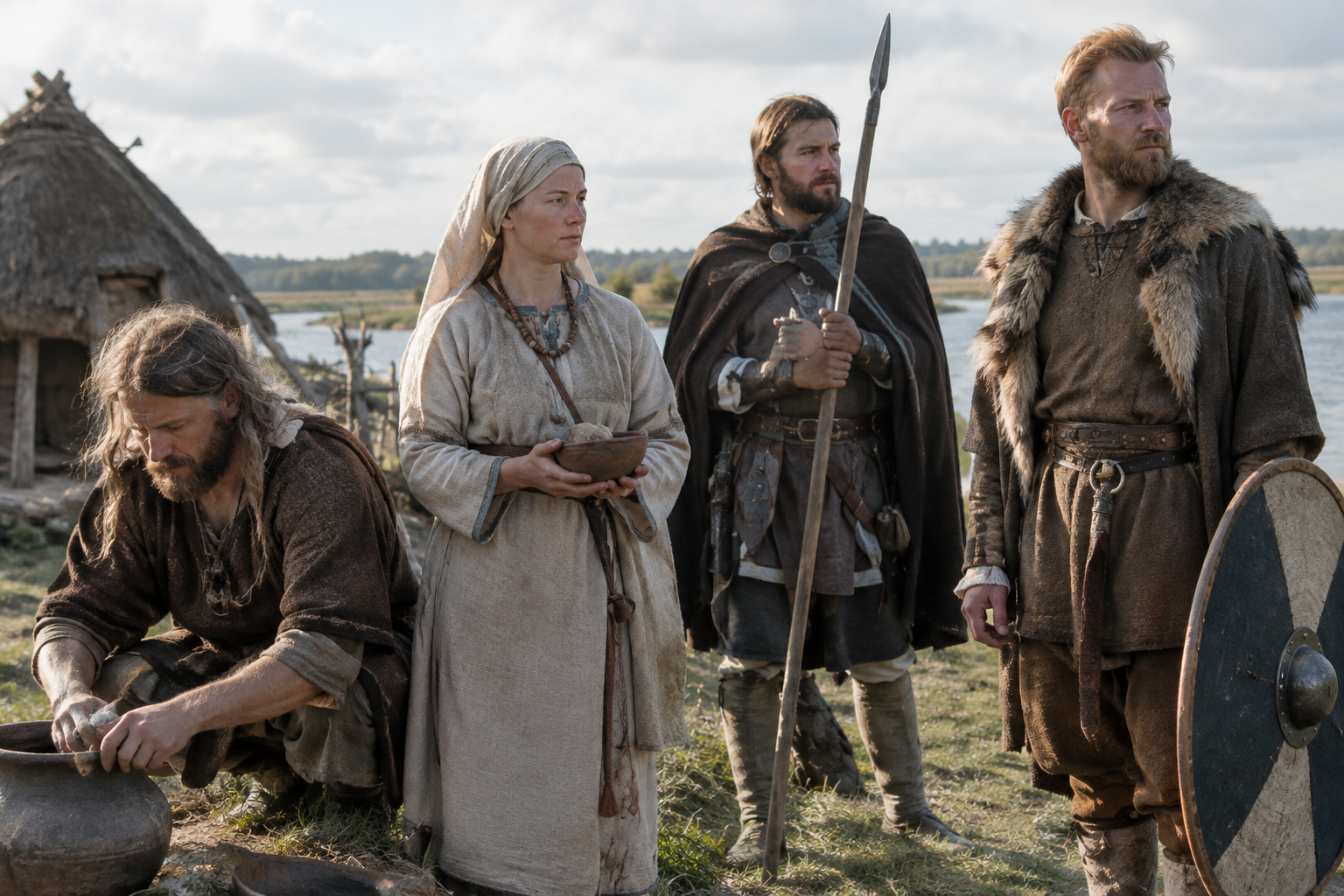
At Espe on Sjaelland, an ancient man dated to around AD 218 appears in the record as CGG107515 and is associated here with the Y-DNA haplogroup I1a2a1a1a1b. That is a very specific paternal branch, and the immediate interest is not simply that it turns up in Denmark, but that it sits beside two other finds from very different settings: a Bronze Age individual from southwest Ukraine and a later Gothic-period burial in Hungary. Even with only a few securely named samples, that is enough to sketch a serious historical problem. Are we looking at one neatly bounded "people"? Or are we seeing a paternal line that moved through changing societies over many centuries?
The safest answer is the more interesting one. Y-DNA follows one direct male line only, not a person's whole ancestry, language, or identity. But when the same branch appears in a Bronze Age context north of the Black Sea, in Roman-period Denmark, and in a Gothic-associated burial in the Carpathian Basin, it gives us a narrow thread running through a much broader archaeological world.
The clearest northern anchor in this small group is CGG107515, identified as a Danii Tribe individual from Espe on Sjaelland and dated to about AD 218. The label is useful as a historical shorthand for a Danish setting in the Roman Iron Age, but it should not be overworked into a rigid ethnic claim. What matters most is the place and period: island Denmark, at a time when southern Scandinavia was deeply involved in exchange, prestige networks, and long-distance contact with the Roman world.
That context matters for haplogroup I1a2a1a1a1b because the wider I1 lineage has a strong long-term association with northern Europe, especially Scandinavia. One should be careful, though, not to pour the whole history of I1 into this narrower subclade. What CGG107515 gives us is something more modest and more valuable: evidence that this particular paternal line was present in Denmark in the early 3rd century AD, in a world that connected the Baltic to continental Europe.
For the wider background on how ancient DNA is reshaping our picture of Denmark across long spans of prehistory, see this related piece:
The oldest sample in this set is poz643 from Bereminay Komarow in southwest Ukraine, dated to around 1500 BC. Chronologically, it sits more than a millennium before the Danish individual. Geographically, it belongs to a very different zone: the western edge of the great north Pontic and forest-steppe contact region, where communities linked central Europe, the Carpathian world, and the lands north of the Black Sea.
This is where the article becomes especially instructive. If poz643 is indeed associated with the same fine-grained branch, then I1a2a1a1a1b was not confined to later Scandinavian settings. It was present, or at least represented, in a Bronze Age population far to the southeast. That does not mean a straight-line migration from one named tribe to another, nor does it allow us to identify the man from Bereminay with a language or ethnicity from later texts. It does, however, place this paternal line within the mobile and interconnected societies of Bronze Age eastern Europe.
That broader zone has become much clearer through ancient DNA work on the north Pontic region. Research on prehistoric populations there has helped show how often local continuity and incoming ancestry existed together rather than as simple replacements. A useful scientific point of reference for that setting is an ancient DNA study of the region, which has helped frame the population history of the wider north Pontic world.
If that landscape interests you, this related article explores the region in more detail:
The third sample, A181015, comes from Kecskemet-Mindszenti in the Transtisza region of Hungary and is dated to about AD 450. It is described as Gothic. That date places the burial in the unsettled centuries around the end of Roman power in much of central Europe, when the Carpathian Basin saw intense movement, political reorganization, and communities with mixed local and extra-local origins.
This is precisely the sort of setting where a paternal lineage like I1a2a1a1a1b becomes historically suggestive. A branch already seen in Roman-period Denmark now appears in a Gothic-associated context much farther south. One should not jump from that to a tidy claim that this was a "Gothic haplogroup". Gothic groups were not biologically uniform, and ancient DNA has repeatedly shown that late antique communities associated with Goths could be genetically diverse.
Still, the pairing of Denmark and a 5th-century Gothic burial in Hungary is hard to ignore. It fits the larger archaeological picture of connections running from the Baltic and southern Scandinavia into central and southeastern Europe during the Migration Period. The line is not proof of a single migration event, but it does sit comfortably inside that world of mobility.
A related MyTrueAncestry article on Gothic diversity is especially relevant here:
Gothic communities and mixed origins
With a haplogroup as specific as I1a2a1a1a1b, the temptation is to tell an overly neat tale: born in one place, carried by one people, arriving intact in another. The evidence here does not support that. What it does support is a narrower and stronger observation. This paternal line appears in at least three very different archaeological settings: Bronze Age southwest Ukraine, Roman-period Denmark, and a Gothic-period burial in Hungary.
That pattern hints at durability across time and flexibility across social worlds. The same direct paternal line could exist in Bronze Age communities of the north Pontic sphere, later be found in Denmark in the Roman Iron Age, and then turn up again in the Migration Period farther south. In other words, this is not a lineage locked to one kingdom, one tribe, or one moment. It belongs to the kind of male-line history that ancient DNA often reveals: persistent, mobile, and embedded in changing populations.
There is also a methodological lesson here. Fine-scale Y-DNA branches can sometimes give the impression of certainty beyond what archaeology allows. In this case, the samples are few, and one should resist any claim of direct descent from poz643 to CGG107515 to A181015. But taken together, they still illuminate a real historical corridor linking the Baltic, the north Pontic region, and the Carpathian Basin.
For readers interested in how similar late antique and early medieval communities blended local and incoming ancestry, this related post adds another frontier perspective:
The distinctive feature of I1a2a1a1a1b, on the present evidence, is not sheer quantity of finds but the historical range they imply. One ancient carrier is anchored in Denmark in the early Roman period; another appears in a Gothic-associated burial in 5th-century Hungary; the oldest known example here reaches back to Bronze Age southwest Ukraine. That is a remarkably wide stage for one narrow paternal branch.
So if you belong to I1a2a1a1a1b, the responsible historical takeaway is not a promise of descent from a named tribe or dynasty. It is something subtler, and in many ways better: your direct paternal line sits within the long northern and eastern European story of contact, movement, and survival across very different archaeological worlds.






Comments