Haplogroup I1a1b1a4b

– 5 min read


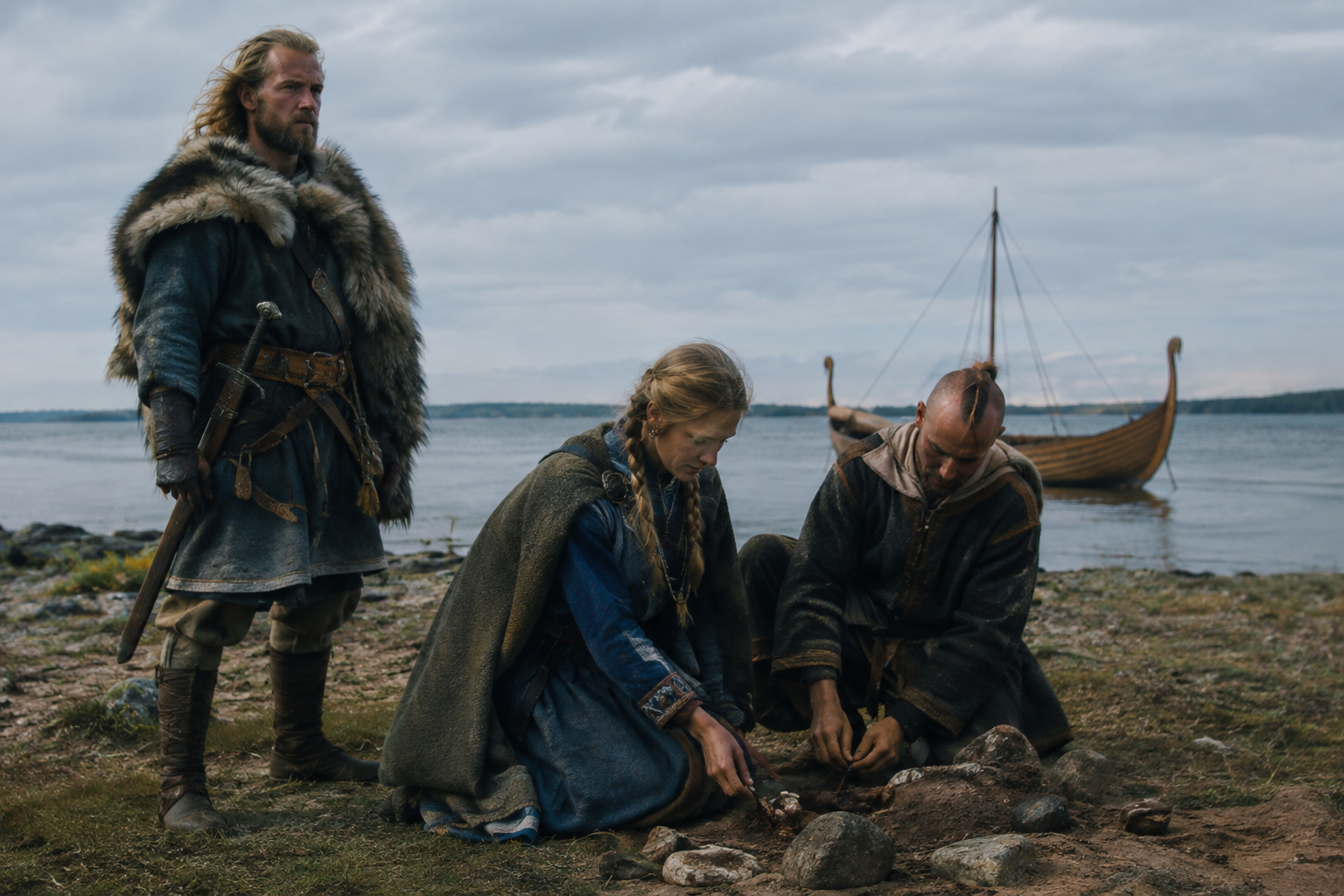
At Salme on the island of Saaremaa, archaeologists uncovered one of the most striking Viking Age finds in the Baltic: boat burials containing men who died far from home in the early 8th century. Among them was sample VK495, dated to about AD 725 and associated with the Vendel Age horizon. For anyone carrying Y-DNA haplogroup I1a1b1a4b, that matters because it places this paternal line in a real and dramatic historical setting: the eastern Baltic world just before the classic Viking Age had fully begun.
The second ancient clue comes from inland Sweden, at Skara Varnhem, where sample VK407, dated to about AD 1050, belongs to a very different moment. Here we are no longer in the age of raiding expeditions and armed mobility, but in a Scandinavia becoming more settled, more Christian, and more deeply integrated into medieval Europe. Taken together, these two finds suggest that the branch I1a1b1a4b sits within a recognizably Scandinavian paternal story spanning both the late pre-Viking and late Viking worlds.
I1a1b1a4b is a narrow branch within the wider Y-DNA haplogroup I1, a lineage long associated with northern Europe, especially Scandinavia. Y-DNA follows one direct paternal line only: father to son, back through time. That makes it powerful for tracing one ancestral thread, but not for reducing a whole person, or a whole population, to a single label.
With ancient DNA, the key point is scale. The broader haplogroup I1 has a long and complicated history in northern Europe, but the article's branch, I1a1b1a4b, is much more specific. The two samples here do not let us write a grand origin myth for the subclade. What they do offer is something more useful: securely placed sightings of this paternal line in Scandinavian and Baltic-connected contexts across several centuries.
An ancient DNA study of Viking Age populations, available as research on Scandinavian and Viking-era genomes, helped make precisely this kind of comparison possible by linking burials, chronology, and paternal lineages across the North.
The Salme burials have attracted so much attention because they show organized seaborne activity in the eastern Baltic before the conventional start date of the Viking Age. Sample VK495 comes from this setting on Saaremaa, an island in present-day Estonia that lay on important maritime routes between Scandinavia and the eastern Baltic coast.
That geographical position is half the story. Saaremaa was not a remote edge of nowhere; it was part of a connected sea-world in which travel, exchange, conflict, and opportunistic warfare could all happen. A paternal lineage such as I1a1b1a4b appearing here fits neatly with that northern maritime zone, where men from Scandinavia could end up buried far from their place of birth.
We should be careful, though, about overstating one grave. VK495 does not prove that everyone at Salme shared the same paternal ancestry, nor does it define the ethnicity of every man in the boats. What it does show is that this branch was present among men involved in the kind of Baltic movement and violence that would soon become one of the best-known features of the Viking Age.
Sample VK407, from Skara Varnhem in Sweden and dated to about AD 1050, belongs to a different historical landscape. By the 11th century, Swedish society was changing rapidly. Christianity was taking firmer hold, older regional power structures were being reshaped, and burial customs across Scandinavia were shifting with them.
Varnhem itself is one of those places where medieval Sweden comes into sharper focus because archaeology and history begin to overlap more densely. A lineage like I1a1b1a4b turning up here does not merely repeat the Baltic evidence from Salme; it places the same paternal branch in the more settled heartland of late Viking and early medieval Sweden.
That contrast is worth dwelling on. At Salme, the setting is outward-facing, mobile, and martial. At Skara Varnhem, the setting belongs to the world of local communities, church influence, and the new social order of Christian Scandinavia. The same Y-line therefore appears not in a single dramatic moment, but across distinct Scandinavian environments.
Two samples are not a dynasty, but they are enough to suggest a pattern. Both known ancient examples linked here to I1a1b1a4b come from the Scandinavian sphere, broadly understood: one from Sweden itself, one from the Baltic arena where Scandinavian voyagers were active. That is a much tighter and more historically coherent pattern than a random scatter across unrelated regions.
It also highlights something important about Viking Age genetics. The Viking world was not simply "Norway, Denmark, and Sweden" in neat modern national boxes. It was a network stretching across islands, coasts, rivers, and trading or raiding corridors. Saaremaa and Varnhem belong to different edges of that network, but both are unmistakably part of it.
This makes I1a1b1a4b especially interesting for members of the MyTrueAncestry community whose paternal matches cluster in Scandinavia, the Baltic rim, or North Sea migration zones. The ancient evidence does not promise a direct link to a named Viking or medieval household, but it does place the branch inside a plausible historical world of Swedish and Baltic interaction.
The dates matter here. VK495 belongs to the Vendel Age, the period just before the classic Viking centuries. VK407 belongs to the very end of the Viking Age, around the middle of the 11th century. That gives I1a1b1a4b a useful chronological spread of more than three centuries.
Seen historically, this is exactly the period when Scandinavian societies were expanding their contacts, crossing the Baltic more intensively, and then transforming internally through kingship, Christianity, and new forms of political authority. A paternal line present at both ends of that arc was part of Scandinavia's population through change rather than tied to a single episode.
That is often the most revealing thing about ancient Y-DNA. Not every lineage is famous because it belongs to a king. Some are important because they stay visible through transition: from ship-borne conflict to churchyard society, from regional warrior culture to medieval kingdom. I1a1b1a4b, on current evidence, looks very much like one of those northern survivor lines.
For now, the best-supported picture of I1a1b1a4b is modest but quite solid. This is a paternal branch found in two ancient men from the Scandinavian world: VK495 in the Baltic-facing Vendel Age context of Salme, and VK407 in late Viking Age Sweden at Skara Varnhem. That combination points toward a northern European, specifically Scandinavian-connected, historical setting rather than a vague pan-European one.
If this is your Y-DNA line, the ancient evidence suggests that one branch of your direct paternal ancestry belonged to the same broad world that linked Swedish heartlands to Baltic seaways in the centuries around the Viking Age. It is not a claim to fame, and it is not a full family tree. But it is a real, archaeological foothold: a father-line seen both in the outward thrust of early Scandinavian expansion and in the settled societies that followed.






Comments