Haplogroup I(xI1)

– 5 min read


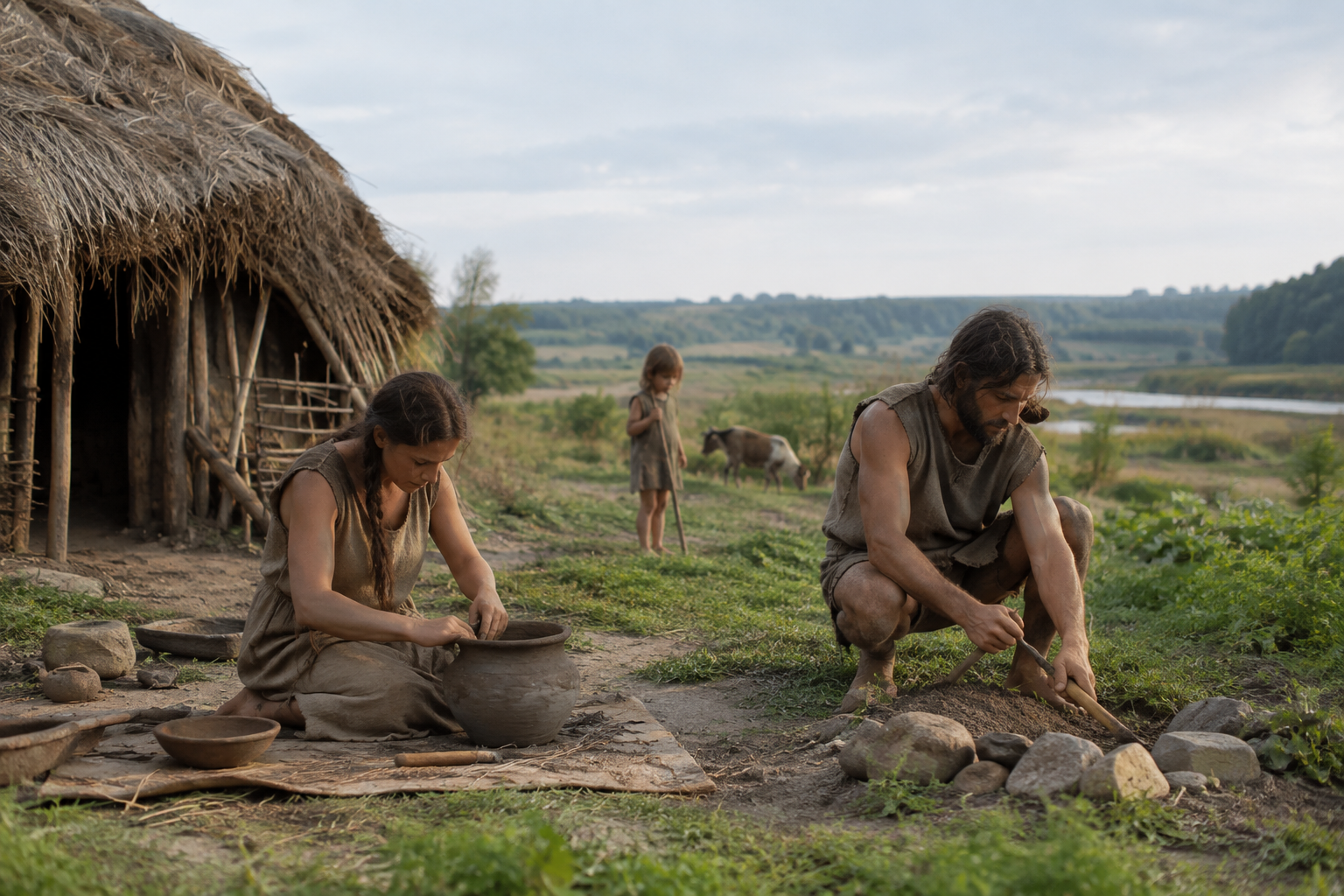
At Bottendorf in Thuringia, one early farming burial has become unexpectedly important for the history of a rare paternal label: sample BOT004, dated to around 5500 BC. He belongs to the first centuries of the Neolithic in central Germany, when farming communities were establishing themselves across landscapes that had long been occupied by hunter-gatherers. In this case, the Y-chromosome was reported not as a neat modern-style terminal twig, but more broadly as I(xI1) - in other words, a paternal line within haplogroup I, excluding I1.
That notation matters. It is not a single tight subclade with one simple historical route attached to it. Rather, it signals an older European paternal background that had not yet been pinned down to a narrower branch in the published result. For anyone who carries I(xI1) today, BOT004 is therefore interesting not because he can be turned into a mascot for an entire lineage, but because he shows that this broader paternal background was present among very early farmers in central Europe.
Bottendorf lies in a region that became part of the great Neolithic transformation of Europe: the spread of farming, livestock, pottery, and more permanent village life. By about 5500 BC, central Germany was no longer a frontier in the old sense. Communities cultivating crops and keeping animals were already reshaping daily life, settlement patterns, and diet.
BOT004 belongs to that world. Even with sparse sample-level detail, the combination of place, date, and Y-DNA assignment is enough to make him historically vivid. He was not a medieval nobleman with a written pedigree, nor an Iron Age war leader embalmed in legend. He was an early Neolithic man from inland Germany whose direct paternal line fell within an old European branch, I(xI1), at a time when the social landscape of Europe was being profoundly reworked.
A genetic study of ancient European populations published in Science Advances helped place such early individuals into the bigger story of how farmers and foragers interacted. The crucial point here is that the Neolithic was not genetically uniform. Farming spread with people, certainly, but local interactions and differing male-line histories also mattered.
Haplogroup I is one of the old Y-chromosome lineages of Europe, but I(xI1) is a deliberately cautious label. It means the paternal line sits somewhere within haplogroup I while excluding one better-known branch, I1. It does not automatically tell us that BOT004 belonged to one specific modern surname cluster, one later ethnic group, or one neatly defined migration.
This is where ancient DNA needs a cool head. Y-DNA traces one direct paternal line only: father to father to father. It can illuminate something very specific about male-line descent, but it is not the same thing as whole ancestry, language, or identity. A man buried in Neolithic Thuringia with I(xI1) was still part of a much larger community history that included maternal ancestry, neighbors, marriage networks, and local cultural change.
Even so, that broad classification is informative. In much of early Neolithic Europe, archaeogenetics has shown a striking mixture of continuity and replacement in paternal lines, depending on region and period. When a sample like BOT004 carries an I-lineage rather than a more typically discussed farmer-associated branch, it reminds us that the spread of agriculture did not erase all earlier male-line diversity.
Popular retellings of the Neolithic often flatten the evidence: farmers arrive, hunter-gatherers retreat, and the genetic story writes itself. Real burials are messier than that. Across Neolithic Europe, archaeologists and geneticists have repeatedly found that early farming societies could include individuals with different paternal histories, even when they shared the same broad material culture.
BOT004 sits neatly in that more complicated picture. His burial belongs to the era of Europe's first farming expansion, but his Y-line shows that such communities were not composed from one uniform paternal source. That does not mean he was personally a hunter-gatherer newcomer, nor that his community was somehow outside the Neolithic. It means that early farming populations could absorb, preserve, or carry forward a deeper range of male-line ancestry than older textbooks imagined.
This matters especially in central Germany, a zone that would remain important for millennia as a corridor of movement, exchange, and cultural reinvention. Later periods in the region would see repeated population shifts, but the Neolithic evidence already warns us against thinking in simple ethnic blocks. The first farmers were historical actors living through change, not tidy categories in a diagram.
Mesolithic-Neolithic transition
Thuringia is easy to overlook if one prefers the grander names of European archaeology, yet it sits in a strategically revealing part of the continent. Central Germany connects river routes, loess farming zones, and the north-south corridors along which ideas, crops, and people moved. A burial from Bottendorf therefore matters not because it stands alone, but because it occupies one of the key stages on which the Neolithic spread was worked out in practice.
By the sixth millennium BC, communities in this region were building a new social order around cultivation and settlement. Ancient DNA helps us see that these communities were not merely migrants dropped whole into an empty map. They were populations forming themselves on the ground, through encounters between incoming traditions and local demographic realities.
That is the real value of a classification like I(xI1) in BOT004. It opens a small but revealing window onto paternal diversity inside the Neolithic of central Europe. The early farmer world of Germany was not genetically featureless, and its male lines cannot be reduced to a single origin story.
Prehistoric Rhine-Meuse context
There is a temptation in genetic genealogy to value only the finest possible subclade. But archaeology often works with imperfect preservation, older datasets, and cautious reporting. A broad assignment is not a failure. In some cases, it is the most honest description of what the evidence can support.
For BOT004, the broad label is historically useful because it anchors I(xI1) in an early, securely prehistoric setting. It tells us that a branch within haplogroup I, outside I1, was present in Neolithic Thuringia at a very early date. That alone makes the sample more than a technical footnote. It places a living paternal lineage into the age when Europe's agricultural societies were still newly made.
It also serves as a warning against overconfident family myths. A modern man with I(xI1) may indeed have deep European paternal roots, but he cannot jump from that fact straight to one tribe, kingdom, or legendary founder. Ancient DNA is most powerful when it narrows possibilities without pretending to deliver a complete biography.
The distinctive thing about I(xI1) in this case is not royal glamour or a dramatic conquest tale. It is the quieter, older fact that this paternal background appears in BOT004, an early Neolithic man from Bottendorf in Thuringia around 5500 BC. For someone researching this lineage today, that is a reminder that one branch of the direct paternal line was already present in the mixed and changing world of Europe's first farmers.
That does not make every modern carrier a direct heir of Bottendorf in any simple sense. But it does place the lineage in a real archaeological landscape: central Europe, early agriculture, and a period when ancient male lines were being folded into new communities rather than neatly replaced by them.
Comments