Haplogroup H2c1a~

– 5 min read


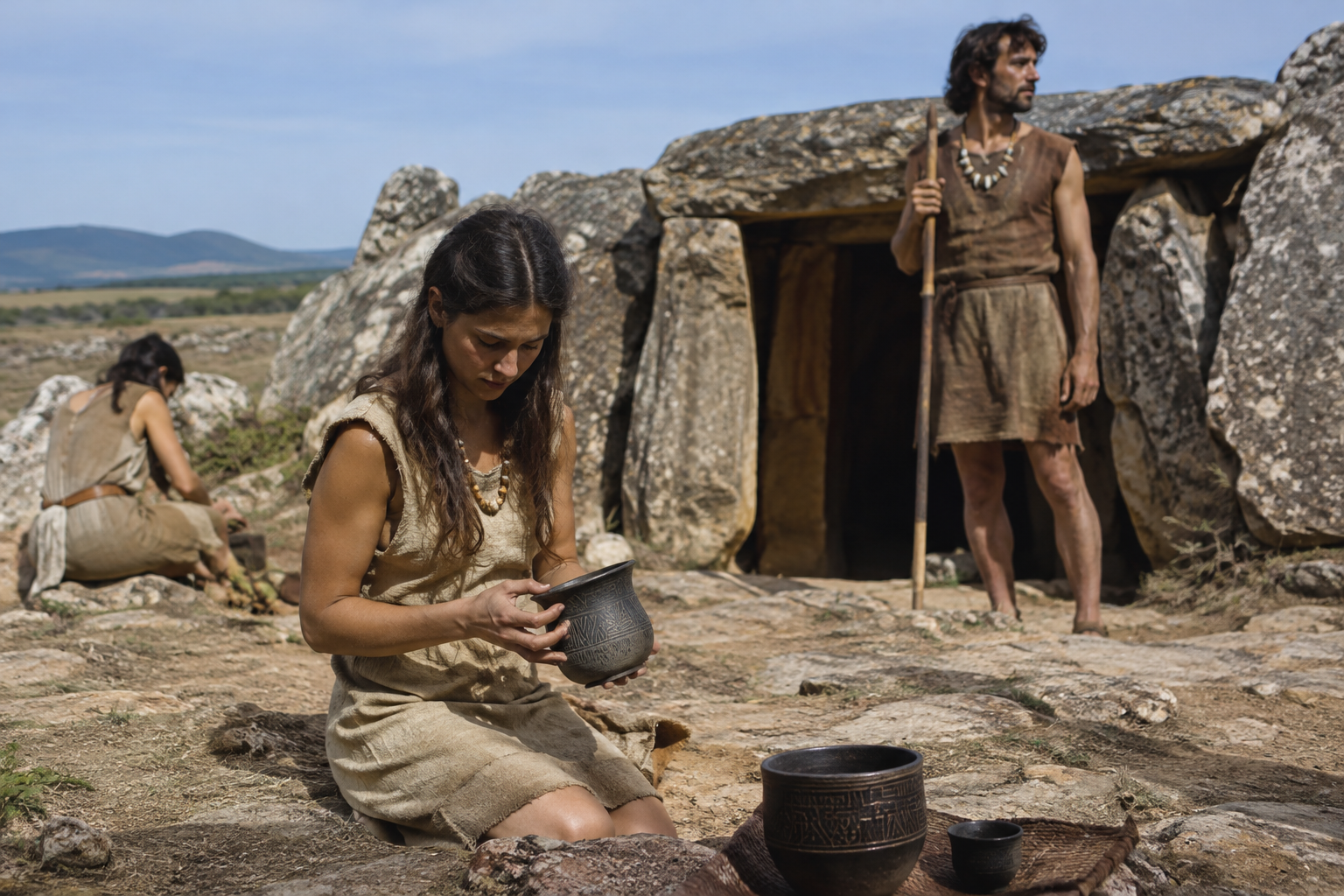
At Anghelu Ruju, near Alghero in northwestern Sardinia, archaeologists uncovered one of the island's most important prehistoric cemeteries: a cluster of rock-cut chamber tombs used and reused over long stretches of time. Among the ancient people recovered there is sample I15941, dated to around 2243 BC and classified as Bell Beaker. That single result is especially intriguing for anyone exploring the Y-DNA haplogroup H2c1a~, because it places this paternal line, or a lineage associated with it at that level of reporting, in a very specific Bronze Age Mediterranean setting.
That matters because H2, in broad terms, is one of the old West Eurasian Y-chromosome lineages often discussed in connection with early farming populations. But this article is not about all of H2. It is about the much narrower label H2c1a~, and the evidence here is modest but valuable: a prehistoric male from Bell Beaker-period Sardinia. Y-DNA follows one direct paternal line only, not a person's whole ancestry, yet even a single secure ancient placement can tell us something important about where a branch was present and in what archaeological world it appears.
Anghelu Ruju is not an ordinary burial ground. It is a large necropolis of domus de janas, the famous rock-cut tombs of Sardinian prehistory, and it remained significant across changing cultural phases. By the later third millennium BC, when Bell Beaker material culture was present on the island, these older funerary landscapes were still being used. Sample I15941 belongs to that long afterlife of the tombs.
What makes the find historically useful is the combination of date, place, and cultural setting. This is not a steppe barrow, not a central European cemetery, and not a later Roman or medieval burial. It is an island context in the western Mediterranean, in a period when Bell Beaker networks linked regions by exchange, movement, and shifting social practices. A man carrying H2c1a~, or reported close to that branch, turns up here in Sardinia rather than in the more stereotyped heartlands people often imagine when Bell Beaker is mentioned.
An ancient DNA study of Sardinia and nearby island populations, circulated as research on prehistoric and historic genetic change in the region, helped show just how informative these island burials can be. Even without forcing one sample into a grand migration saga, I15941 reminds us that the Bell Beaker world was not genetically uniform and that older male lines could persist within new archaeological horizons.
The phrase "Bell Beaker" can mislead if treated as though it were a single people marching across Europe with one shared ancestry. Archaeology has spent decades dismantling that sort of oversimplification. In some regions Bell Beaker appears alongside major population turnover; in others it looks more like the adoption of a package of objects, habits, and connections by communities with substantial local continuity.
Sardinia is one of the places where that distinction matters. The island already had a deep Neolithic and Copper Age history before Bell Beaker traits arrived. So when we find I15941 in this context, the most responsible reading is not that H2c1a~ was "the Bell Beaker haplogroup," still less that it defines Bell Beaker identity. Rather, it shows that a paternal line associated with H2c1a~ was part of the human mixture present in Bell Beaker-period Sardinia.
This fits a broader pattern in ancient DNA: cultural labels and paternal lineages do not map neatly onto one another. One archaeological culture can contain several Y-DNA lines, and one Y-DNA line can pass through very different cultures over centuries. That is precisely why I15941 is interesting. He anchors H2c1a~ in a real archaeological setting instead of an abstract tree diagram.
To understand why this Sardinian sample stands out, it helps to place H2c1a~ within the wider story of haplogroup H2. Broadly speaking, H2 has been recovered in ancient European contexts connected with early farming expansions from Southwest Asia into Europe. That does not mean every H2 branch shares the same local history, nor that every later H2 carrier simply represents unchanged Neolithic continuity. Branches split, populations move, and lineages survive unevenly.
Still, the older association is useful background. Sardinia has long been central to debates about how much early farmer ancestry endured on Mediterranean islands. A Bell Beaker-period male with H2c1a~ sits at an intriguing crossroads: later than the first Neolithic settlers, but still early enough to belong to a world before classical antiquity transformed the island's demography again. He may represent survival of an older paternal strand within a changing Bronze Age society, or a branch carried into Sardinia through movements already entangled with earlier farming populations. With only this sample, one should not pretend to know more than that.
The point, though, is a good archaeological one. H2c1a~ is not appearing here in isolation from history. It is appearing in a landscape shaped by centuries of settlement, seafaring, exchange, and reuse of ancestral burial places.
Readers sometimes assume that a single ancient man cannot tell us very much. In one sense, that is true: I15941 cannot stand for all Sardinians, all Bell Beaker communities, or all branches of H2. But ancient DNA works cumulatively. One well-placed sample can show that a lineage was present in a place, at a time, under a particular archaeological label. That is a small claim, but it is a solid one.
And solid claims are the ones worth keeping. For H2c1a~, the Sardinian evidence suggests a paternal line embedded in the western Mediterranean during the late third millennium BC. It also warns against a common temptation in genetic genealogy: treating rarity today as though it automatically implies mystery, isolation, or noble descent in the past. Often the past is more ordinary and more interesting at once. A lineage survives because real communities survived, adapted, intermarried, and buried their dead in places that archaeologists can still excavate.
It is worth lingering on Sardinia itself. The island is sometimes imagined as remote, but prehistory tells a different story. Sardinia was deeply connected to wider Mediterranean currents while also preserving local traditions with remarkable stubbornness. Tomb architecture, settlement history, and later Bronze Age developments all show that this was no cultural cul-de-sac.
That is exactly why Anghelu Ruju is such a useful setting for H2c1a~. A paternal lineage found there belongs to an island population that was both rooted and connected. In that sense, I15941 is a better historical witness than a bare haplogroup frequency table. He belongs to a place with a biography: old tombs, reused graves, and a community living in the overlap between inherited local worlds and broader Bell Beaker-era contacts.
For someone researching the Y-DNA haplogroup H2c1a~, the best current ancient clue here is not a sweeping migration map but a man from Anghelu Ruju, sample I15941, living around 2243 BC in Bell Beaker-period Sardinia. That places this paternal branch, or a closely reported version of it, in a western Mediterranean funerary landscape with deep roots stretching back before the Bronze Age. The most distinctive insight is therefore one of continuity amid change: H2c1a~ appears in a community participating in wider Beaker-era connections without losing the island's older archaeological character.
Comments