Haplogroup G2a2b2a1a2

– 5 min read


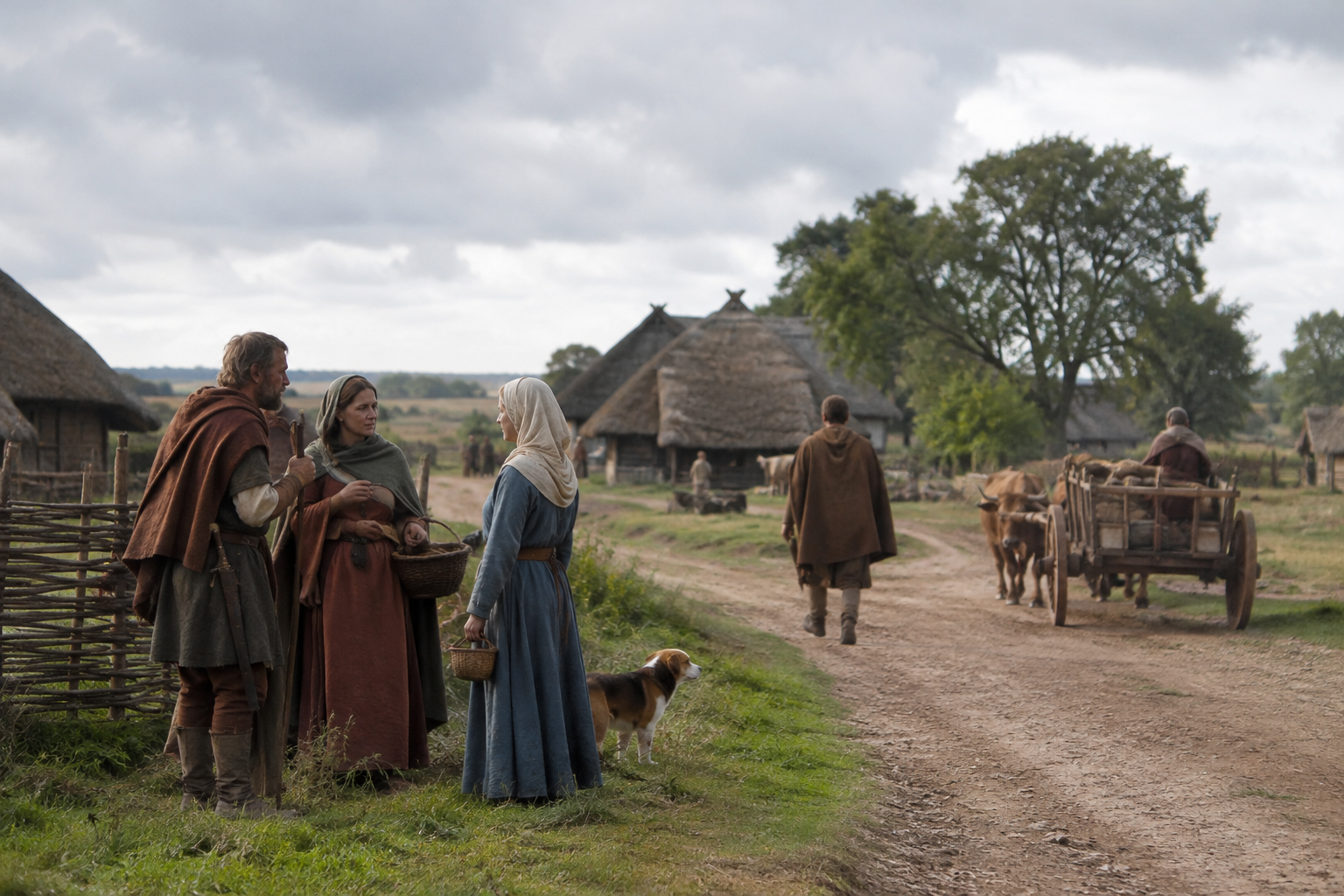
At Gamlingay in Cambridgeshire, one ancient man brings an unexpectedly deep paternal story into Middle Saxon England. The sample GAM034, dated to around AD 825 from Station Road, belongs in the world of later Anglo-Saxon villages, fields, churches, and local lordship. Yet the Y-DNA branch associated here, G2a2b2a1a2, is not the lineage most people instinctively expect when they think of early medieval England.
That is precisely what makes this find interesting. A single Y-chromosome line does not define a person's whole ancestry, language, or identity, but it can preserve one very old paternal thread. In GAM034, that thread appears inside a Middle Saxon setting, reminding us that England's early medieval population was never made from one neatly bounded "Anglo-Saxon" biological type. Research on ancient genomes from Britain has repeatedly shown a more mixed and locally varied picture, and this Cambridgeshire individual sits comfortably inside that larger historical reality.
Gamlingay lies in a part of eastern England that was deeply involved in the transformations of the early Middle Ages. By the ninth century, this was a countryside shaped by long-settled farming communities, regional power, and Christian institutions. The importance of a sample like GAM034 is not that he represents all of Cambridgeshire, still less all of Anglo-Saxon England, but that he captures one real paternal line present in that landscape at a specific time.
Middle Saxon burials and settlements in eastern England often sit at the meeting point of continuity and change. Some lineages in these cemeteries likely had deep roots in Britain; others may descend from migrants or from families already mixed over generations. A haplogroup such as G2a2b2a1a2 in this context is a useful warning against overly simple stories in which early medieval eastern England is imagined as genetically uniform.
An ancient DNA study of early medieval and later British populations, linked through the Gamlingay project record at https://www.ebi.ac.uk/ena/browser/view/PRJEB97400, forms part of the wider research background for placing such individuals into that complicated regional picture. What matters most here is caution: the presence of GAM034 shows that this paternal branch existed in Middle Saxon Cambridgeshire, not that everyone nearby shared it or that one straight migration route can be drawn from it.
Roman and Early Medieval Britain DNA
The wider haplogroup G is one of the old and important paternal lineages of western Eurasia. In prehistoric Europe, branches of G are especially well known from early farming populations, where they appear again and again in Neolithic contexts. But that broad fact must be handled carefully. It does not mean that every later man with a G-lineage is a simple stand-in for "the first farmers," nor does it tell us exactly when the narrower branch G2a2b2a1a2 reached Britain.
What can responsibly be said is that G2a2b2a1a2 belongs to a paternal family tree with deep roots in European and Near Eastern prehistory, and that branches of G survived through many later population turnovers. The Bronze Age, Iron Age, Roman period, and early medieval centuries did not erase earlier paternal lines completely. Instead, they reshuffled them, sometimes reducing once-common branches to scattered survivals, sometimes preserving them in quite ordinary local communities.
That is one reason a Middle Saxon English example matters. GAM034 is not interesting because he is exotic, but because he shows how ancient paternal diversity could persist inside a thoroughly early medieval English setting.
Cambridgeshire is a particularly good county for this sort of question because it sits in a region central to debates about migration into post-Roman Britain. Eastern England has often been treated as the classic zone of continental North Sea influence. That broad picture is real enough, but once we zoom in to actual graves and genomes, we find variety rather than a single replacement event.
In practical terms, GAM034 tells us that by around AD 825, a man carrying G2a2b2a1a2 was part of that society. His paternal line may have been present in Britain long before the Anglo-Saxon period, or it may have arrived through some later movement within Roman, post-Roman, or early medieval networks. The present evidence does not let us choose confidently between those possibilities. But the very range of plausible histories is itself revealing: England was connected to many older layers of European population history at once.
This is also a useful corrective to popular assumptions that unusual Y-lines in medieval England must always signal elite outsiders, mercenaries, or dramatic one-off arrivals. Sometimes the truth is more historically interesting. A lineage can simply persist, quietly, through centuries of social change.
There is an old temptation, in both popular history and amateur genetics, to imagine that a period label and a Y-haplogroup ought to line up neatly. Anglo-Saxon equals one set of male lines; Viking equals another; Norman another again. Archaeology has never really supported that sort of tidiness, and ancient DNA supports it even less.
The people living in early medieval England were formed by overlapping processes: survival of earlier British populations, immigration from across the North Sea, marriage networks between groups, local mobility, ecclesiastical connections, and later Scandinavian disruption in some regions. By the time we reach the ninth century, many communities had already been mixed for generations. A man like GAM034 may have identified entirely within the social world of Christian Anglo-Saxon England while carrying a paternal branch whose deeper history stretched far beyond that label.
This is one of the strongest lessons of archaeogenetics. Cultural identity belongs to lived history; Y-DNA belongs to one narrow line of biological descent. They intersect, but they are not the same thing.
Haplogroup G is famous among ancient-DNA enthusiasts because it appears so often in Europe's early farming record. That fame can be misleading. What survives into later historical periods is not a frozen relic of the Neolithic but the result of thousands of years of demographic change. Some G branches dwindled, some moved, some mixed into new populations, and some reappear in places where a casual observer might not expect them.
Seen in that light, GAM034 is part of a much larger European pattern: old paternal lines surviving inside later societies that had very different languages, institutions, and identities from the people who first carried their distant ancestral branches. If your own Y-DNA falls under G2a2b2a1a2, that does not make you "Neolithic" in any simple sense. It does, however, place your direct paternal line in one of the most historically durable families of western Eurasia.
That endurance is rather striking. Kingdoms rise, burial customs change, migrations alter the genetic balance of whole regions, and yet a direct male line can continue from father to son until it surfaces in a grave like GAM034's in Cambridgeshire.
For G2a2b2a1a2, the clearest ancient anchor here is a man from Middle Saxon Gamlingay, sample GAM034, living in eastern England around AD 825. That does not provide a ready-made family tree, but it does show this paternal branch documented in a real early medieval English community. The larger historical significance is simple and valuable: even in a region closely associated with Anglo-Saxon settlement, paternal history remained more diverse than stereotypes allow.
If you belong to G2a2b2a1a2, your direct male line may connect to one of those long-lived European threads that endured from deep prehistory into the documented societies of medieval Britain. That is not a claim of noble descent or a single migration legend. It is, in many ways, better than that: a glimpse of real continuity carried through ordinary human lives.
Comments