Haplogroup G2a2b2a1a1b1a1a2a1a3b
– 5 min read


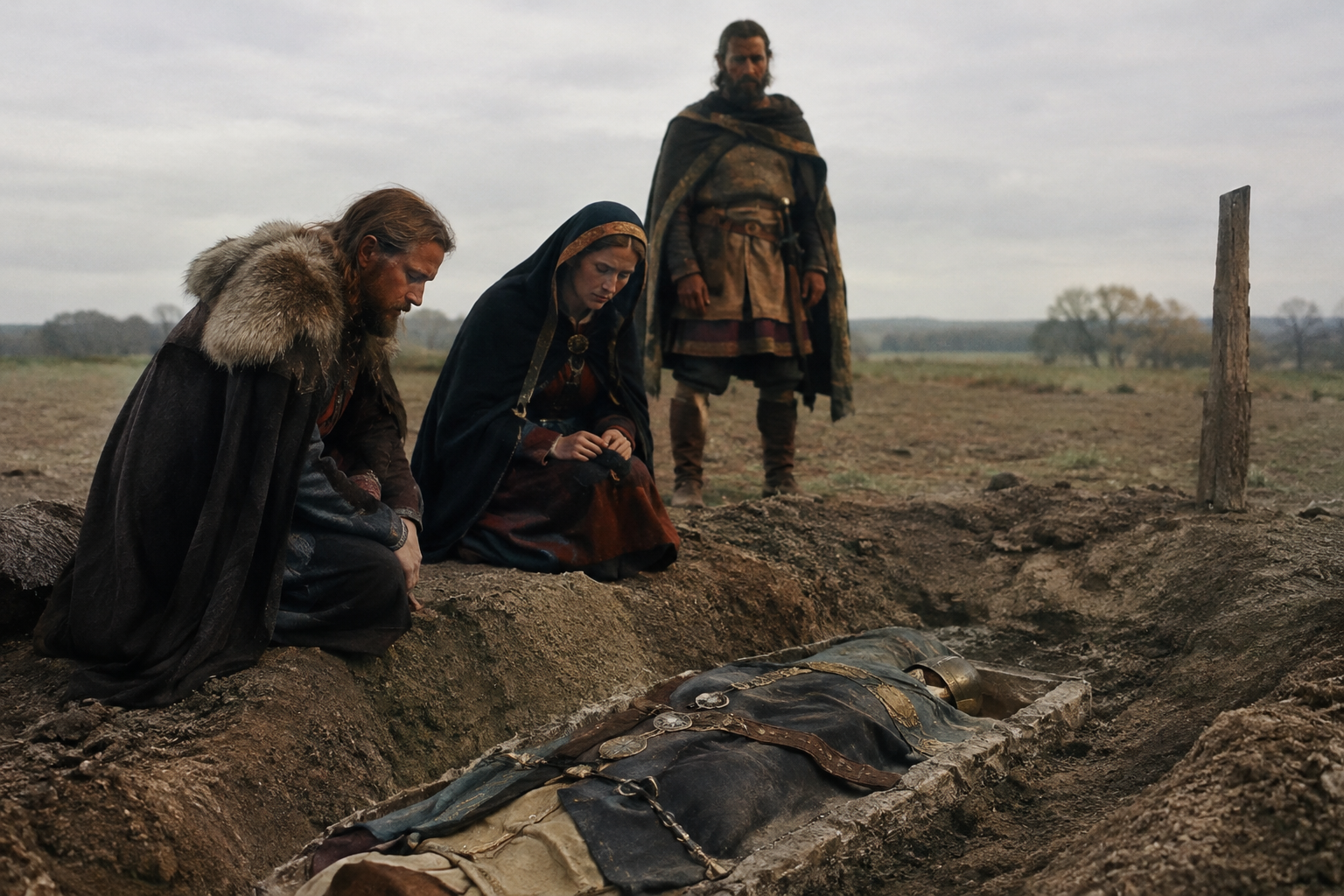
In a Merovingian grave at Alt-Inden in North Rhine-Westphalia, dated to around AD 600, one excavated man has been associated with the very specific Y-DNA line G2a2b2a1a1b1a1a2a1a3b. He appears in the ancient record as IND001. That is already enough to make him interesting, because this is not the sort of paternal lineage people casually expect to encounter in an early medieval burial from the Rhineland.
The fascination here lies in the mismatch between easy historical labels and the more awkward realities of ancestry. Alt-Inden belongs to the Merovingian world, a landscape of Frankish power, post-Roman frontiers, Christianization, and mixed communities. Yet a Y chromosome does not tell us that a man was "Frankish" in any simple ethnic sense. It traces one direct paternal line only. In IND001, that paternal line reminds us that early medieval western Europe was full of inherited strands far older, and often less tidy, than the political map.
Alt-Inden sits in a region that had long been shaped by Rome and by the transformations that followed Rome's retreat. By AD 600, this was not an untouched "Germanic" zone in any pure sense, if indeed such a thing ever existed. It was a lived-in frontier and post-frontier, where local continuities, migration, military service, marriage, and changing rule had all left their mark.
That makes IND001 especially useful as a historical witness. He was buried in a Merovingian context in what is now western Germany, but his Y-DNA line belongs to a broader paternal family, haplogroup G, better known in deep European prehistory than in simplistic stories of early medieval identity. The point is not that IND001 was somehow a surviving Neolithic farmer in a museum case. The point is that paternal lines can persist for millennia while the cultures, languages, and states around them change completely.
An ancient DNA study on population change and mobility in this broader period of European history, published in PNAS, helped establish just how mixed and historically layered such communities could be. That wider lesson fits Alt-Inden well: graves from the Merovingian centuries often resist any attempt to turn archaeology into a neat ethnic label.
The full label G2a2b2a1a1b1a1a2a1a3b is a very narrow twig on a much larger paternal tree. The wider haplogroup G has a long history in western Eurasia and appears repeatedly in early farming contexts in Europe. But that does not mean every later man with a G lineage came from the same recent population, spoke the same language, or belonged to the same people. A branch this specific must be treated carefully.
For family historians, this is one of the useful disciplines of ancient DNA. A match to such a lineage does not hand you a ready-made ethnic identity card. What it can do is place your direct paternal line within a historical pattern: one in which some male lines survived enormous cultural change, passing through the Neolithic, Bronze Age, Iron Age, Roman centuries, and into the early medieval world.
That endurance is especially striking in regions like the Rhineland. Here, paternal continuity can sit side by side with major shifts in language, law, burial customs, and political authority. The Merovingian cemetery gives us the historical moment; the haplogroup hints at the much deeper timescale behind it.
It matters because early medieval Europe is often narrated as though one migrating group simply replaced another, carrying a clean package of ancestry, language, and identity. The genetic evidence has been steadily dismantling that picture. Communities could adopt new material culture, join new kingdoms, and speak new languages without every paternal line being newly arrived.
In that sense, IND001 is historically valuable precisely because he is ordinary in context and unusual in paternal detail. He was part of a Merovingian burial landscape in North Rhine-Westphalia, not an obvious outsider marked by some dramatic archaeological exception in the information we have. Yet his Y-DNA line shows that the male ancestry present in these cemeteries could be diverse, and that diversity need not advertise itself clearly in the grave record.
There is also a useful caution here. One sample does not stand for an entire cemetery, still less for all Merovingian men. But a single well-placed individual can still expose the poverty of crude labels. "Frankish," "Germanic," "Roman," and "local" were not genetic containers. They were historical categories operating in a world where ancestry had many layers.
Germanic Languages and Genomics
To understand why this lineage turns up here, it helps to remember how deep the region's history runs. Long before the Merovingians, the lower Rhine and nearby lands had seen repeated population movements and local persistence stretching back into prehistory. Farming spread through this broad zone in the Neolithic; later came Bell Beaker horizons, Bronze Age transformations, Iron Age societies, Roman military organization, and post-Roman realignment.
Each of those episodes could alter the genetic landscape without wiping it clean. That is why a haplogroup more familiar from older European strata can still appear in an early medieval burial. Human populations are not reset at every historical turning point. They accrete. They absorb newcomers, preserve older lines, and reorganize socially faster than they reorganize biologically.
This is also why the Rhineland is such a rewarding place for archaeogenetics. It sits at the meeting point of river corridors, imperial frontiers, and agricultural heartlands. Studies of the region repeatedly show that mobility and continuity were both real. Ancestry was not static, but neither was it endlessly replaced from scratch.
Merovingian graves are often pressed into service in modern arguments about origins, ethnicity, and migration. Archaeologists have become increasingly wary of that habit, and with good reason. Burial style can reflect status, religion, local custom, aspiration, or fashion. It does not translate neatly into a biological identity.
IND001's association with G2a2b2a1a1b1a1a2a1a3b is a fine example of why caution is sensible. If we met him only through a historical label, we might imagine a straightforward story about an early medieval Frank. If we met him only through his Y chromosome, we might be tempted into an equally simplistic tale about ancient farmers. In reality, he belonged to both a very immediate historical community and a much older paternal inheritance.
The best reading is not to choose one story over the other, but to hold them together. The cemetery tells us where and when he lived. The Y-DNA tells us that his direct male line had a deeper history than the kingdom under which he was buried. That combination is often where ancient DNA is most illuminating.
For someone exploring this haplogroup today, the strongest supported insight is not a glamorous royal connection or a single migration legend. It is something more historically substantial. G2a2b2a1a1b1a1a2a1a3b, as represented by IND001 at Alt-Inden around AD 600, points to the survival of an older paternal line inside the politically new world of the early medieval Rhineland. That is exactly the sort of result that makes archaeogenetics so useful: it shows how deep ancestry and lived history overlap without ever being the same thing.






Comments