Haplogroup G2a2b2a1a1b1a1a2a1a
– 5 min read


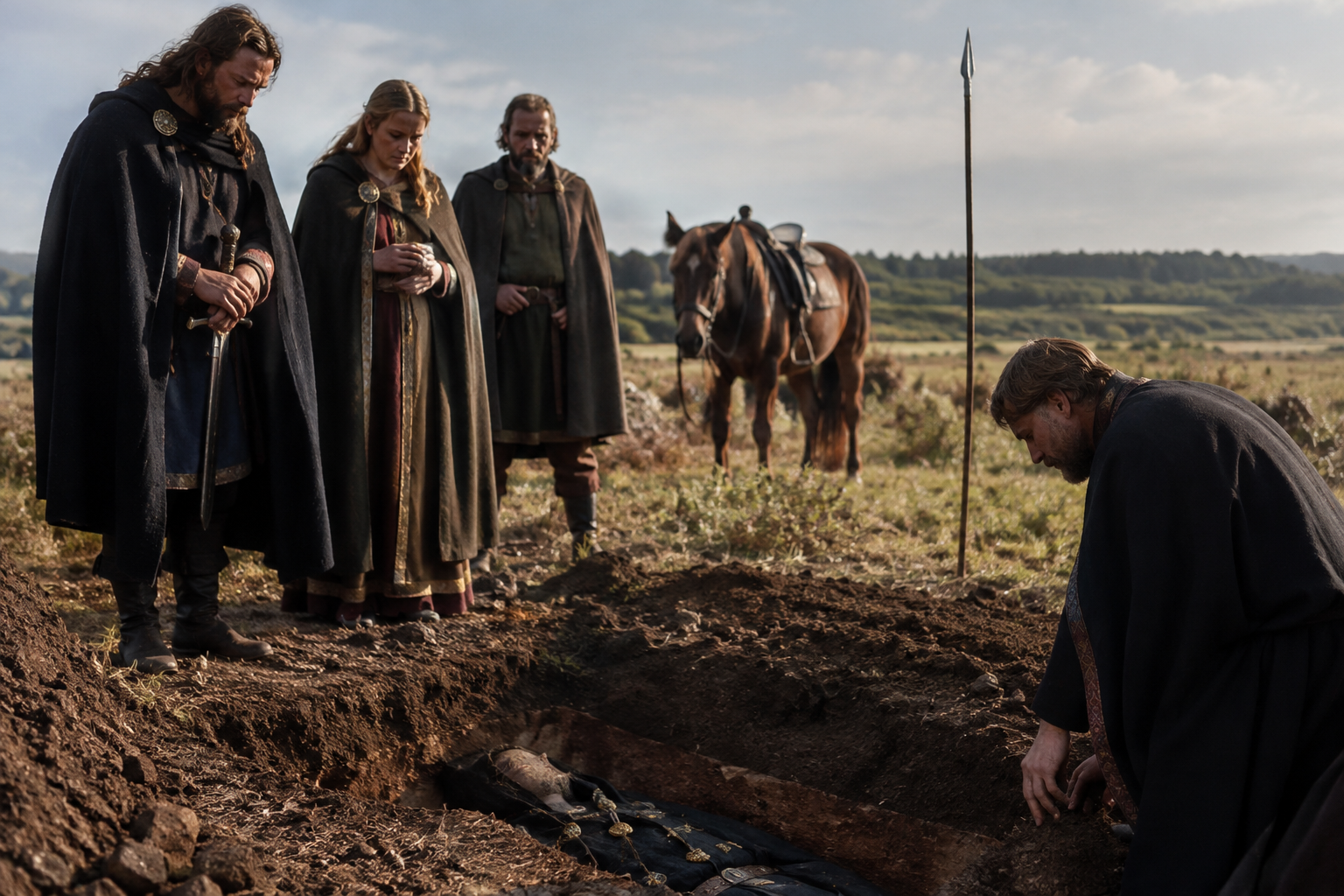
At Alt-Inden in North Rhine-Westphalia, one Merovingian-period grave has become unexpectedly useful for thinking about a very deep paternal line. The individual known as IND008, dated to around AD 600, was buried in a region that sat on one of early medieval Europe's busiest frontiers: a landscape shaped by the fading Roman world, Frankish power, and local communities whose histories were already many centuries old. For people exploring the Y-DNA haplogroup G2a2b2a1a1b1a1a2a1a, this grave matters because it places that paternal branch, or a reported association with it, in a firmly documented early medieval setting.
That is already intriguing. Haplogroup G is better known in European prehistory, especially among early farming populations, than in popular narratives about the Merovingian age, which tend to focus on "Germanic" migrations and royal politics. IND008 is a reminder that paternal lines do not obey neat textbook labels. A Y chromosome traces one direct male line only, not a person's whole ancestry, language, or identity, and yet that one line can preserve unexpectedly old strands of population history inside later societies.
Alt-Inden lies in the broader Lower Rhine zone, a region that had long been a contact area rather than a cultural island. By around AD 600, this was Frankish territory, but that simple statement conceals a much more complicated reality. The people buried here lived in a world built on Roman roads, older local settlement patterns, and the political structures of the Merovingian kingdoms.
Sample IND008 comes from that mixed frontier environment. With only one named ancient individual in view, caution is essential: one grave does not stand for all Merovingians, all Franks, or all men in the Rhineland. But a single securely placed burial can still be historically valuable, because it shows that a lineage associated with G2a2b2a1a1b1a1a2a1a was present in an early medieval community of western Germany rather than confined to some much earlier prehistoric horizon.
This matters especially in the Rhineland, where continuity and change were layered together. Roman imperial administration had gone, but populations did not simply vanish and get replaced wholesale. Research on the region's ancient people has repeatedly emphasized blended communities on the late and post-Roman frontier, where local ancestry, migration, military movement, and marriage networks all met one another in complicated ways.
The long string of letters and numbers can look forbidding, but its historical importance is quite straightforward. G2a2b2a1a1b1a1a2a1a is a very specific twig on the wider haplogroup G tree. The broader G family has deep roots in western Eurasia and is famous in ancient-DNA studies because branches of G2a appear again and again among early European farmers of the Neolithic.
What we should not do is lazily transfer that entire Neolithic story onto this exact terminal branch. The wider parent lineage has one history; this much narrower subclade has another, usually harder to reconstruct because it appears in fewer directly documented ancient males. In the case of IND008, the safest reading is not that he was a "Neolithic farmer surviving unchanged," but that an old paternal lineage still circulated within a much later early medieval population.
That survival is historically plausible. Male lines can persist through enormous shifts in language, material culture, political allegiance, and even broad genetic profile. A man buried in Merovingian Germany might carry a paternal lineage whose deeper ancestry connects to much older demographic events, while the rest of his family tree reflects centuries of mixing in Roman and post-Roman Europe.
When evidence is sparse, context becomes everything. IND008 is valuable not because he lets us tell a grand dynastic tale, but because he sits at the intersection of two stories that are often kept too far apart: the prehistoric spread of paternal lineages and the historically documented societies of the early Middle Ages.
Merovingian cemeteries across western and central Europe have shown again and again that these communities were not biologically uniform. Some burial grounds include people whose ancestry points largely to local continuities, while others show links extending across former Roman provinces and beyond. That broader lesson fits well with the appearance of a G-line male in North Rhine-Westphalia: early medieval populations were made from many older ingredients.
A useful comparison is the growing body of work on mixed and mobile communities in western Europe after Rome. Rather than imagining fixed "tribes" marching with single genetic signatures, archaeogenetics increasingly reveals local populations absorbing newcomers, newcomers marrying locals, and long-established lineages persisting beneath new political labels. For a reader with this haplogroup, IND008 is best understood in exactly that kind of world.
An ancient DNA study of European population change published in PNAS helped sharpen this wider picture by showing how shifts in ancestry and social identity can be more complex than traditional ethnic labels suggest. That does not make the paper a direct biography of IND008, but it supports the broader caution needed here: lineages, peoples, and archaeological cultures are not interchangeable categories.
Germanic languages and genomes
There is another reason the Alt-Inden context deserves attention. The Lower Rhine and neighboring regions were not only migration corridors; they were also places of stubborn continuity. Farms, villages, cemeteries, and routes of movement often endured through dramatic constitutional change, from Roman imperial rule to Frankish kingdoms.
In such a setting, an uncommon paternal lineage does not need an exotic explanation. It may represent the long survival of a family line already present in the region for centuries, or it may have arrived through movements that were themselves already ancient by AD 600. Both possibilities fit what we know of frontier societies, and neither should be turned into a confident single-route narrative without more data.
This is one of the most useful correctives offered by archaeogenetics. Popular history used to like clean replacements: Romans out, barbarians in; one people leaves, another arrives. The graves are messier than that, and therefore more interesting. A line such as G2a2b2a1a1b1a1a2a1a appearing in a Merovingian cemetery is precisely the sort of detail that pushes against overly tidy ethnic storytelling.
For the broader haplogroup G family, the great archaeological backdrop is the spread of farming into Europe. That does not mean every later G-line male is a direct social continuation of those first farmers, but it does explain why G branches often attract attention in ancient DNA. They are part of one of the major demographic transformations in European prehistory.
By the early medieval period, however, that old inheritance had been folded into entirely new societies. The man in grave IND008 would have lived in a Christianizing, post-Roman, politically Frankish world, not a Neolithic village. His Y-DNA could preserve one slender paternal thread reaching back into much older population history, while his daily life belonged to the realities of the 6th and 7th centuries.
That distinction is easy to miss but worth holding onto. Genetics can connect periods; it does not collapse them. The same paternal branch can move through very different archaeological worlds, from early farming horizons to frontier cemeteries of the Merovingian age, without carrying a single unchanged identity along with it.
Neolithic transition in Europe
The strongest thing this evidence tells us is modest but meaningful: a paternal line associated with G2a2b2a1a1b1a1a2a1a was present in the Merovingian-era Rhineland, in the person of IND008 from Alt-Inden around AD 600. That places this branch within a real early medieval community at a major European crossroads, and it hints at the long survival of older male-line ancestry inside later Frankish society. For someone researching this haplogroup today, that is the real value of the evidence: not a promise of a famous dynasty, but a glimpse of continuity through one of Europe's most transformative ages.






Comments