Haplogroup G2a2b1
– 6 min read


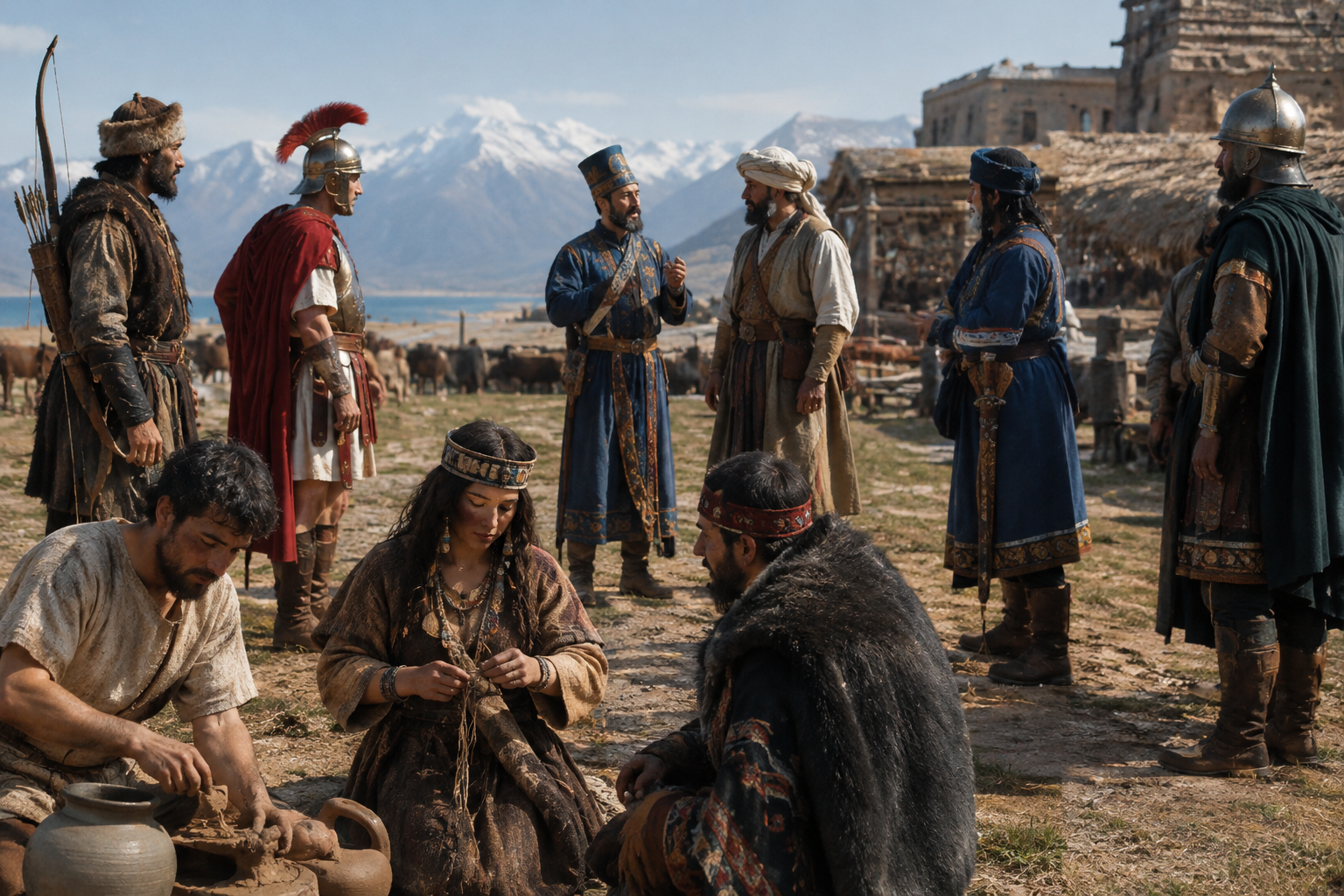
Haplogroup G2a2b1 is one of those paternal lineages that rewards a second look. It does not usually appear in popular accounts of sweeping conquests or famous royal dynasties, yet in ancient DNA it turns up in places that matter enormously for the history of Eurasia: early farming Anatolia, the Black Sea coast, eastern Anatolia, Byzantine military worlds, post-Roman Hungary, and even the far reaches of the Greco-Bactrian sphere in Central Asia. That is a remarkable spread, and it tells us something important. Some Y-DNA lineages are not the story of a single people. They are the story of movement, settlement, endurance, and adaptation over a very long time.
As always, Y-DNA traces only one narrow line of ancestry: the direct paternal line, passed from father to son. It does not describe a person's whole ancestry, culture, language, or identity. Even so, paternal haplogroups can be extraordinarily useful historical tools. In the case of G2a2b1, the evidence points us toward deep connections with the ancient Near East and especially with the worlds shaped by early agriculture. From there, the trail leads into later Bronze Age and medieval societies where older paternal lines still persisted, sometimes in quite unexpected places.
Within the wider Y-chromosome tree, haplogroup G belongs to an old West Eurasian branch with strong associations in ancient DNA studies to early farming populations, especially those linked to Anatolia and the spread of agriculture into Europe and neighboring regions. That does not mean every branch of G had the same history, and it would be careless to assign the full story of broad haplogroup G to the narrower subclade G2a2b1. But it is fair to say that G2a2b1 sits in a part of the tree that repeatedly appears in some of the earliest agricultural settings known from ancient DNA.
The supplied samples make that point vividly. One of the earliest is ART014 from Neolithic Anatolia Arslantepe, dated to 4568 BC. Another is IKI037 from Ikiztepe Black Sea Anatolia, dated to 3300 BC. These are not marginal places in prehistory. Anatolia was one of the key zones in which farming communities grew, interacted, and expanded. When a lineage such as G2a2b1 appears there in the Neolithic and Chalcolithic horizons, it places that paternal line in one of the great laboratories of early settled life.
Readers interested in that bigger archaeological setting may enjoy this broader look at how farming ancestry moved and changed across the continent.
Explore the Neolithic Expansion
Arslantepe in particular is a site with a formidable pedigree in archaeology: a mound of deep stratigraphy, elite buildings, and evidence for social complexity long before the classical world. Ikiztepe, on the Black Sea coast, reminds us that Anatolia was never one thing. Inland plateaus, mountain corridors, and coastal settlements all formed different pieces of a connected but varied human landscape. G2a2b1 in these contexts suggests persistence across different Anatolian zones rather than a lineage confined to one tiny pocket.
The later samples show why this haplogroup is historically so interesting. Consider I19612 from Bronze Age Eastern Anatolia Van, dated to 800 BC. By that point, we are far beyond the first farmers. Eastern Anatolia had become a crossroads of highland polities, imperial frontiers, trade, and military movement. A G2a2b1 lineage here hints at continuity through changing political orders, though continuity in a region does not mean the same local family surviving unchanged for millennia. Populations mix, reshape, and absorb newcomers. What the haplogroup shows is that this paternal branch remained part of that eastern Anatolian world.
Then there is NS3b, the Byzantine Roman Warrior, dated to 605 AD. That label alone pulls us into the late antique eastern Mediterranean: an empire under pressure, armies shuttling across provinces, and military men who might have been stationed far from their ancestral home. A G2a2b1 lineage in a Byzantine warrior does not prove anything simple about ethnicity, but it does underline how older paternal lines from Anatolia and neighboring regions could remain embedded within imperial institutions.
Even more striking is I12293 from Greco-Bactrian Tajikistan, dated to 50 BC. One should be cautious here. A single paternal lineage in Greco-Bactrian or post-Hellenistic Central Asia does not map neatly onto Greek identity, local identity, or any one migration event. But it does show how far west-to-east connections could extend. The Hellenistic and post-Hellenistic worlds opened corridors linking the eastern Mediterranean, Iran, and Central Asia. G2a2b1 appearing in that setting is a reminder that paternal lines can travel astonishing distances without carrying tidy historical labels with them.
For a wider look at ancient mobility around the Black Sea and adjacent zones, this related article is a useful companion.
The Hungarian samples are especially revealing because they sit in a landscape of upheaval. RKF255 from Migration Period Roman Hungary Rakoczifalva Szolnok, dated to 500 AD, and RKF258 from Migration Period Hungary Rakoczifalva, dated to 650 AD, belong to centuries when the Carpathian Basin saw successive waves of movement and political transformation after the Roman order weakened.
What is so useful about these two individuals is not that they let us pin G2a2b1 to one named people, but that they show the lineage present in a region famous for demographic change. The old temptation is to imagine the Migration Period as a chessboard of neat ethnic blocks. Ancient DNA has been steadily wrecking that picture. Communities in this era were often mixed, mobile, and locally rooted at the same time. A paternal branch with older Anatolian associations turning up in post-Roman Hungary is exactly the sort of finding that makes the period more interesting, not less.
If you want to dig further into that setting, this article on post-Roman Hungary is particularly relevant.
It also helps explain why haplogroups should never be used as ethnic shorthand. The same paternal lineage can appear in Neolithic farmers, Bronze Age highlanders, Byzantine military contexts, and Migration Period cemeteries. That is not confusion; it is history.
The latest sample in the set, I14647 from Medieval Era Southeast Anatolia Gaziantep, dated to 1200 AD, rounds off the story rather neatly. Southeast Anatolia in the medieval centuries was a region of fortresses, trade routes, competing dynasties, and overlapping religious and linguistic communities. To find G2a2b1 there is to see, again, the persistence of a paternal line in a region where we already met it thousands of years earlier in prehistoric Anatolia.
That does not mean a simple unbroken family chain from ART014 to I14647. No responsible genetic historian would claim such a thing from broad haplogroup evidence. But it does suggest that this branch was part of the durable human substrate of Anatolia and its borderlands, surviving the rise and fall of kingdoms, empires, and armies.
Usually this is the point where one turns from ancient skeletons to medieval families and their castles. But here we must be disciplined. The supplied field for associated noble families and castles is empty. So the honest thing to say is that, for this article, there is no family-or-castle dossier we can responsibly connect to G2a2b1.
That is not a failure. In fact, it illustrates a larger truth about archaeogenetics. Ancient DNA often tells us more securely about populations than about named medieval pedigrees. Castles preserve memory, heraldry preserves claims, and genealogies preserve lines of inheritance, but none of these automatically preserves a verified Y-chromosome. Without explicit evidence, it would be wrong to assign G2a2b1 to any noble house simply because the lineage appears in historically important regions.
For readers interested in how MyTrueAncestry handles documented historical families when evidence is available, this dynasty-focused article offers a useful contrast.
So what does haplogroup G2a2b1 reveal? First, that some paternal lines have very deep roots in the Near East and Anatolia, and can be followed across enormous stretches of time. Second, that these lines did not remain trapped in prehistory. They show up in imperial, frontier, and migration-era contexts that remind us how mobile Eurasian history really was. Third, that ancient DNA is often most powerful not when it confirms a legend, but when it complicates the map: a Byzantine warrior here, a man in Hungary there, an individual in Greco-Bactrian Tajikistan farther east than many would expect.
For anyone who carries G2a2b1 today, that does not prove descent from a warrior, a prince, or a named medieval house. What it does offer is something more solid and, in a way, more interesting: a place within a paternal history that reaches back into some of the oldest farming societies of western Eurasia and continues through the busy, mixed, often untidy worlds that followed.
If you have tested your DNA, MyTrueAncestry can help you explore whether your results show connections to ancient individuals and historical populations like those discussed here. These matches do not by themselves prove direct descent from any specific ancient person or noble lineage, but they can open a fascinating window onto your deeper past.
Comments