Haplogroup G2a2a1a2a1a1

– 5 min read



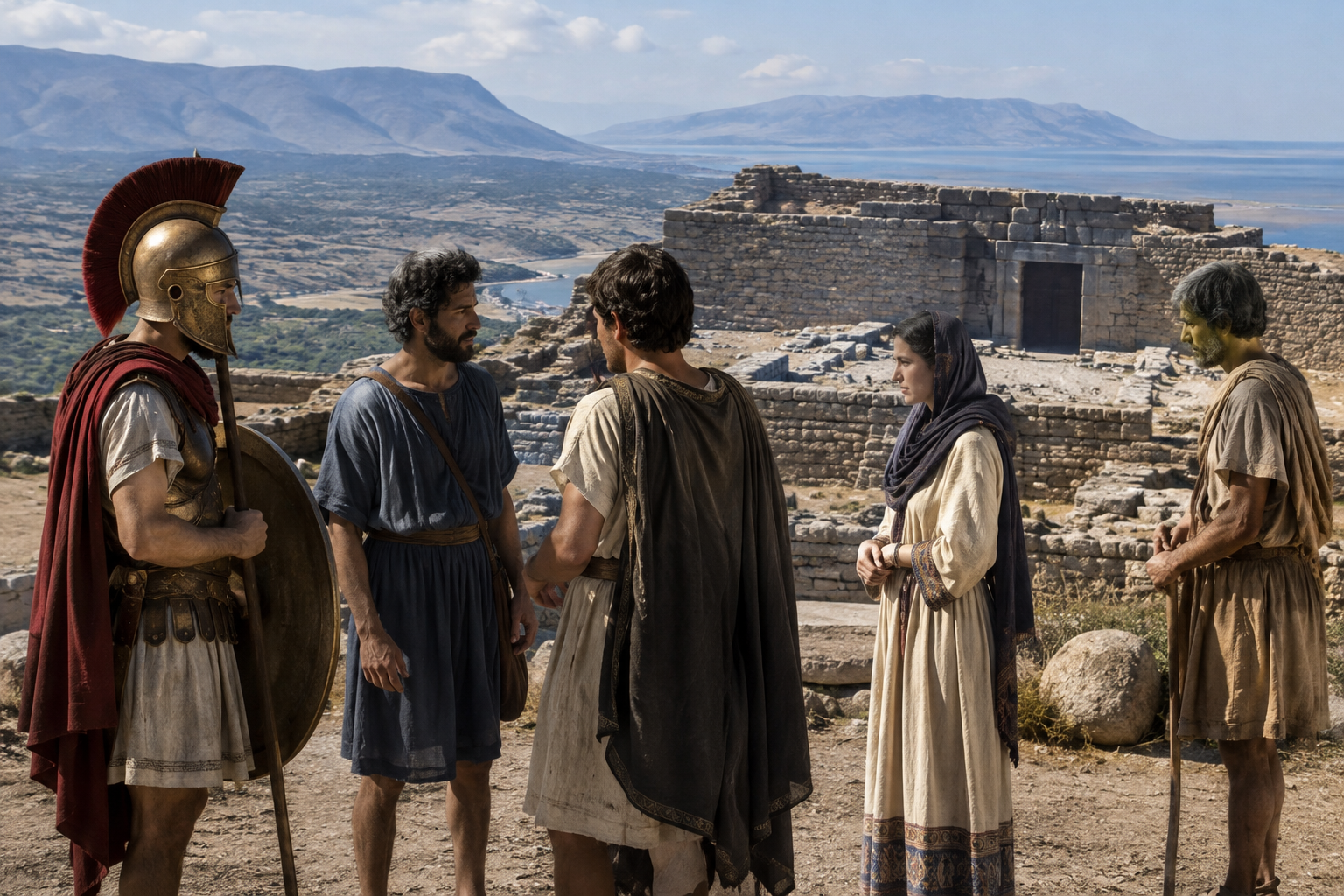
At the Mycenaean Palace of Nestor at Pylos, one ancient male sample, I13517_d, dated to about 1385 BC, places haplogroup G2a2a1a2a1a1 in one of the most famous centers of Late Bronze Age Greece. That matters because Pylos is not just any archaeological site. It is a palace world of scribes, storerooms, and regional power, known from Linear B tablets and from the wider history of Mycenaean society. Seeing this paternal line there anchors it, at least once, in the Aegean long before classical Greece or the Roman Empire.
That is also a useful reminder of what Y-DNA can and cannot do. It traces one direct paternal line only, not a whole ancestry or an ethnic label. Even so, when the same branch appears again in later Macedonia, Punic North Africa, and early medieval Croatia, it gives us something rather interesting: not a single conquering story, but a lineage that repeatedly turns up in connected Mediterranean and Balkan worlds.
The Pylos sample is the earliest point in this small cluster, and the most evocative. A man associated with the Palace of Nestor and carrying G2a2a1a2a1a1 places this lineage within the orbit of Mycenaean palace civilization. That does not mean the haplogroup was uniquely Mycenaean, still less that all Mycenaeans shared it. But it does show that this paternal branch was present in the Aegean during the high age of Bronze Age palace society.
For anyone interested in deep paternal history, that is a significant context. Haplogroup G, in its broader form, is often discussed in relation to early farming expansions into Europe, but this article's branch is far narrower than the parent lineage. We should therefore be careful. The evidence here does not license a grand claim about the full origin story of G2a2a1a2a1a1; it shows only that one attested carrier appears in Late Bronze Age southwestern Greece, in a politically central setting.
A wider ancient DNA study of the Aegean and surrounding regions helped establish how complex these Bronze Age populations were, mixing local continuity with broader eastern Mediterranean connections. For the broader prehistoric background, MyTrueAncestry readers may enjoy this related piece on the Aegean world.
A second important appearance comes from the Ancient Macedonian Kingdom: sample I10390 from Idomenae Marvinci-Valandovo, dated to around 410 BC. Chronologically, this is a very different world. The palaces of Bronze Age Pylos were long gone; the Greek mainland and Balkans were now part of the political landscape of classical city-states and the expanding Macedonian kingdom.
What makes I10390 valuable is not that it proves a direct line from Pylos to Macedonia. It does not. What it does show is that this paternal branch, or a reported association with it, appears again in the north Aegean-Balkan zone nearly a millennium later. That recurrence fits a region where movement, intermarriage, and political integration linked communities across the Aegean hinterland.
Ancient Macedonia is often flattened into legend because of later fame, but archaeologically it was a contact region as much as a kingdom: inland and coastal, Greek-speaking and multi-regional in its ties. A lineage found there in the 5th or early 4th century BC sits in precisely the kind of crossroads where paternal lines might persist, split, and reappear across centuries without leaving a simple documentary trail.
Readers interested in how genetics is illuminating ancient Macedonia more broadly can compare this with MyTrueAncestry's discussion of royal-era Macedonian burials.
Then the map shifts dramatically west and south. Sample I24196 comes from Carthaginian Tunisia, at Kerkouane, dated to about 550 BC. Kerkouane is one of the great Punic archaeological sites of North Africa, a town tied to the Carthaginian sphere and to the seaborne commercial networks of the central Mediterranean.
This is perhaps the most revealing sample in the set, because it warns us against imagining haplogroups as neatly confined to later national histories. A man associated with G2a2a1a2a1a1 in Punic Tunisia suggests that this paternal line participated, at least at some point, in the highly mixed human landscape of the Phoenician and Carthaginian world. That could reflect mobility across the Mediterranean, local continuity folded into Punic society, or both. The important thing is not to force a single route where the evidence gives us only presence.
Research on Punic populations has emphasized just this diversity: Carthaginian and Punic communities were not biologically uniform colonies stamped from one homeland, but complex societies drawing people from different shores of the Mediterranean. An ancient DNA study on Punic populations, published in Science, has been central to that wider reassessment.
If this setting interests you, there is a closely relevant MyTrueAncestry article on the mixed origins of Punic communities.
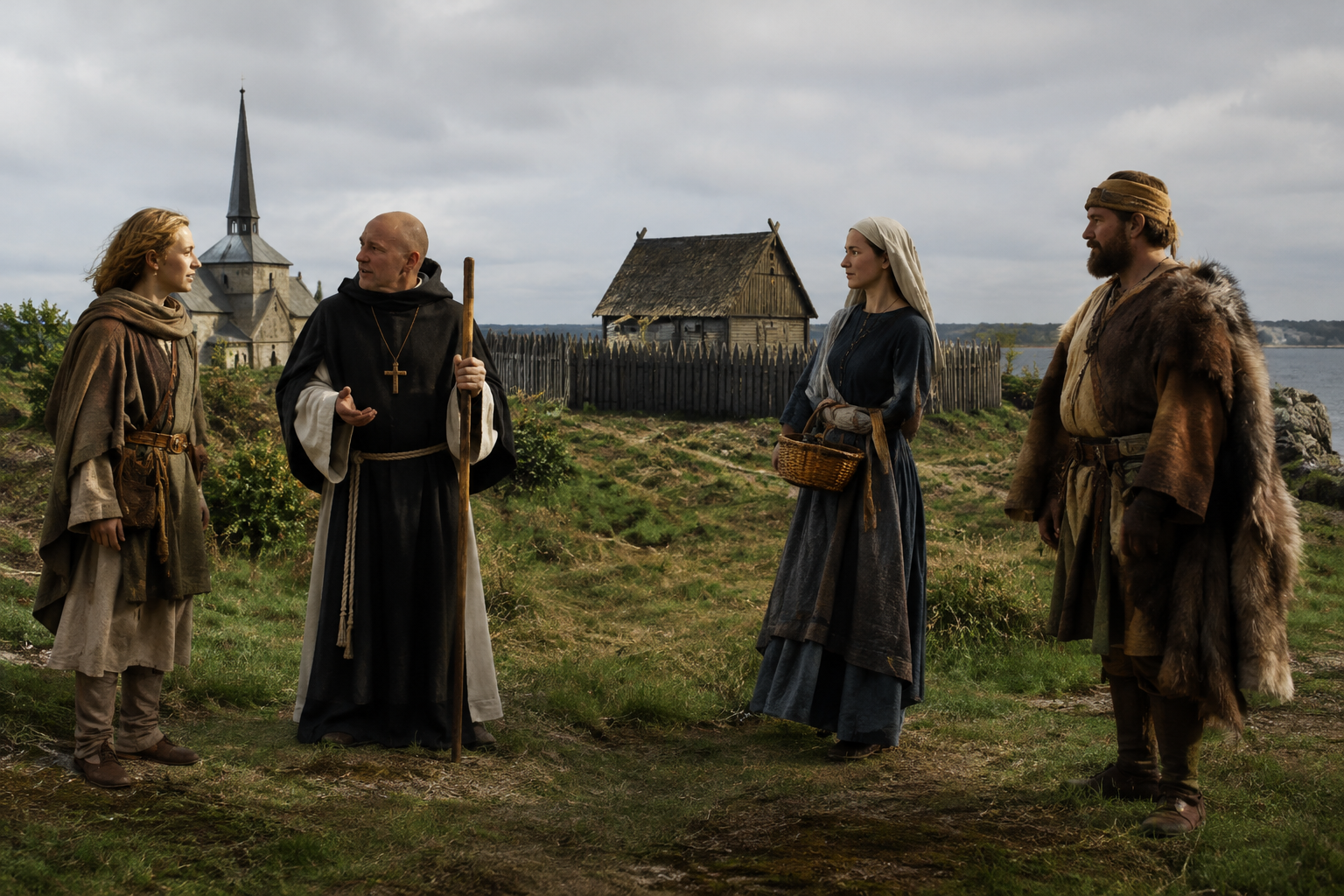
The latest evidence in this group comes from early medieval Croatia: sample I26767 from Sipar, dated around AD 700, and sample I26746 from Jagodnjak, dated around AD 850. These are especially useful because they show the lineage turning up again in the northern Adriatic and Pannonian-adjacent world after the end of Roman rule and during the reshaping of southeastern Europe in the early Middle Ages.
This was not a static landscape. Late antique provinces had fractured, new political formations were emerging, and the eastern Adriatic was tied to both inland Balkan populations and wider Mediterranean exchange. Finding the same article haplogroup in more than one early medieval Croatian context suggests that this paternal branch was part of those post-Roman populations, though not necessarily dominant within them.
What makes Croatia particularly interesting is that ancient DNA is beginning to show both long-term continuity and change in the region. Maternal lines can persist while paternal patterns shift; local ancestry can remain substantial even when historical labels change. That is why Y-DNA evidence needs to be read alongside archaeology and genome-wide data rather than turned into a simple story about one people replacing another. A broader regional genetic study, published in Nature, speaks directly to these long-term Croatian patterns.
There is also a useful MyTrueAncestry discussion of that Croatian evidence for readers wanting the larger regional frame.
Croatia's Shifting Paternal Lines
Put these finds together and a cautious picture emerges. G2a2a1a2a1a1 is not appearing here as the signature of one narrowly defined historical people. Instead, the attested samples place it in several linked but distinct settings: Mycenaean Greece, the Macedonian sphere, Punic North Africa, and early medieval Croatia.
That spread makes historical sense in one very particular way. These are all regions shaped by movement across the Mediterranean and Balkans: traders, settlers, soldiers, farmers, and families over many centuries. The branch may have persisted in some local communities while also traveling through wider networks of exchange and empire. What the evidence does not show is a neat uninterrupted chain from one named ancient individual to another.
For someone researching G2a2a1a2a1a1 today, the strongest supported insight is depth rather than exclusivity. This lineage is attested in the Aegean by the Late Bronze Age, reappears in the classical north Greek-Balkan world, is present in Punic Tunisia, and is still visible in early medieval Croatia. In other words, it belongs to an old and well-connected human landscape stretching across the Mediterranean and southeastern Europe.
That is a pleasingly archaeological result. Not a fantasy pedigree, not a single heroic migration, but a paternal line that turns up where history was busiest: palace Greece, maritime North Africa, and the changing Adriatic world of late antiquity and the early Middle Ages.
Comments