Haplogroup G2a2a1a
– 5 min read


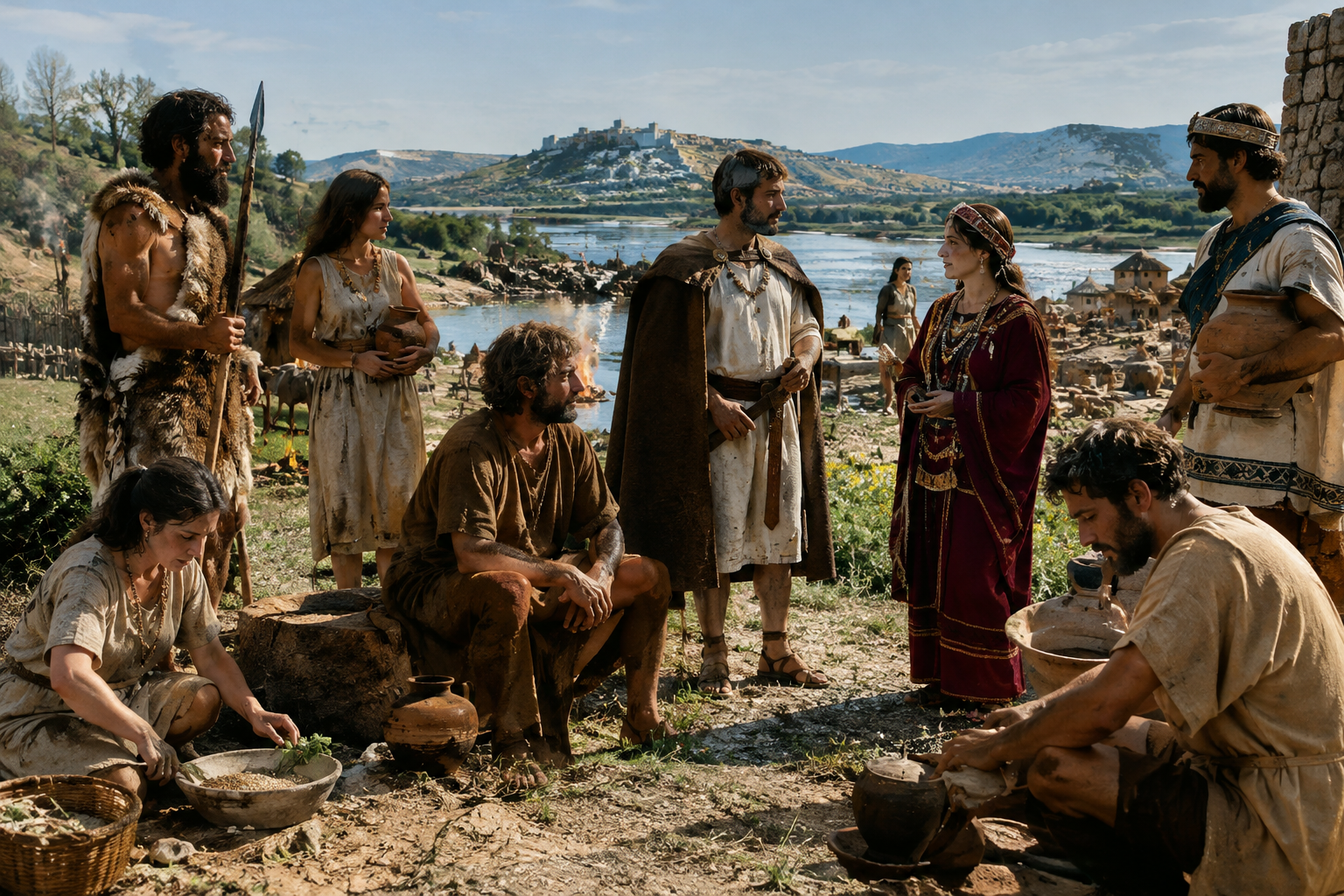
Some Y-chromosome haplogroups appear in history like a royal procession, loudly announced and easy to follow. G2a2a1a is not quite like that. Its story is older, quieter, and in some ways more interesting: it sits close to the deep paternal history of the first farming worlds of Europe and the eastern Mediterranean, turning up in graves that belong not to famous kings but to the men who lived through the great reshaping of prehistoric society.
That matters because Y-DNA traces a direct paternal line only: father to son to son across many generations. It does not describe a person's whole ancestry, culture, or identity. Still, when a lineage such as G2a2a1a appears in ancient DNA from Austria, Romania, Croatia, Iberia, Syria, and Punic Sardinia, it gives us a striking glimpse of how one paternal branch could move with early farmers, persist through local communities, and later surface in some of the most connected places of the ancient world.
Broadly speaking, G lineages are strongly associated in ancient DNA research with early agricultural populations spreading across parts of western Eurasia. For narrower branches such as G2a2a1a, caution is essential: we should not simply pour the entire history of haplogroup G into one small subclade. But the evidence supplied here does point in a clear direction. This branch appears repeatedly in Neolithic and Chalcolithic contexts in southeastern and central Europe, suggesting that it belonged to paternal lines present among some of the continent's early farming societies.
That makes G2a2a1a historically interesting for another reason. Much popular imagination about European prehistory jumps straight from Stonehenge to steppe horsemen. Yet between those worlds stood millennia of village life, local violence, mobility, exchange, and adaptation. A lineage like G2a2a1a seems to belong to that earlier chapter: the age of settlement, fields, stock-keeping, and expanding farming networks that linked the Balkans, the Carpathian Basin, central Europe, and beyond.
Readers interested in that broader context may enjoy this overview of early agricultural expansion in Europe:
Explore the Neolithic Expansion
The most vivid evidence for G2a2a1a comes from actual individuals. At Asparn Schletz in Austria, sample I27793, dated to 5000 BC, comes from the famous Neolithic massacre site. This is no serene textbook picture of the first farmers. Asparn Schletz shows that early farming Europe could also be brutal, with fortified settlements, conflict, and shattered communities. A G2a2a1a paternal line here belongs to that hard-edged reality.
Further south and east, the branch appears in prehistoric Romania more than once. I17835 from Carcea Viaduct, dated to 5750 BC, is especially early and places the lineage in a Chalcolithic Romania context very close to the formative farming zones of southeastern Europe. Then there is Urzi13 from Urziceni, dated to 4000 BC, showing that this paternal line was still present in the region long after the first arrival of agriculture. These are not isolated curiosities; together they suggest continuity, or at least repeated presence, in the lower Danube and Carpathian world.
Central Europe adds another layer. Sample I7192 from Makotrasy in central Bohemia, associated with Baalberge and dated to 3602 BC, places the lineage within the broad stream of later Neolithic and Copper Age societies north of the Danube. And I5077 from Osijek, Croatia, dated to 5070 BC, helps anchor the branch in the corridor between the Balkans and central Europe, one of the great routes through which farming populations moved and mixed.
If you want to dig deeper into that southeastern European background, this article is a useful companion:
What is particularly striking is that G2a2a1a does not vanish with the end of the Neolithic. It turns up far to the west in CLL001 from Cueva de las Lechuzas in Iberia, dated to 2200 BC. By this point we are in a Bronze Age world, and the appearance of the lineage in Iberia hints that paternal branches connected to earlier farming expansions could survive and travel across very large distances. That does not mean one simple migration story from the Balkans to Spain and nothing else. Prehistoric Europe was full of back-and-forth movement, local survival, and regional reshuffling. But Iberia shows that the lineage belonged to a genuinely wide western Eurasian network.
Then there is an eastern Mediterranean surprise: ETM018 from Ebla, Syria, dated to 2050 BC, described as a Middle Bronze Age Outlier. Outliers are often where the plot thickens. They remind us that ancient cities were magnets for merchants, migrants, soldiers, and marriage alliances. A G2a2a1a-linked paternal line at Ebla may reflect mobility into one of the great urban landscapes of Bronze Age Syria, though the exact route and context remain a matter for careful interpretation rather than confident storytelling.
By the Iron Age, the branch appears again in a highly connected maritime setting: MSR002 from Mount Sirai, Sardinia, dated to 675 BC, in a Phoenician/Punic context. This is fascinating because Punic communities were not genetically uniform colonial outposts. They drew in local islanders, settlers, and wider Mediterranean influences. The presence of this lineage there does not make it "Phoenician" in any exclusive sense; rather, it shows how an old paternal branch could become part of the mixed societies of the first-millennium Mediterranean.
For readers curious about that world of Sardinia and island mobility, this is well worth following up:
Discover Ancient Italian Islands
Put these finds together and a pattern begins to emerge. G2a2a1a looks like a paternal branch deeply at home in the Neolithic and Chalcolithic landscapes of southeastern and central Europe, with later appearances across the western Mediterranean and into the Near East. In other words, it belongs to the long history of movement that linked the first farming communities to later Bronze and Iron Age societies.
This is precisely where ancient DNA changes the conversation. Written sources for nobles, dynasties, and castles begin very late. Genetics lets us peer behind them into populations that left no chronicles at all. But it also imposes discipline. A shared haplogroup is not the same as a family tree. Two men separated by thousands of years can belong to the same broad paternal branch without being close genealogical relatives in any meaningful documentary sense.
That is why Y-DNA is best treated as historical context. It can show that a medieval or modern paternal line sits within a very old geographical pattern. It cannot, on its own, prove descent from any specific burial, chief, or noble house.
In this case, the supplied field for associated noble families and castles is empty, and that is actually a useful reminder of method. Not every haplogroup article should end with a parade of heraldry. Sometimes the evidence is strongest in prehistory, not in the age of towers and charters.
Even so, the absence of named noble houses here does not make the story smaller. Quite the opposite. It reminds us that the medieval world rested on much older demographic foundations. The lords of later centuries occupied landscapes first settled, cleared, defended, and worked by communities among whom paternal lineages like G2a2a1a were already present thousands of years before the first castle curtain wall was raised.
If you are interested in how genetics later intersects with documented aristocratic lineages, one of the clearest examples in the community archive is this piece on a ruling dynasty:
G2a2a1a is a fine example of what makes archaeogenetics so compelling. It takes us from a massacre site in Neolithic Austria to early communities in Romania and Croatia, to Copper Age Bohemia, to Bronze Age Iberia and Syria, and finally into Punic Sardinia. That is not a straight line and not a royal pedigree. It is better than that: it is a record of human presence across changing worlds.
For anyone who carries a G-lineage today, discoveries like I27793, I17835, Urzi13, I7192, I5077, CLL001, ETM018, and MSR002 offer historical perspective, not a certificate of descent. They show the kinds of places and populations in which related paternal branches once lived. They connect your direct male line to the archaeology of fields, frontiers, ports, and ancient towns.
If you want to see whether your DNA reveals links to ancient populations like these, MyTrueAncestry lets you compare your results with archaeological samples from across the ancient world. Those matches can offer remarkable clues about deep ancestry, even though they do not by themselves prove descent from a specific ancient person or noble family.






Comments