Haplogroup E1bPF2477

– 5 min read


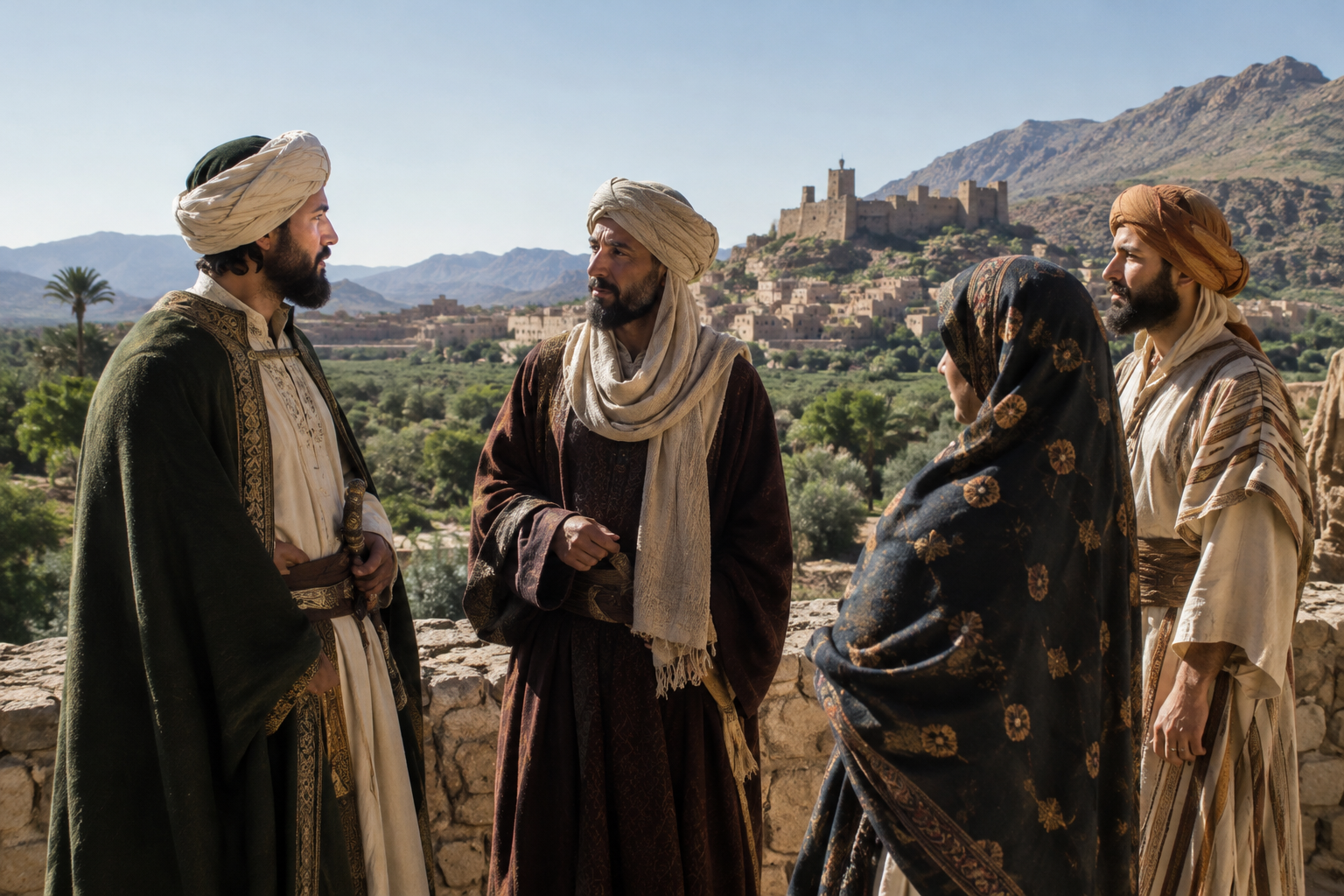
At La Vall d'Uixo, in eastern Spain, a cluster of burials dated to about AD 797 offers a small but unusually focused glimpse into paternal ancestry in the early Umayyad period. Four related sample labels from the site - GOG23a, GOG23b, GOG23c, and GOG23 - are associated here with the Y-DNA haplogroup E1bPF2477, placing this branch in a very specific archaeological setting: Islamic Spain in the late 8th century, when al-Andalus was still young and politically restless.
That matters because this is not a vague story about "Mediterranean ancestry" in general. It is a case in which one paternal line appears in a defined medieval community, in a region shaped by Roman legacies, Visigothic rule, and then the arrival of Islamic power from across the Strait of Gibraltar. Y-DNA traces one direct paternal line only, not a person's whole ancestry, but in a context like La Vall d'Uixo it can still tell us something sharp about male-line continuity, movement, and presence.
By the late 8th century, the Iberian Peninsula was no longer the Visigothic kingdom of earlier centuries. Much of it had come under Umayyad control, and eastern Iberia sat inside a wider political world linked to North Africa and, more distantly, the central Islamic lands. A burial cluster at La Vall d'Uixo therefore belongs to a society that was already multilingual, legally layered, and socially mixed.
The association of multiple individuals from this place and period with E1bPF2477 is intriguing precisely because it is repeated. A single result can always be a curiosity. Several related entries from one medieval Spanish site suggest that this paternal line was not an accidental outlier in the cemetery record, but part of the living male population in this corner of al-Andalus.
An ancient DNA study examining these burials is linked through research on the medieval population of Islamic Spain. Even without forcing details the present evidence does not securely provide, the core point is clear enough: E1bPF2477 appears in an Umayyad-era Iberian context, and that places the lineage inside one of medieval Europe's most connected frontier societies.
The important thing is to keep the scale of the claim sensible. E1bPF2477 is a specific branch within the broader E1b paternal family, a major lineage with deep roots outside any single medieval kingdom. But a narrow subclade should not simply inherit every grand statement ever made about its parent branch. The article's evidence is not telling us that all E1b history leads to La Vall d'Uixo. It is telling us that one defined offshoot of that wider paternal family was present there around AD 797.
Nor should we slide too quickly from genetics to identity labels. A man carrying E1bPF2477 in Umayyad Spain was not genetically "equal" to a language, a religion, or a legal status. He may have belonged to a local family long established in Iberia, to a family with more recent North African links, or to a community already formed by generations of mixture. Y-DNA alone cannot choose between those possibilities. What it does show is that this paternal branch had become part of the human landscape of early Islamic Iberia.
Eastern Iberia is a very good place to find this kind of evidence because its history is full of overlap rather than replacement. Roman rule had already brought mobility and settlement into the peninsula on a large scale. The post-Roman centuries added new regional power structures, and the Islamic conquest did not create a blank slate; it reshaped an old and densely peopled world.
That is why a medieval Y-lineage from this region should be read against long-term population complexity, not against simplistic invasion narratives. The paternal signature seen at La Vall d'Uixo may reflect connections across the western Mediterranean, but it sits in a land where people had been moving, mixing, converting, and adapting for centuries. One of the most useful lessons of Iberian archaeogenetics has been that political change and genetic change do not always move in lockstep.
That wider background makes a late 8th-century male lineage especially interesting. It belongs to the generation after conquest, not the moment of conquest itself. In historical terms, that is significant. We are no longer looking at the first shock of regime change, but at a society already settling into Umayyad rule, with communities beginning to reproduce themselves across generations inside al-Andalus.
The sample designations GOG23a, GOG23b, GOG23c, and GOG23 are best treated cautiously and concretely. They indicate a cluster of records tied to the same site and year attribution rather than four fully narrated biographies. It would be reckless to turn them into a clan, a dynasty, or a tightly proven father-to-son pedigree without explicit kinship results.
Yet repetition still matters. When the same site produces multiple entries associated with the same paternal branch, it strengthens the case that E1bPF2477 was genuinely embedded in that burial population. Archaeologically, that is more valuable than a lone spectacular find. It suggests an ordinary social reality: men carrying this line were living, dying, and being buried within the community represented at La Vall d'Uixo.
For readers interested in how Islamic-period Iberia could contain strikingly varied origins within a single regional setting, medieval cemetery studies elsewhere in Spain are useful comparanda. They repeatedly show that burial grounds can preserve evidence of local continuity alongside newcomers and descendants of newcomers, all within the same broad political order.
The western Mediterranean has long been a zone of circulation rather than a hard border. People crossed it in Roman times, in late antiquity, and throughout the medieval centuries. In that setting, a haplogroup such as E1bPF2477 appearing in Umayyad Spain is historically plausible without needing melodrama. The sea between Iberia and North Africa was a route, an administrative corridor, and often a family bridge.
That does not mean every carrier of the lineage arrived recently from across the water. Some paternal lines may have entered Iberia earlier; some may have come with Islamic-era movements; some may reflect later local reproduction within Andalusi communities. The value of the La Vall d'Uixo evidence is that it anchors the branch to a time and place where all of those possibilities belong to real history, not fantasy genealogy.
There is a broader lesson here too. Medieval Spain is often flattened into religious labels - Christian, Muslim, Jewish - as if those categories alone explain the population. Ancient DNA keeps disrupting that neatness. The people of al-Andalus were biologically and socially diverse, and paternal lineages like E1bPF2477 help make that diversity visible at human scale.
Iberian-North African Connection
For someone researching E1bPF2477 today, the most distinctive point from these ancient finds is not a sweeping claim of origin, but a well-placed historical foothold. This paternal line is attested in an Umayyad-era community at La Vall d'Uixo around AD 797, showing that it formed part of the male population of early medieval al-Andalus. That places the lineage inside a western Mediterranean world shaped by Iberian continuity, North African links, and the social complexity of Islamic Spain.
In other words, E1bPF2477 is not merely abstract phylogeny here. It turns up in the bones of men buried in a real medieval landscape, at a moment when Iberia was being remade yet not remade from scratch. That is a modest conclusion, but a solid one - and solid evidence is always more interesting than romance.
Comments