Haplogroup E1b1b1b2b2a1

– 5 min read


At Prague, around 100 BC, two Iron Age males catalogued as 2338 and 2338X carry a paternal line reported here as E1b1b1b2b2a1. That is an arresting little fact. Central Europe in the late Iron Age is usually discussed through the language of Celtic archaeology, oppida, trade, and later Roman expansion; yet a Y-chromosome branch more often associated, in its broader family, with Africa and the Mediterranean turns up in Bohemia.
That does not mean one neat migration story, and it certainly does not tell us an individual's whole ancestry. Y-DNA follows one direct paternal line only. But these Prague finds become much more interesting when placed beside a second cluster of evidence: several ancient men from Kenya, mostly in Pastoral Neolithic and later pastoral contexts, also linked to this haplogroup assignment. Taken together, the pattern suggests that the branch represented by E1b1b1b2b2a1 belonged to a much wider historical world than modern national maps encourage us to imagine.
The Prague samples 2338 and 2338X are the most unexpected entries in this set because they sit so far from the East African cluster. A man buried in Iron Age Czech territory around 100 BC was living in a region shaped by long-distance exchange networks. Bohemia was not a sealed box. Amber, metal, prestige goods, and people moved through it, and late Iron Age communities in Central Europe were tied into wider continental systems.
What the Y-chromosome tells us here is modest but important: a paternal line associated with E1b1b1b2b2a1 was present in Iron Age Prague. That is enough to challenge any simplistic picture of ancient Europe as genetically uniform or cut off from the Mediterranean and beyond. It is also a useful reminder that unusual lineages in an archaeological cemetery are not mistakes by default; sometimes they are the human trace of mobility, marriage, soldiering, trading, or older population layers that written history never recorded.
For a broader look at how ancient genomics is reshaping ideas about Central European and Celtic-period movements, this related piece is worth exploring.
One should be careful, though, not to overstate the Prague evidence. Two individuals do not establish a local dynasty, an ethnic label, or a continuous male line in the region. Nor can we safely collapse the exact subclade into the full history of broader E1b1b or E-M35. The narrower branch in this article may have had its own much more specific history, and the sample list alone cannot reconstruct that branching path in detail.
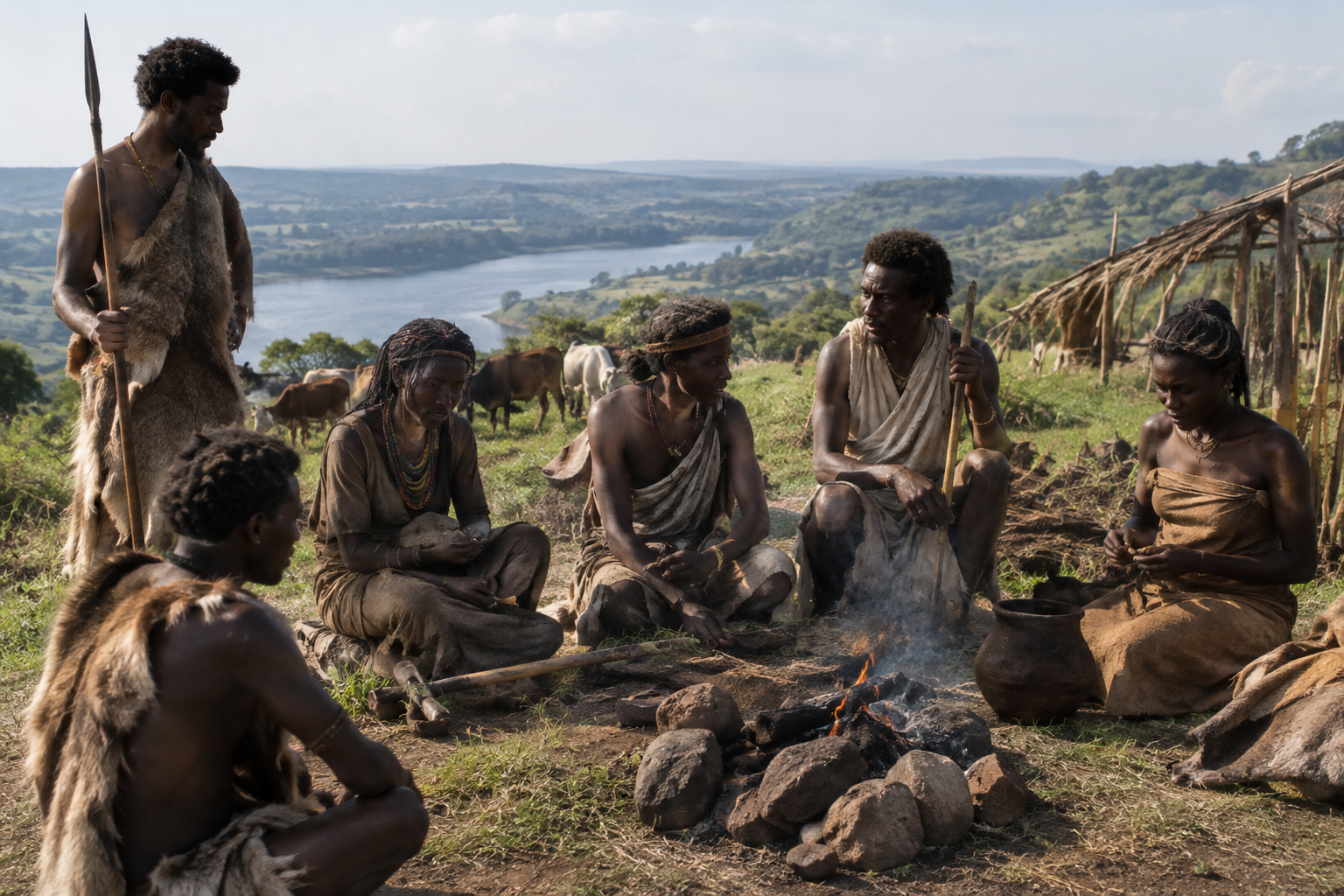
The strongest geographical concentration in this group lies in Kenya. At Hyrax Hill, sample HYR002, dated to around 350 BC and described as Cushitic, places the lineage in a setting long associated with herding communities in eastern Africa. At Ol Kalou, another Pastoral Neolithic Cushitic-associated individual, I12384, dated around AD 300, extends that presence into a later horizon. Keringet Cave adds yet another data point with I12398, dated around AD 540.
These are not interchangeable labels. "Pastoral Neolithic" refers to archaeological communities in eastern Africa that adopted livestock herding well before the arrival of ironworking in many areas, and whose material culture and biological ancestry can show strong links to movements from the northeast into East Africa. Research on eastern African ancient DNA, including a major study published in Science, has shown that the region's population history involved substantial interaction between local forager ancestry and incoming pastoralist-related ancestry.
That context makes the E1b1b1b2b2a1 pattern highly plausible in eastern Africa. In the broadest sense, E1b1b lineages have a long and well-known place in northeast and eastern African population history. The important point for this article is narrower: the specific branch reported here appears in several Kenyan ancient individuals connected with pastoral and Cushitic-associated contexts, making East Africa the clearest recurring archaeological setting in this evidence set.
A separate MyTrueAncestry article on African population history helps place these paternal findings alongside the deeper maternal story.
Another Kenyan sample, MOL001 from Molo Cave, dated around AD 650, matters because it shows continuity of the paternal branch in a later first-millennium setting. Add to this I12379 from the Iron Age pastoral site of Emurula Ole Polos Cairns in Kenya, dated around AD 1750, and the timespan becomes striking. We are no longer looking at a single short-lived episode but at a line appearing across many centuries in related regional worlds.
That does not prove unbroken descent from one excavated man to another. Archaeology rarely grants us such tidy family sagas. What it does suggest is that the paternal branch had persistence within populations participating in East African pastoral lifeways, whether in cave contexts, cairn fields, or other settlement-burial landscapes that reflect herding economies and mobile social ties.
In eastern Africa, caves are often discussed as if they belonged to some wholly separate, earlier world of foragers, but the genetic record keeps spoiling neat categories. Caves, open-air cemeteries, and pastoral landscapes can all sit within overlapping histories of movement, mixture, and adaptation. An ancient DNA study in Science Advances likewise underlined just how layered eastern Africa's population past was, rather than fitting into a single migration pulse.
One of the most intriguing samples in this set is I13762 from Gishimangeda Cave in Tanzania, dated around 100 BC and described as a South-East African hunter-gatherer. Here the interpretive ground becomes more delicate. A lineage associated elsewhere in this sample group with pastoral or Cushitic-linked contexts appears in an individual classified within a hunter-gatherer setting.
That is precisely the sort of finding that makes archaeogenetics so useful, and so awkward for older textbook categories. It may reflect contact, admixture, incorporation, or simply the fact that cultural labels and paternal lines do not map neatly onto one another. A hunter-gatherer individual does not have to carry a "hunter-gatherer" Y lineage in any essential sense, just as a pastoralist burial need not speak for an entire population's paternal history.
The Tanzanian evidence therefore broadens the story. E1b1b1b2b2a1 was not confined to one economy or one self-contained community type. It could appear in the messy borderlands where foragers and herders met, married, exchanged, and reshaped one another over generations.
This broader point about mixed ancient communities also resonates with findings from other regions where burial labels and genetic backgrounds do not align as neatly as older narratives once assumed.
The honest answer is that this sample set shows the pattern more clearly than it explains the mechanism. East Africa provides the densest and most coherent archaeological cluster. Prague provides the surprise. Between them lay, in antiquity, the interconnected worlds of the Nile corridor, the eastern Mediterranean, the Roman sphere, earlier movements through northeast Africa, and the many small-scale biographies that never entered a chronicle.
What one should resist is the temptation to turn a scattered paternal signal into a single heroic migration route. The Prague men are not automatically "from" East Africa in any recent sense, and the Kenyan men are not mere stepping stones in a march toward Europe. Human paternal lines can travel through many intermediate populations, over long spans of time, while the rest of a person's ancestry changes dramatically around them.
For readers interested in how African-linked ancestry can appear in unexpected European archaeological settings, there is an especially relevant comparison in Roman and post-Roman Britain.
The most distinctive thing about E1b1b1b2b2a1 in this evidence is not royal glamour or a single place of origin, but its appearance in real ancient people across very different settings: a pair of Iron Age males in Prague, several pastoral and Cushitic-associated individuals in Kenya, and a hunter-gatherer context in Tanzania. That combination points to a paternal line with deep roots in African population history and a capacity to surface far beyond any one cultural zone.
If this is your haplogroup, the ancient record here most responsibly suggests connection to a long, mobile, and historically entangled paternal past, especially in eastern Africa, with occasional appearances in wider Old World networks. The value of that is not that it hands you one identity, but that it places your direct male line inside the real human complexity that archaeology keeps uncovering.






Comments