Haplogroup E1b1b1b2a1a1a1a1f

– 5 min read


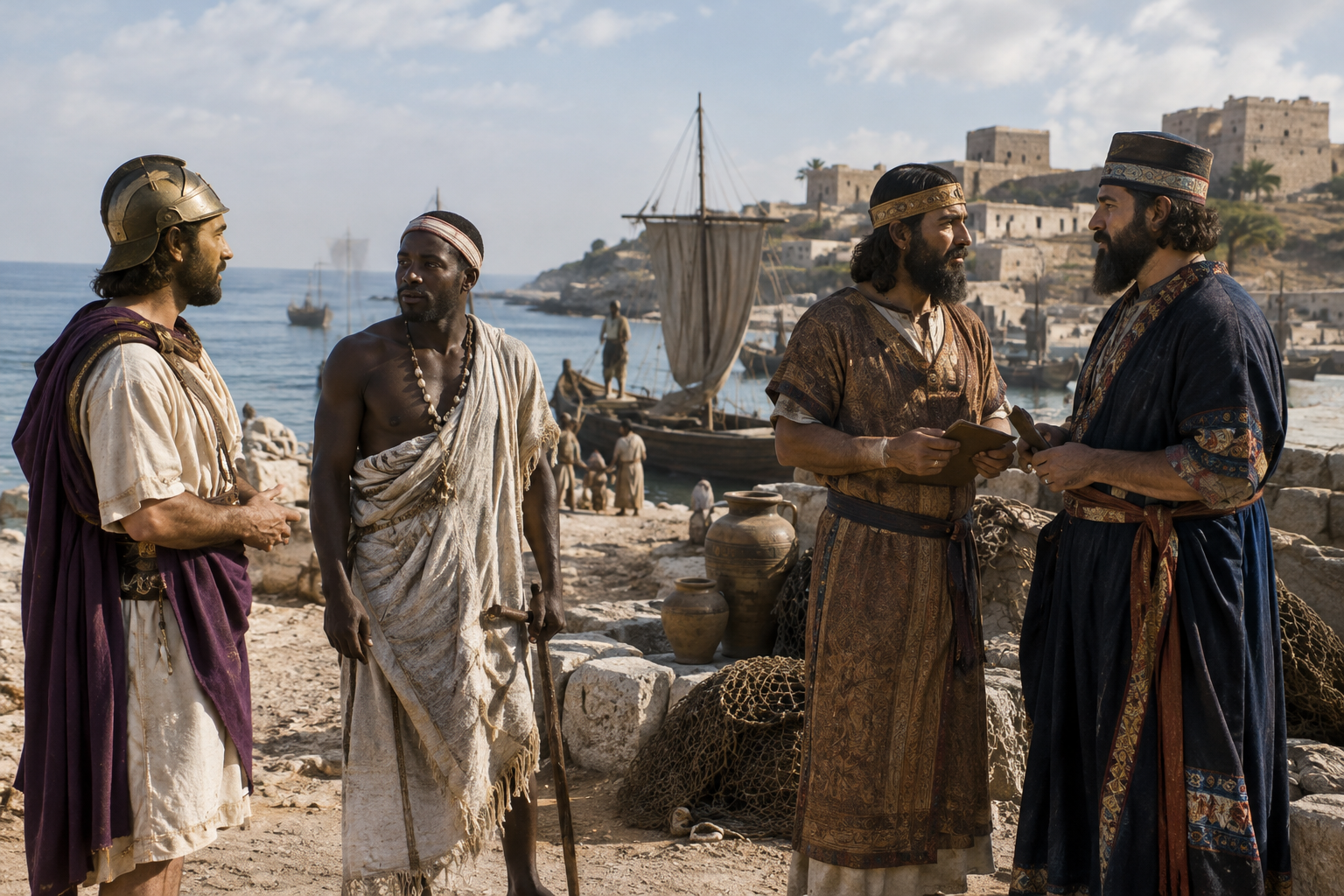
At Kerkouane on the Cap Bon peninsula of Tunisia, one ancient male dated to about 550 BC, sample I24194, places the Y-DNA haplogroup E1b1b1b2a1a1a1a1f in one of the most famous maritime worlds of the first millennium BC: Punic North Africa. Kerkouane is not just any site. It is one of the best-preserved Punic towns in the Mediterranean, abandoned before Roman rebuilding could thoroughly overwrite it, which means that each excavated individual can feel unusually close to the living city behind the ruins.
That makes this paternal line interesting at once. Rather than appearing in one narrow, isolated setting, E1b1b1b2a1a1a1a1f is represented here by ancient men from Punic Tunisia, Bronze Age southeast Anatolia, and medieval coastal Kenya. Y-DNA tracks one direct male line only, not a person's whole ancestry, but that single line can still illuminate the corridors through which men, families, and communities moved across the eastern Mediterranean and western Indian Ocean.
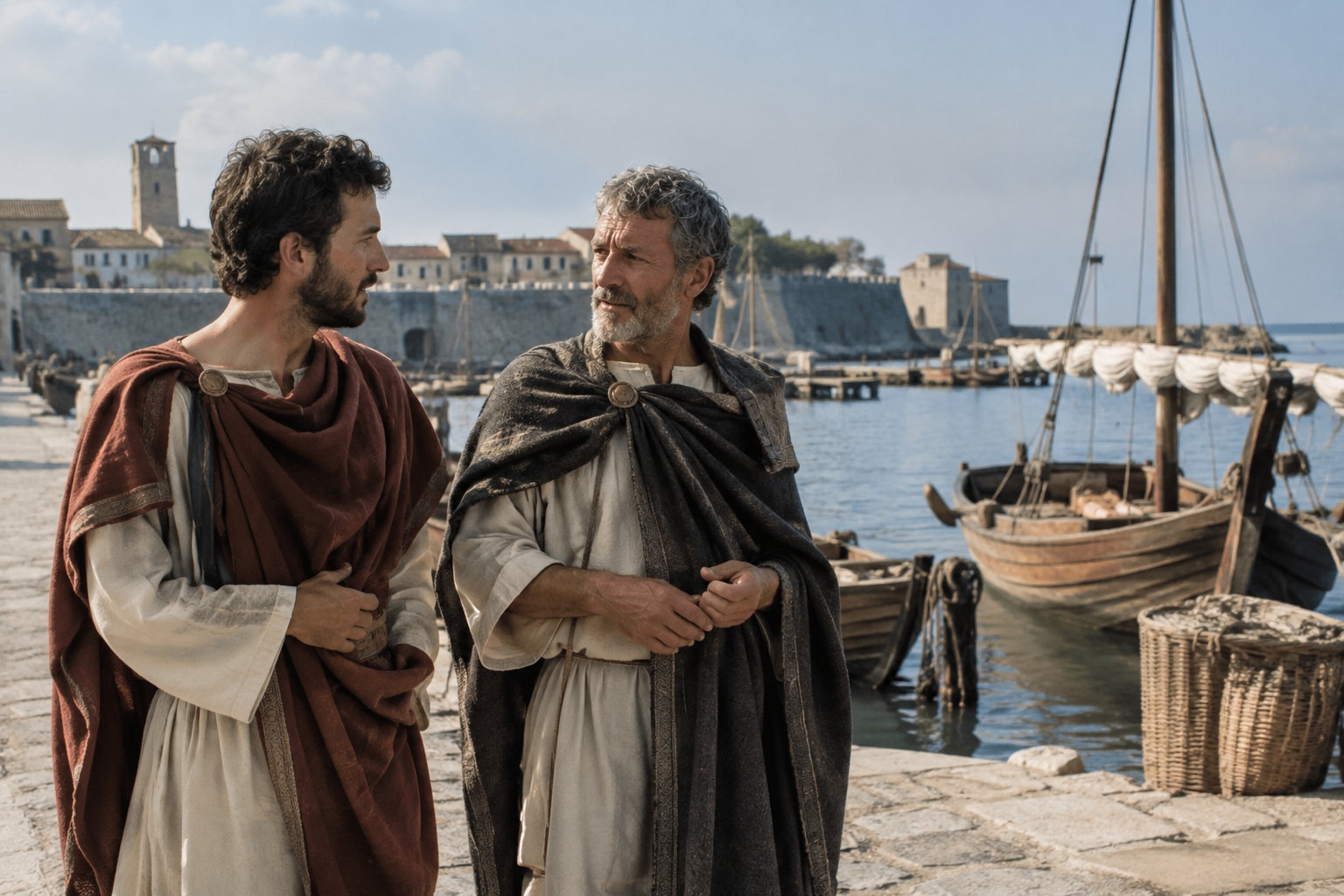
The Kerkouane individual, I24194, belongs to a world shaped by Carthage, Phoenician expansion, and local North African societies. By the sixth century BC, this coast was tied into dense networks of trade, religion, and politics spanning Tunisia, Sicily, Sardinia, Iberia, and the Levant. A paternal lineage found here therefore matters not because it proves one simple origin story, but because Punic towns were precisely the kinds of places where Mediterranean histories met in one population.
That broader point has become clearer through ancient DNA work on Punic sites, including research on Punic and Phoenician-associated communities published in a major ancient DNA study of the Punic world. One of the important lessons from this research is that Punic populations were not genetically uniform replicas of Levantine founders. They were local, mixed, mobile, and regionally varied. A lineage such as E1b1b1b2a1a1a1a1f sits comfortably in that reality: not a badge of a single ethnicity, but part of the male-line diversity present in an urban North African setting.
There is also a useful historical caution here. A Carthaginian context does not automatically make every paternal line "Phoenician" in a narrow sense. Punic society incorporated people with different family histories, including lineages rooted in North Africa itself and others arriving through centuries of contact. The value of I24194 is that it anchors this branch in a real Punic town, not that it resolves every argument about where that branch first emerged.
Well before Carthage rose to Mediterranean prominence, this haplogroup's trail appears in Bronze Age southeast Anatolia. Two ancient individuals from the Yamhad Kingdom at Kilis, I14782 dated around 1750 BC and I14784 dated around 1740 BC, connect E1b1b1b2a1a1a1a1f to the inland frontier between Anatolia and northern Syria.
That is a remarkable setting. Yamhad, centered on Aleppo, was one of the major kingdoms of the Middle Bronze Age Near East. Its political orbit touched caravan traffic, diplomatic exchange, and the shifting balance of power among Syrian, Mesopotamian, and Anatolian states. When the same narrow paternal branch turns up in this region nearly twelve centuries before the Kerkouane man, it suggests that the lineage belonged to a much older Near Eastern and eastern Mediterranean human landscape.
Just as importantly, there are two men from the same broad kingdom and nearly the same period, not a lone outlier. That does not prove they were close relatives, nor that this was a dominant local lineage, but repeated appearances do strengthen the impression that the branch was established in this wider northern Levant-southeast Anatolian zone during the Bronze Age.
For readers interested in how ancient DNA is reshaping our understanding of this broader region, the MyTrueAncestry piece on Bronze and Iron Age Mesopotamia offers a nearby parallel: ancient states were rarely genetically simple, and paternal lines moved through them in ways that followed trade, kinship, and politics rather than modern national boundaries.
The most unexpected appearance in this set is perhaps I19394, a male from Mtwapa on the coast of Kenya, dated to about 1585 AD. By the late medieval and early modern period, Mtwapa belonged to the Swahili world of coral-built towns, Indian Ocean commerce, and layered African and overseas connections. Finding the same article haplogroup there is a reminder that male-line histories did not stop at the Mediterranean shore.
The Swahili coast was never sealed off from the Red Sea, Arabia, Persia, or South Asia. Nor was it merely a passive recipient of outside influence. Coastal East African communities were active participants in long-distance exchange, and their populations reflect that complexity. Ancient DNA research on medieval and early modern eastern African coastal populations, including a widely discussed study of the Swahili coast, has shown just how historically entangled these port towns were.
In that light, I19394 is especially valuable. He does not show that one Bronze Age Anatolian family somehow marched intact to Kenya across three millennia. What he does show is that the paternal branch represented here could travel, persist, and reappear in major exchange zones linking Africa to western Asia. The line's history is not a straight arrow; it is a chain of documented appearances in connected worlds.
E1b1b1b2a1a1a1a1f is clearly a very fine-grained subclade, much narrower than the larger and better-known umbrella of E1b1b. That distinction matters. It would be careless to take every broad statement ever made about E1b1b and pin it directly onto this much smaller branch. The evidence here is more modest, but in some ways more interesting: this particular paternal line is attested in several historically important contact zones.
Those zones share a theme. Kilis in the age of Yamhad sat near the hinge between Anatolia and Syria. Kerkouane stood inside the mixed urban world of Punic North Africa. Mtwapa belonged to the cosmopolitan Swahili coast. None of these is a remote backwater. All are places where merchants, migrants, soldiers, marriage networks, and local populations intersected.
That pattern does not let us assign a single ethnic label to the branch. It does, however, make one historical reading plausible: men carrying this lineage were present in societies shaped by mobility over a very long period, from the Bronze Age to the early modern era.
There is a temptation with any haplogroup article to demand a neat homeland and a simple migration route. The samples here resist that sort of tidiness. Instead, they point toward a broad connected zone running from the northern Levant and southeast Anatolia into North Africa, and then, by a much later date, into the western Indian Ocean sphere.
That may sound less dramatic than a one-line origin myth, but historically it is richer. Ancient and medieval people did not live inside the tidy boxes that later genealogies prefer. Ports, kingdoms, caravan centers, and coastal towns were forever taking in newcomers and producing descendants who belonged wholly to their own local worlds. The men represented by I14782, I14784, I24194, and I19394 were separated by enormous stretches of time and culture, yet their shared paternal branch quietly links those worlds together.
Mediterranean mixing in medieval Sicily
If your paternal line falls under E1b1b1b2a1a1a1a1f, the strongest lesson from the current ancient evidence is not a claim to one famous people, but a connection to old corridors of exchange linking the Near East, North Africa, and the African coast of the Indian Ocean. So far, this branch appears in a Bronze Age kingdom near Aleppo, a Punic town in Tunisia, and a Swahili settlement in Kenya. That is a small dataset, but it is a historically revealing one: your direct male line belongs to a record of movement through some of the most connected places of the ancient and medieval world.

Comments