Haplogroup E1b1b1b1b1a

– 5 min read


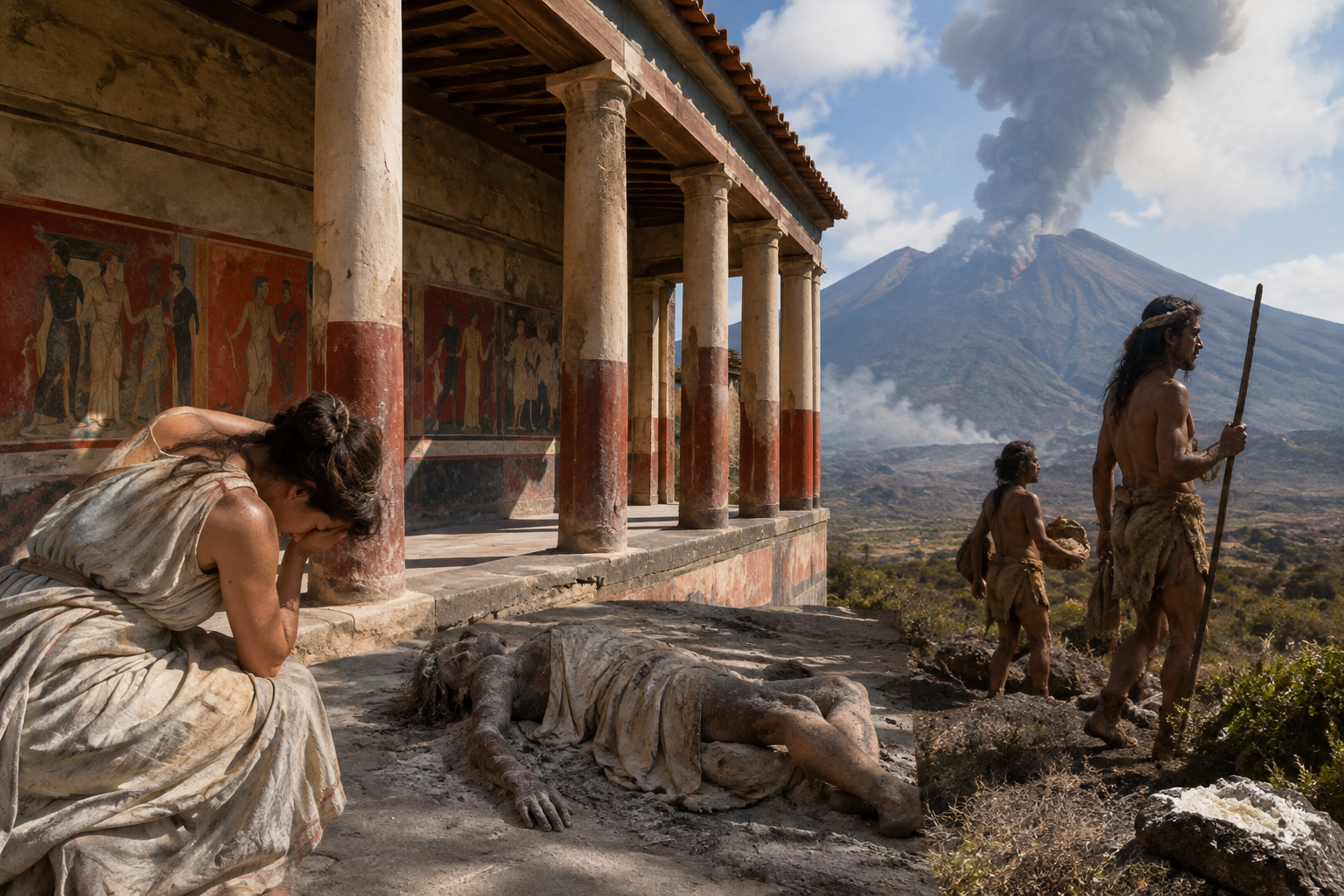
In AD 79, one of the men caught in the destruction of Pompeii was later recovered from the Villa of the Mysteries and catalogued as I3682. That alone would be enough to arrest the imagination: a life stopped by Vesuvius, then resumed for us through archaeology and DNA. But for Y-DNA researchers there is another point of interest, because this individual has been associated with the paternal lineage E1b1b1b1b1a, a branch within the broader E1b1b family that today is often discussed in Mediterranean and North African contexts.
What makes this especially interesting is not that one Pompeian man can stand for all Romans - he plainly cannot - but that he sits beside another much later example from a very different island world: CAN.048, a Late Guanche-era individual from Salitre on Tenerife, dated around AD 1155. Put those two finds side by side and the pattern is immediately historical rather than abstract. This is a haplogroup turning up in two intensely connected maritime zones: Roman Campania and the Canary Islands on the eve of European expansion.
The Pompeii sample I3682 is valuable because Pompeii is so often imagined as a neat snapshot of "typical" Italy. In fact, Roman towns were rarely neat in that way. Campania was tied into trade, slavery, military service, migration, and the ceaseless movement of people around the Mediterranean. A paternal lineage such as E1b1b1b1b1a appearing in this setting fits that broader picture of Roman Italy as socially local but biologically mixed.
That matters because Y-DNA tracks only one direct paternal line. It does not tell us a person's whole ancestry, language, legal status, or cultural identity. Yet in a Roman context that narrowness can be useful. One paternal branch can reveal how men and their descendants became part of urban communities that looked thoroughly Roman in material culture while still preserving lineages with deeper histories elsewhere around the Mediterranean basin.
A recent ancient DNA study on Pompeii and its victims has helped sharpen this picture of the town as a real human community rather than a plaster-cast cliche, and it provides the wider framework for thinking about individuals such as I3682 in their proper archaeological context: research on Pompeii's ancient inhabitants.
The branch named here, E1b1b1b1b1a, is a very specific terminal-style label inside the much larger E1b1b family. That distinction is important. The parent haplogroup has a long and complicated prehistoric history spanning parts of Africa, the Near East, southern Europe, and the Mediterranean, but that does not mean every downstream branch shared exactly the same route or timing.
So the safest historical reading is a modest one. These ancient associations suggest that lineages within this narrow paternal branch were present in Mediterranean populations by the Roman period and also present in the Canary Islands by the later medieval period. They do not, on their own, prove a single migration event, a single ethnic identity, or a simple story of origin.
Still, even modest evidence can be revealing. When a branch appears in both Roman Campania and indigenous Canary Islands remains, it points us toward the old highways of movement linking southern Europe, North Africa, and Atlantic island frontiers. That is exactly the zone where E1b1b lineages, in broader terms, have often been historically important.
The second sample, CAN.048, comes from Salitre on Tenerife and is dated to about AD 1155, firmly within the Late Guanche era. Here the historical setting is very different from Pompeii. We are not in a Roman town destroyed in a single famous catastrophe, but in an island society whose roots are generally connected to North African Berber-related settlement of the Canaries, followed by long periods of relative isolation before Castilian conquest.
That makes the association with E1b1b1b1b1a especially suggestive. In the Canary Islands, paternal lineages are part of a wider debate about how strongly pre-Hispanic island populations preserved North African ancestry, how much variation existed between islands, and how later colonial disruption reshaped the genetic record. A lineage in this branch sits comfortably within that discussion, because Tenerife was never a sealed box: it was an island, yes, but one with an origin story tied to movement across water.
An ancient DNA study of the Canary Islands has been central to understanding these long-term island histories and the survival of indigenous ancestry into later periods: research on ancient Canary Island populations.
Colonial Lanzarote and North African mixing
It is tempting to look at I3682 from Pompeii and CAN.048 from Tenerife and draw a straight line between them. Historians should resist that temptation. The two men lived more than a thousand years apart, in different political worlds, under different social systems, and on opposite ends of the Roman and post-Roman maritime sphere.
Yet the comparison is still worthwhile, because it shows how one paternal branch can appear in places shaped by connected but not identical histories. Pompeii represents the Roman Mediterranean at its busiest: trade routes, imperial integration, and urban diversity. Tenerife represents an Atlantic island society whose deeper background points back toward North Africa and whose later fate would be tied to Iberian expansion.
Seen that way, E1b1b1b1b1a is not the badge of one people. It is better understood as part of a pattern of male-line continuity and movement around the southern edges of Europe and into the Atlantic islands. The interest lies precisely in that layered geography.
Roman Hispania's genetic legacy
There is a reason E1b1b branches so often appear in discussions of Mediterranean antiquity. The Mediterranean was not a boundary in the modern sense. It was a machine for contact. Armies crossed it, merchants crossed it, enslaved people were forced across it, and families remade themselves on its shores over generations. A Y-chromosome lineage could travel within any of those processes while its carriers became culturally Punic, Greek, Roman, Berber, Christian, Muslim, or something more local and mixed.
That is why a Roman victim at Pompeii and a Late Guanche individual on Tenerife can belong in the same article without being forced into the same identity. Archaeology gives us the settings; genetics gives us one line of descent; history explains why the settings were never as isolated as old nationalist stories liked to imagine.
This also helps explain why island populations matter so much in archaeogenetics. Islands preserve continuity, but they also preserve arrivals. They can make old movements visible precisely because they narrow the stage.
North Africa's long genetic history
For someone exploring E1b1b1b1b1a today, the most responsible takeaway is not a claim to be "Roman" or "Guanche" in any simple sense. It is that this paternal branch has credible ancient associations in two historically important zones: Roman Italy and the pre-conquest Canary Islands. That points toward a deep history connected to Mediterranean and North African worlds, and to the movements that linked them to Atlantic islands.
In other words, this is a lineage that turns up where history was made by contact: ports, islands, empire, and migration. That is quite enough to make it worth following.
Comments