Haplogroup E1b1b1b1a1e1

– 4 min read


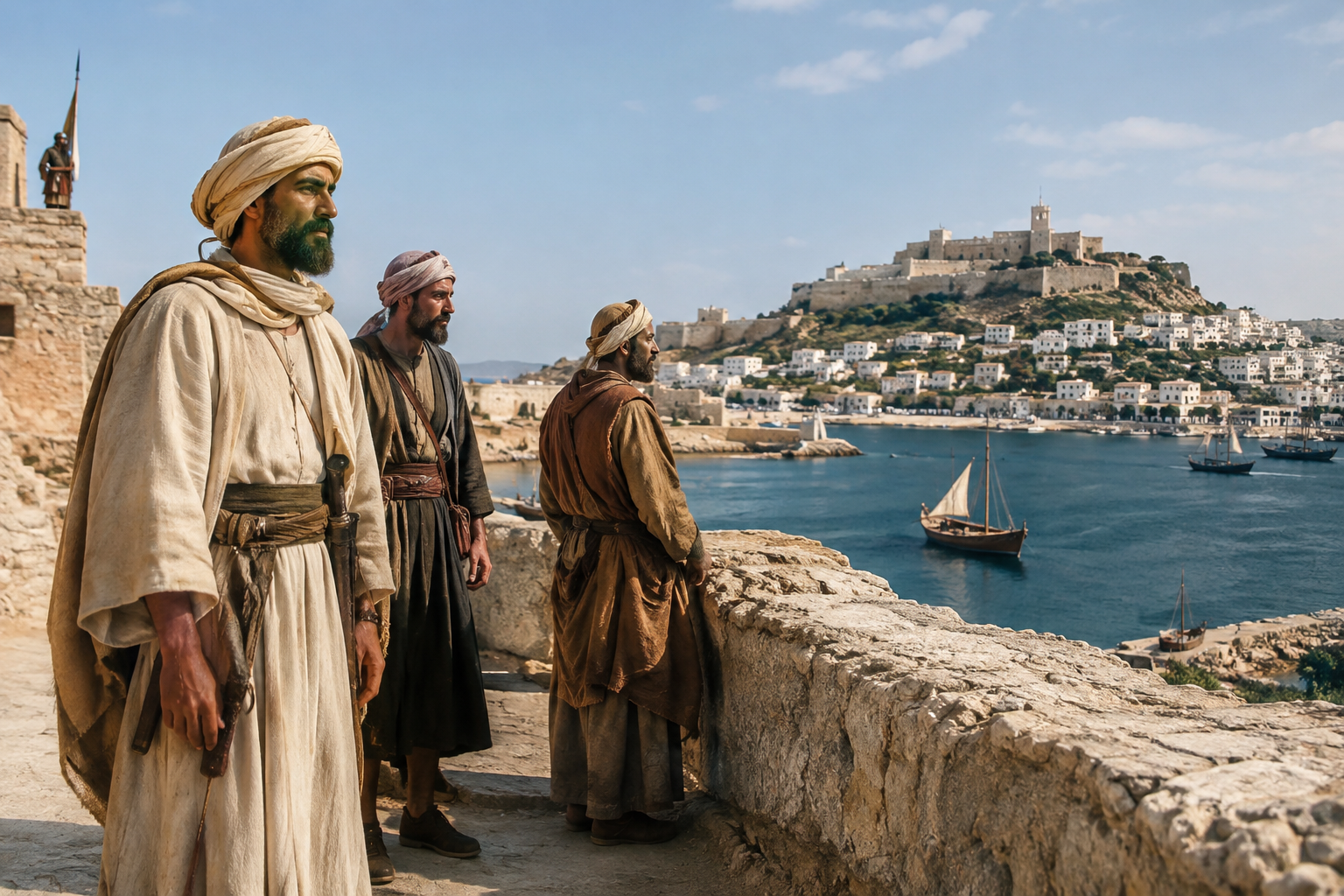
One of the clearest fixed points for haplogroup E1b1b1b1a1e1 in this set of evidence is a man buried in medieval Ibiza, identified as ldo130 and dated to around AD 950. That date places him in the period when Ibiza formed part of the Islamic world of al-Andalus, tied by sea to the Iberian mainland, the Maghreb, and the wider Mediterranean. A paternal lineage like this one is only a single line of descent, not a whole biography, but its appearance in that setting is historically revealing.
The interest here is not that one Y-chromosome branch can explain medieval Ibiza. It plainly cannot. The interest is that E1b1b1b1a1e1 sits within the wider E1b1b1 family, a major paternal cluster with deep roots around the Mediterranean and North Africa, and that this particular branch turns up in an island community that was anything but isolated. Medieval Ibiza was a maritime crossroads, and the genetics increasingly match the history.
By the 10th century, the Balearic Islands were drawn into the political and commercial orbit of Islamic Iberia. Ibiza was not some forgotten outpost at the edge of the map. It was linked into the same sea-lanes that carried goods, people, ideas, and families between Iberia, North Africa, Sicily, and beyond. In that context, a lineage such as E1b1b1b1a1e1 makes good historical sense without needing any melodrama.
The sample ldo130, described as a medieval individual from Ibiza Al-Andalus, belongs to exactly that world. What matters is not a fantasy of a single migration event, but the broader fact that Islamic-period island populations could include men whose paternal ancestry pointed toward long-standing Mediterranean and North African connections. That is consistent with the known history of the western Mediterranean in the early Middle Ages, where movement was frequent, layered, and often ordinary rather than exceptional.
It is worth being precise. E1b1b1b1a1e1 is a narrow paternal branch, while E1b1b1 is the much wider umbrella. Those are not interchangeable labels. The larger family has a long and complicated history across Africa, the Mediterranean, and parts of Europe and western Asia; the narrower subclade should not automatically be given every migration story ever associated with its parent branch.
That distinction matters especially in public genetics. When a medieval man from Ibiza is linked to E1b1b1b1a1e1, we are looking at one direct male line carried by one individual in one burial population. We are not, on that basis alone, identifying his language, social status, legal identity, or the full ancestry of everyone around him. The real value lies in how such lineages accumulate across sites and begin to show the mixed texture of past populations.
The Balearic Islands have often been treated as marginal in grand historical narratives, but archaeologically they are better understood as connectors. Their population history reflects repeated contact: prehistoric settlement, Phoenician and Punic networks, Roman incorporation, late antique change, and then the Islamic centuries. Each phase left demographic traces, and none of them erased the islanders' earlier complexity.
That is why a medieval Islamic burial from Ibiza matters beyond its single grave. It adds one more data point to a bigger picture in which island populations were continuously reshaped by seaborne mobility. If a man carrying E1b1b1b1a1e1 was living and dying on Ibiza in about AD 950, that fits a society in which paternal lines from southern and eastern shores of the Mediterranean could be woven into local communities over generations.
Balearic Islands Genetic History
Ibiza's Islamic-period burials are particularly useful because they sit at the intersection of archaeology and broader Iberian history. Al-Andalus was never genetically uniform. It included people descended from earlier Iberian populations, newcomers from North Africa, and lineages formed through generations of movement and mixture across the western Mediterranean. A burial ground from that world should look diverse, and increasingly it does.
This is where the sample ldo130 becomes more than a label. It speaks to the ordinary demographic reality of medieval Islamic societies in Iberia and its islands: not a neat opposition of "locals" and "outsiders," but communities created through sustained contact. Related work on medieval Iberia has repeatedly pointed to varied origins in burial populations, including in central Spain, which helps place Ibiza into a larger and better documented pattern.
Diverse Origins in Medieval Spain
The wider E1b1b1 family appears again and again in discussions of Mediterranean population history because it helps track connections that are older and broader than any single empire. Long before medieval Ibiza, the western Mediterranean had been tied together by exchange, colonization, enslavement, warfare, marriage, and everyday movement. By the Islamic period, those old channels had not vanished; they had been reorganized.
For that reason, E1b1b1b1a1e1 in Ibiza should be read historically, not romantically. It does not announce a lone adventurer stepping ashore from Africa or the Levant. More plausibly, it reflects the kind of repeated human movement that made the medieval Mediterranean what it was: interconnected, multilingual, and demographically mixed at many scales, from courts and ports to farms and cemeteries.
A recent ancient DNA discussion of these Ibiza burials can be found in research on genetic and disease diversity in medieval Islamic Ibiza. Even without forcing more certainty than the evidence allows, the direction is clear enough: these island cemeteries preserve traces of a population shaped by broad Mediterranean links rather than by isolation.
If your direct paternal line falls under E1b1b1b1a1e1, this medieval Ibiza evidence offers a careful kind of historical companionship. It places the branch, or an associated assignment to that branch, within a 10th-century Balearic community connected to al-Andalus and the western Mediterranean world. That does not prove descent from Ibiza, nor does it pin your family to one ethnicity or kingdom. But it does anchor the lineage in a real archaeological landscape where African, Iberian, and Mediterranean histories met in everyday life.

Comments