Haplogroup E1b1b1a1b1a20
– 5 min read


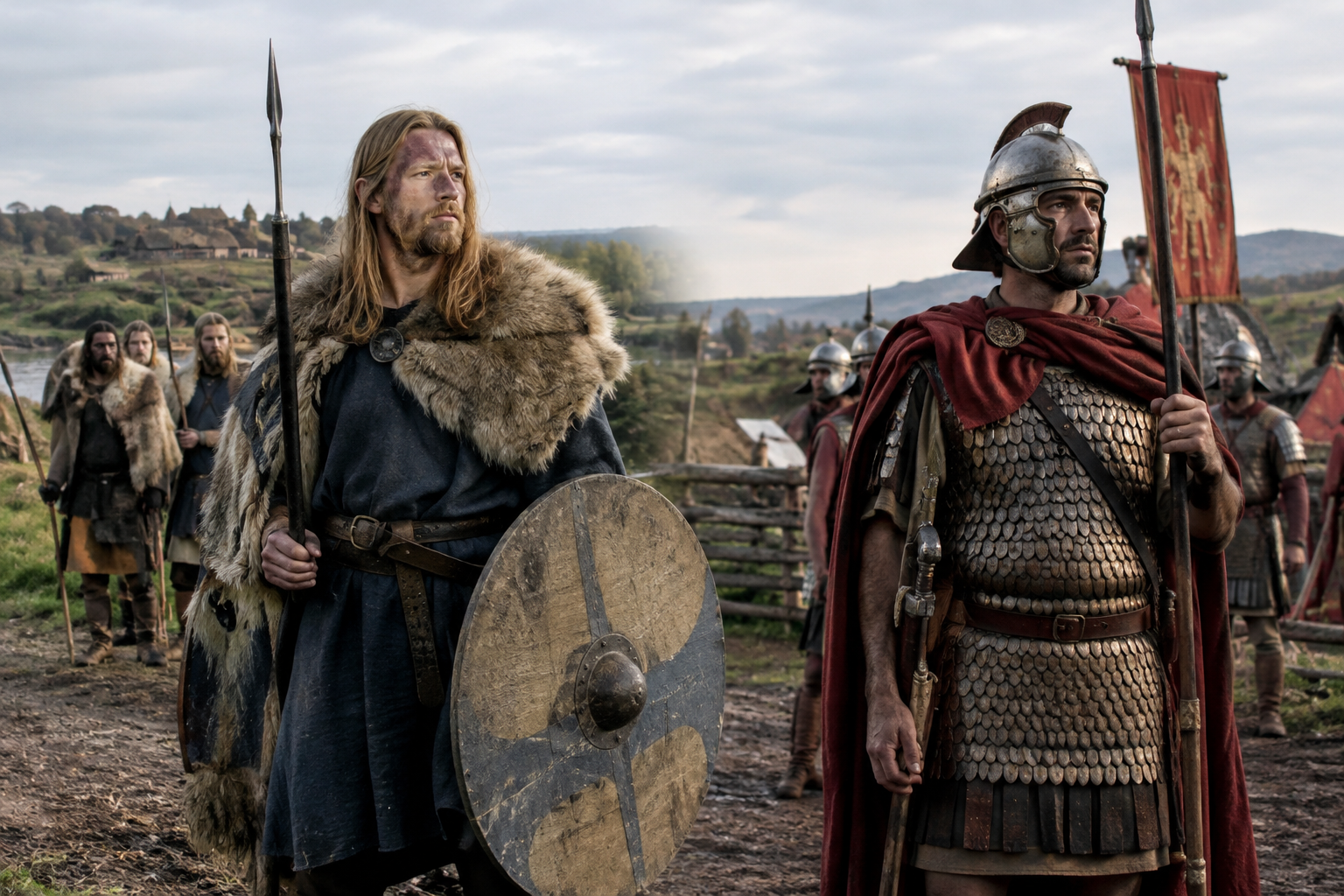
At Valkenburg Marktveld in the Netherlands, one ancient male dated to around AD 59, identified as CGG107765, brings haplogroup E1b1b1a1b1a20 into a setting many readers would not expect: the Roman frontier on the Lower Rhine. This was Batavian country, a zone of forts, roads, river traffic, and military service, where local communities lived in constant contact with the Roman world. A Y-chromosome result here is not a grand summary of identity, but it is a sharp little clue. It tells us that one direct paternal line associated with E1b1b1a1b1a20 was present in a frontier population usually described in historical terms as "Germanic".
The second clue comes from much farther southeast, at Scitarjevo in Croatia, where a Late Roman era individual dated to around AD 310, R3659, has also been connected with this haplogroup. Put those two finds side by side and the interest is immediate. We are not looking at a single isolated burial, but at a lineage appearing in two different provinces of the Roman world, in two different centuries, and in two very different historical landscapes.
E1b1b1a1b1a20 is a very specific branch within the broader E1b1b1 family, a major Y-DNA clade with a deep history stretching across parts of Africa, the Mediterranean, and western Eurasia. It is important not to flatten those scales. The broad parent haplogroup has a wide and complicated past; that does not mean every narrower branch followed the same route or had the same historical distribution.
What a Y-DNA assignment tracks is one direct paternal line: father to son across many generations. It does not define a person's whole ancestry, language, or cultural identity. In the Roman world especially, that distinction matters. Frontier communities, army zones, and provincial towns were full of people whose genetic backgrounds, legal status, and cultural affiliations did not line up in neat textbook boxes.
The sample CGG107765, dated to around AD 59, belongs to the world of the early Roman Lower Rhine. Valkenburg, known in Roman sources as part of the frontier system, sat in a region where Rome relied heavily on local manpower. The Batavi became famous as soldiers and horsemen in Roman service, yet their homeland was never some sealed ethnic container. It was a contact zone, and contact zones are exactly where unexpected Y-lineages often turn up.
That is what makes this sample so useful. E1b1b1a1b1a20 appearing in a Batavian-associated context does not mean the entire tribe carried that lineage, nor does it license romantic stories about one man's origin. What it does show is that the paternal landscape of the Lower Rhine in the first century AD was more varied than a simple northwestern European stereotype would suggest.
A recent ancient DNA study of the Lower Rhine frontier has pushed precisely this wider point: these military-border communities were biologically mixed as well as culturally entangled. For readers wanting the broader setting, the frontier picture is explored in research on the Roman Lower Rhine border community, which helps frame why a lineage like this can appear in such a place without any need for melodrama.
There is a wider historical lesson here too. Roman imperial power did not simply impose itself on fixed local populations; it gathered recruits, merchants, families, camp followers, and migrants into new social worlds. Some lineages persisted locally, some arrived from elsewhere, and some became part of communities that later historians would label with a single ethnic name. CGG107765 sits neatly inside that messy, fascinating reality.
The Croatian sample R3659, dated to around AD 310, moves the story into a rather different Roman landscape. Scitarjevo lies in the zone of the Middle Danube and the Balkan hinterland, an area that by the early fourth century belonged to a heavily militarized and mobile imperial world. Emperors campaigned nearby, armies crossed and recrossed the region, and civilian settlements lived in the shadow of roads, forts, and changing administrative boundaries.
Here again, the significance lies less in any fantasy of tracing one man from one province to another than in the repeated appearance of the lineage in historically connected worlds. By the Late Roman period, the Balkans were one of the empire's great mixing grounds. People moved through the region as soldiers, traders, dependants, settlers, and captives. A paternal line such as E1b1b1a1b1a20 appearing at Scitarjevo fits that broader picture of circulation across imperial space.
Research on ancient Croatian populations has increasingly shown a long pattern of continuity mixed with change, especially when maternal and paternal lines are compared across periods. That matters because Y-DNA shifts can reflect very different social processes from the rest of the genome. One recent study relevant to this region is an ancient DNA investigation of population history in Croatia, useful for understanding why a single paternal branch should be placed within a much larger demographic story.
Croatia's shifting paternal lines
It is tempting to see the Netherlands and Croatia as opposite ends of the map, and in one sense they are. Yet under Rome they were tied together by service, taxation, transport, and state power. Men from frontier societies could be recruited far from home. Provincial populations were nudged, pulled, or pushed by opportunities and crises created by the empire. The real value of these two E1b1b1a1b1a20-linked finds is that they belong to that same connected system.
That does not prove direct movement between Valkenburg and Scitarjevo, and it certainly does not prove close kinship between CGG107765 and R3659. But it does remind us that a rare or unexpected paternal line in one region may make better sense when placed against the scale of Roman connectivity. The empire was not just a political map. It was a machine for moving people.
In that respect, this haplogroup fits neatly beside other ancient DNA studies showing mobility and mixture in Roman Europe, whether in Iberia, Italy, Britain, or the Rhine frontier. The Roman period repeatedly frustrates any hope for tidy ethnic genetics. That is not a failure of the evidence. It is the evidence.
Roman and early medieval Britain
Many haplogroup articles begin too broadly and end up saying very little. E1b1b1a1b1a20 is more interesting when kept narrow. Its present value in the ancient record, at least from the evidence here, lies in the way it appears in historical contexts where identity was layered: a Batavian-associated individual on the Lower Rhine and a Late Roman individual in Croatia. Those are not the same society, not the same century, and not the same local history. Yet both belonged to the Roman world, and both show how paternal lineages could sit inside communities that modern readers might otherwise imagine as genetically uniform.
There is also a methodological point worth making. When a precise Y-DNA branch turns up in only a small number of ancient samples, it is easy to overread it. The better approach is to ask what pattern is securely visible. Here the secure pattern is one of presence across Roman Europe, especially in zones shaped by military and provincial mobility.
Roman soldiers on the Lower Rhine
If your paternal line falls under E1b1b1a1b1a20, these ancient finds do not hand you a single homeland or a heroic tribal badge. What they do offer is something better grounded in evidence: your direct male line is already visible in the archaeology of the Roman world, in both a first-century Lower Rhine frontier setting and a fourth-century Balkan provincial one. That is a lineage with a documented place in the lived complexity of imperial Europe.
For family historians, that makes E1b1b1a1b1a20 less a story of one people than of movement, service, settlement, and survival across connected regions. It is exactly the sort of result that ancient DNA handles well: not myth, not prestige, but a sharper sense of where one paternal thread can be seen in the historical record.






Comments