Haplogroup E1b1b1a1a1c1b

– 5 min read


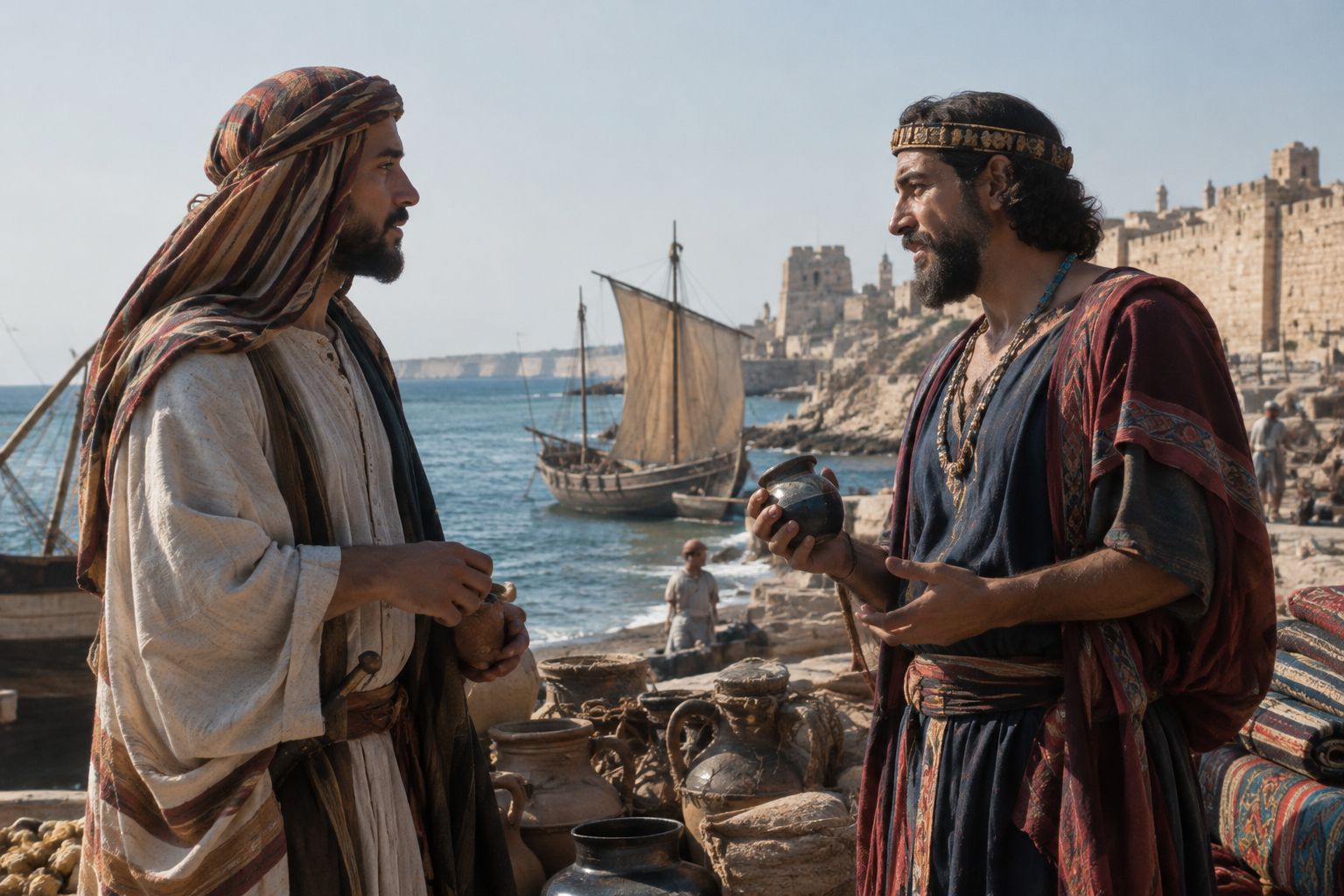
At Achzib on the northern coast of present-day Israel, one ancient man dated to around 585 BC carries an unusually evocative label: Phoenician. The sample, I11794, matters not because one burial can stand in for an entire people, but because it fixes the Y-DNA haplogroup E1b1b1a1a1c1b within a very real eastern Mediterranean setting of harbours, maritime exchange, and mixed coastal communities.
That is a useful place to begin, because this is a lineage best understood through movement around the Levant and Arabia rather than through any tidy ethnic box. Y-DNA tracks one direct paternal line only, but when that line appears in both a Phoenician-period coastal context and, centuries later, in Nabataean-period northwest Arabia, it hints at the durability of male lines within regions tied together by trade, migration, and imperial rule.
Achzib was no remote village. In the first millennium BC it belonged to the busy coastal world that linked the Levant with Cyprus, North Africa, and much of the Mediterranean. A man from this setting, sample I11794, dated around 585 BC, places the haplogroup E1b1b1a1a1c1b in a landscape associated with Phoenician urban culture at a moment when the region was entangled with the great powers of the age.
It is worth being careful with labels here. "Phoenician" is a historical and archaeological designation tied to coastal city culture, language, and networks of exchange; it is not the name of a single genetic lineage. Still, an ancient paternal line from Achzib is important evidence because it shows that this branch, or a reported association with it, existed in the same human world that produced the seafaring cities so familiar from classical sources.
That matters especially because Phoenician communities were famously connected, but not genetically uniform. Ports attract people. Men with the same broad Y-DNA family can belong to very different local histories, and men with different paternal lines can share the same language, cults, and material culture. The value of I11794 is precisely that it gives us one securely anchored point in that complicated coastal mosaic.
The second sample is later and inland: I12682 from Qurayyah in northwest Arabia, dated to around AD 50 and identified with the Nabataean period. This is a striking companion to the Achzib individual. We are no longer on the Phoenician coast, but in a region tied to caravan routes, oasis settlements, and the political world of the Nabataeans, whose power rested on controlling movement across desert corridors.
Again, the temptation is to overstate the case: one should not leap from a single paternal line to claims about "the Nabataean haplogroup." But taken together, I11794 and I12682 show something historically plausible and archaeologically interesting. E1b1b1a1a1c1b appears in two linked but distinct environments of the southern Levant and northwest Arabia, separated by more than six centuries.
This is exactly the sort of pattern ancient DNA is good at revealing. Not a heroic saga of one clan marching intact across the ages, but the quieter persistence of paternal lines in regions that were constantly connected by merchants, soldiers, administrators, herders, and townspeople. A genetic study of the region, accessible through research on ancient populations of the broader Near Eastern world, has helped make these smaller but more realistic historical patterns visible.
The wider haplogroup family behind E1b1b1a1a1c1b belongs to a cluster long associated, at broad scale, with parts of Africa, the Near East, and the Mediterranean. But broad scale is not enough here. The article's branch is a much narrower twig, and the evidence in front of us does not justify assigning it a single point of origin, a single ancient tribe, or a single migration event.
What it does justify is a crossroads interpretation. Both Achzib and Qurayyah sit in zones where identities were layered and political control shifted repeatedly. The Phoenician coast was bound into imperial systems and maritime exchange; Nabataean northwest Arabia was tied into caravan commerce stretching toward the Levant, Egypt, and deeper Arabia. A paternal line found in both worlds fits that geography rather well.
For family historians, that is often the more valuable lesson. A haplogroup like E1b1b1a1a1c1b is not a passport to one label; it is evidence that your direct paternal line may belong to a long history of eastern Mediterranean and Arabian connectivity.
There is a pleasing historical symmetry in these two samples. One stands in a coastal world usually imagined through ships and colonies; the other in a desert-linked world usually imagined through caravans and rock-cut cities. Yet both belonged to societies that were anything but isolated. The Mediterranean shore and Arabian interior were connected more often than older textbook maps used to suggest.
That is why ancient DNA has been so useful in breaking down crude oppositions between "local" and "foreign." An individual buried at a Phoenician site may carry a paternal line with deeper roots elsewhere in the region. A Nabataean-period man may belong to a lineage already present centuries earlier in adjacent lands. None of this is surprising historically, but genetics lets us observe it in named individuals rather than merely infer it from trade goods or inscriptions.
There is also a methodological point worth making. When a modern tester matches an ancient sample, the result does not mean direct descent from that exact man. It means shared paternal ancestry somewhere along the branching tree. That is why archaeological context is essential. Without Achzib and Qurayyah, E1b1b1a1a1c1b would just be a string of letters and numbers; with them, it enters a real historical map.
Eastern Mediterranean mobility
These samples are few, but they are not trivial. I11794 from Achzib anchors the lineage in the Iron Age or early Persian-era Levantine coast around 585 BC. I12682 from Qurayyah places it again in northwest Arabia around AD 50, in the Nabataean period. Those are two specific sightings of the same paternal branch in historically connected regions.
That does not prove uninterrupted local continuity, nor does it map every step between them. But it does make a strong, sober point: E1b1b1a1a1c1b belongs comfortably within the human history of the Levant-Arabia interface. A broader ancient DNA resource linked through published regional archaeogenetic data has helped make such cross-regional comparisons possible, even when our best evidence still comes from a small number of individuals.
In other words, the story here is not one of splendid isolation. It is one of connected landscapes, where coasts, caravan towns, and imperial frontiers allowed paternal lines to persist while languages, political loyalties, and cultural forms shifted around them.
Eastern Mediterranean influence
The distinctive lesson of E1b1b1a1a1c1b is that even a very specific paternal branch can surface in more than one historic society without belonging exclusively to either. So far, the clearest ancient signals point to the eastern Mediterranean and northwest Arabia: a Phoenician-context individual at Achzib and a Nabataean-period individual at Qurayyah. For someone researching this haplogroup today, that is a meaningful clue toward a paternal history shaped by Levantine-Arabian contact zones, trade networks, and long regional continuity.





Comments