Haplogroup E1b1b1a1a1c

– 5 min read


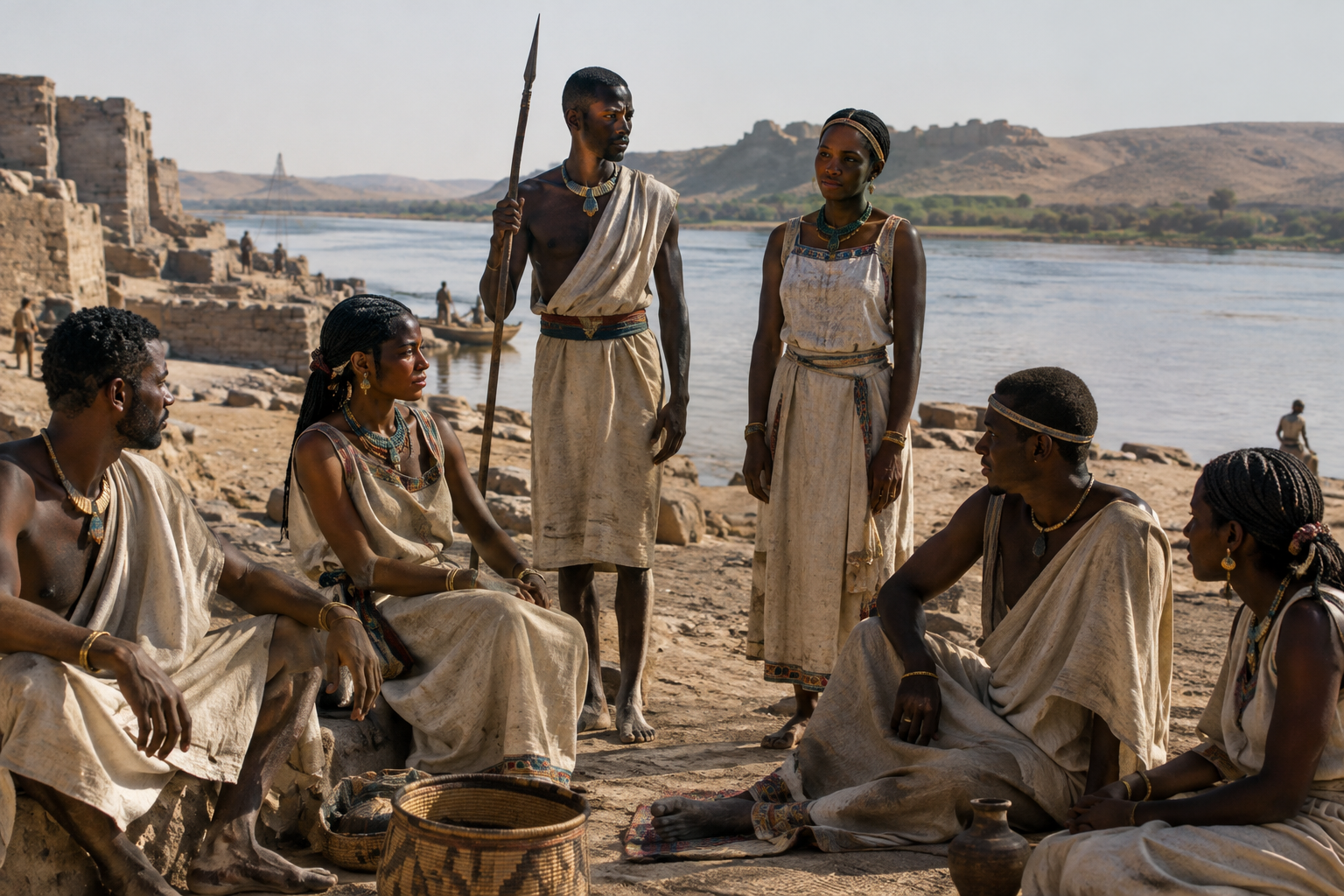
At Kulubnarti in Nubia, a cluster of medieval burials has become unexpectedly important for the history of Y-DNA haplogroup E1b1b1a1a1c. Several male individuals from this community, including I19015 and I19138 dated around AD 810, I6336 dated around AD 870, I6252 dated around AD 790, and the earlier Makurian individuals I18514, I18610, and I18612 dated around AD 750, have been reported in association with this paternal branch. That matters because Kulubnarti is not a vague prehistoric horizon or a legendary migration route: it is a real medieval community on the Nile, in the Christian kingdom of Makuria, where ancient DNA can be set against a richly historical landscape.
That immediately gives this haplogroup a more grounded story than many lineages get. Y-DNA tracks one direct paternal line only, not the sum total of a person's ancestry, but when the same branch appears repeatedly at one place and within a fairly tight period, it tells us that this was not an isolated accident. In the case of E1b1b1a1a1c, the evidence here points us toward Nile Valley continuity, local paternal depth, and the social world of medieval Nubia rather than toward some neat, overconfident tale of wandering founders.
Kulubnarti lies in what is now northern Sudan, in a stretch of the Nile that was once part of Makuria, one of the Christian kingdoms of medieval Nubia. By the eighth and ninth centuries AD, this was a long-established political and cultural world, connected both to the wider Nile corridor and to the eastern Mediterranean through trade, diplomacy, and religion. So when we meet individuals at Kulubnarti carrying E1b1b1a1a1c, we are looking at paternal lines embedded in a functioning medieval kingdom, not at a population living outside history.
The Kulubnarti group is particularly useful because the samples span both Early Makurian and Makurian contexts. I18514, I18610, and I18612 are assigned to around AD 750 in the Early Makurian phase, while I6252, I19015, I19138, and I6336 fall around AD 790 to AD 870. That spread suggests persistence across more than one generation and probably several, which is exactly the sort of pattern that makes archaeogenetics historically interesting.
An ancient DNA study examining this population can be found here: https://www.biorxiv.org/content/10.1101/2021.02.17.431423v1. Even without forcing details beyond what is securely available, the Kulubnarti evidence already shows that this paternal branch was present in medieval Nubia in multiple documented individuals.
One ancient sample can be a curiosity. Seven samples from one place and broad period are something else. The sequence from I18514, I18610, and I18612 through to I19015, I19138, I6252, and I6336 suggests that a paternal lineage connected with E1b1b1a1a1c was established in this community across time.
That does not mean all these men were close relatives, nor does it prove a local dynasty in the grand sense. Archaeology is rarely that obliging. But it does make it much harder to treat the branch as a one-off arrival. Repetition at Kulubnarti points instead to a lineage that belonged to the demographic fabric of the community.
This is also where careful language matters. The article haplogroup here is the specific lineage name E1b1b1a1a1c, but ancient Y-DNA calls can sometimes be reported at different levels of resolution depending on coverage and analysis. The safest reading is that these individuals are associated with this branch in the reporting tradition tied to the site; we should resist the temptation to turn that into a sweeping claim about every E1b1b lineage in Nubia, North Africa, or the Near East.
The broader haplogroup family E1b1b is well known in parts of Africa and the Mediterranean, but that broad fame can be misleading if it is allowed to do too much work. A narrow branch such as E1b1b1a1a1c has its own history, and the Kulubnarti evidence places at least one chapter of that history firmly in the medieval Nile Valley. This is far more useful than a generic map shaded across three continents.
Nubia was a contact zone, but not merely a corridor through which other peoples passed. It had old local populations, deep links to Egypt, interaction with Red Sea worlds, and its own kingdoms, churches, and elites. A paternal lineage found repeatedly at Kulubnarti may therefore reflect long regional continuity, local social reproduction, and the ordinary inheritance of fathers to sons within Nubian society.
In other words, the significance of E1b1b1a1a1c here is not that it proves some dramatic migration on its own. The significance is that it appears among named ancient individuals in a historically documented medieval African kingdom. For people tracing this haplogroup today, that is a much more solid starting point.
The chronological spread inside Kulubnarti is worth pausing over. The Early Makurian individuals I18514, I18610, and I18612 sit at about AD 750, while the later group includes I6252 at about AD 790, I19015 and I19138 at about AD 810, and I6336 at about AD 870. That is not a single burial episode. It is a pattern extending across roughly a century or more.
For historians, that is the interesting bit. Kingdoms can change, churches can be founded and rebuilt, outside powers can press on frontiers, yet paternal lines often persist quietly through all that noise. The Kulubnarti evidence suggests that men associated with E1b1b1a1a1c were part of that continuity in Nubia during the early medieval period.
It also reminds us that ancient DNA is often most powerful when it confirms the durable, local, rather unglamorous truth: communities endure. The men behind these sample numbers were not abstractions. They belonged to a settled riverine world whose population history cannot be reduced to a single invasion, conversion, or political event.
Because E1b1b in general appears across such a wide region, there is always a temptation to make every subclade into a grand story of Mediterranean seafarers, Levantine founders, Saharan expansions, or Egyptian dispersals. The trouble is that a specific branch like E1b1b1a1a1c needs specific evidence. The Kulubnarti cluster gives us that evidence for medieval Nubia, but it does not by itself license a complete reconstruction of the branch's full origin story.
Still, one can say something useful. The concentration of associated samples in Makurian Nubia makes the Nile Valley an important historically documented setting for this lineage. If your paternal line belongs to E1b1b1a1a1c, the ancient evidence presented here makes medieval Nubia part of the conversation in a concrete way, rather than as a speculative backdrop.
The most distinctive thing about E1b1b1a1a1c in the current ancient DNA record is not a legendary founder or a royal pedigree. It is the repeated appearance of this lineage at Kulubnarti, among men living in the Christian kingdom of Makuria between about AD 750 and AD 870. That gives the branch a clear archaeological setting: medieval Nubia, the Nile, and a community durable enough for the same paternal line to recur across time.
For family historians, that is valuable precisely because it is modest and firm. This haplogroup does not tell you everything about your ancestry, but it may connect your direct paternal line to one of the best known ancient population clusters yet associated with this branch: the people of Kulubnarti, living on the southern reaches of the medieval Nile world.






Comments