Haplogroup E1b1b1a1a1b2
– 5 min read


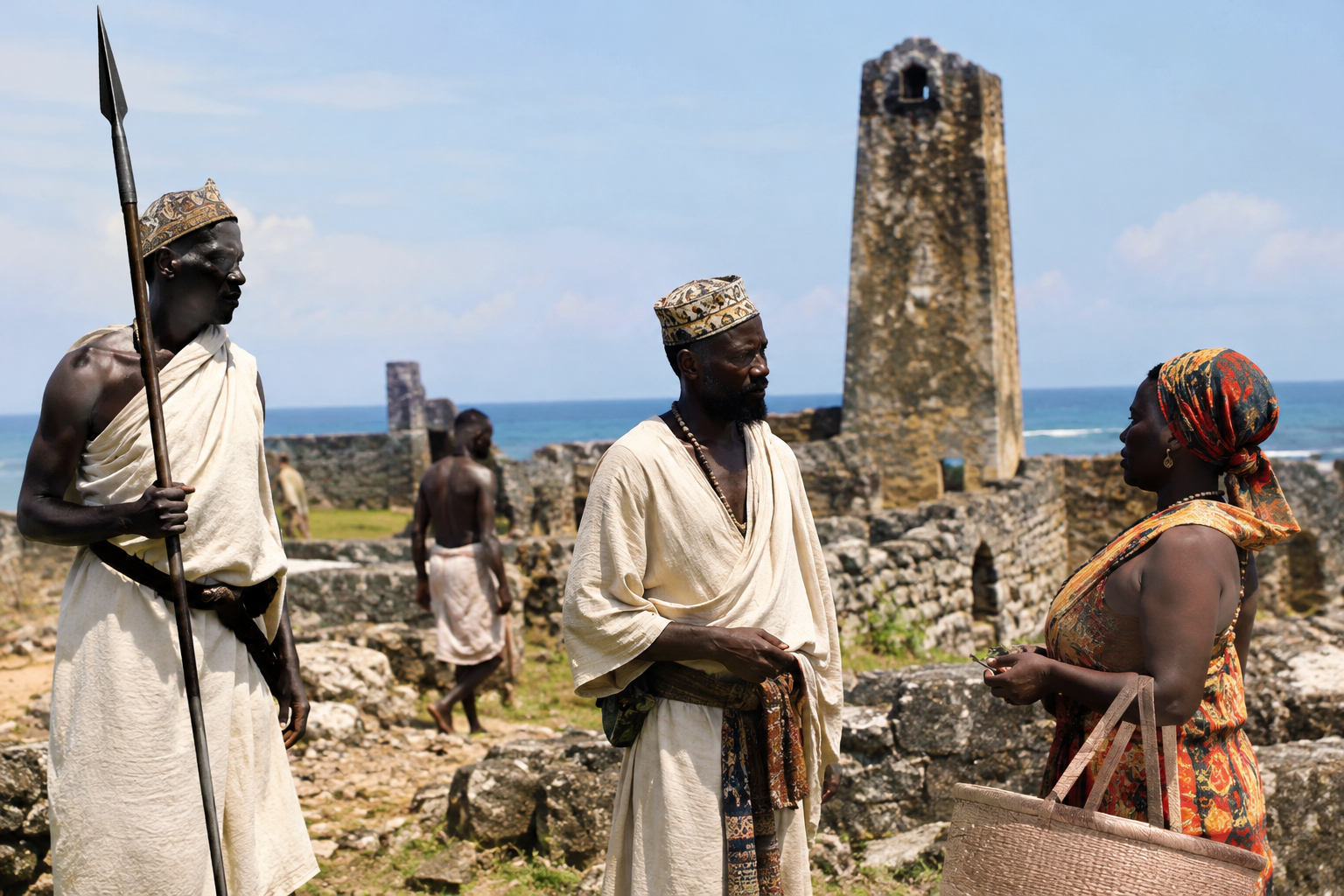
At Songo Mnara, on one of the islands of the southern Swahili coast in present-day Tanzania, archaeologists and geneticists have begun to recover something unusually vivid: not just the outlines of a medieval trading town, but actual paternal lineages carried by people who lived there. One of the ancient individuals from this setting, sample I19549, dated to around AD 1710, has been associated with the Y-DNA haplogroup E1b1b1a1a1b2.
That may look like a forbidding string of letters and numbers, but it matters because it places one direct paternal line inside a very specific historical world: the late Swahili coast, where African towns were tied into Indian Ocean commerce, Islam, and long-distance cultural exchange. Y-DNA traces just one line of descent, father to son, not a person's whole ancestry. Even so, when a lineage like E1b1b1a1a1b2 turns up in a securely dated archaeological context, it gives us a small but firm point of contact between genetics and history.
Songo Mnara is not some vague coastal backdrop. It was one of the urban settlements of the Swahili world, part of the chain of towns that linked East Africa to Arabia, Persia, India, and beyond. Stone-built mosques, houses, tombs, and imported goods have long shown that these were not isolated communities but active participants in a maritime network stretching across the western Indian Ocean.
That is what makes I19549 so interesting. The sample comes from a place already famous in archaeology for showing how African urban societies shaped, absorbed, and redirected overseas connections on their own terms. A genetic signal from this site does not reduce that history to biology; rather, it adds another layer to the evidence, anchoring one paternal branch in a town whose identity was formed by both local continuity and outward-looking exchange.
An ancient DNA study examining medieval and later individuals from the Swahili coast is linked here in research on these coastal populations. Even without overclaiming details beyond the sample information at hand, the association of I19549 with E1b1b1a1a1b2 fits the broader importance of the site: this was a lived African urban environment, not merely a stop on someone else's trade route.
The haplogroup in this article, E1b1b1a1a1b2, sits within the wider E1b1b1 family, one of the major Y-chromosome groupings with deep roots in Africa and important branches spread across parts of Africa, the Mediterranean, and western Asia. But it is essential not to blur the levels. The history of the broad parent branch is not automatically the history of this exact subclade.
In other words, it would be careless to take everything ever said about E1b1b1 and paste it onto E1b1b1a1a1b2. What we can say safely here is narrower, but more useful: a lineage reported as E1b1b1a1a1b2 appears in an ancient individual from Songo Mnara in the early modern or very late medieval Swahili world. That is a concrete historical placement, and concrete placements are what make archaeogenetics valuable.
There is also a useful historical point lurking here. The Swahili coast has sometimes been described in older writing as though its sophistication had to be explained from outside, by settlers from Arabia or Persia. Archaeology has been dismantling that story for years. A paternal lineage from an excavated burial does not settle every debate, of course, but it belongs to a growing body of evidence that keeps the focus where it should be: on African populations as the makers of Swahili civilization.
With only a single ancient sample named here, it might be tempting to shrug. But archaeologists are used to the force of well-provenanced fragments. A single coin in the right layer can date a wall; a single inscription can identify a sanctuary; a single genome, cautiously handled, can tell us that a lineage was present in a particular place at a particular time.
That is the value of I19549. The sample fixes E1b1b1a1a1b2, or a reported association with that branch, in coastal Tanzania around AD 1710. It does not mean every man at Songo Mnara belonged to that haplogroup, nor does it prove an unbroken local dynasty. What it does offer is a clean historical observation: this paternal line formed part of the human reality of the Swahili coast.
For people exploring paternal ancestry today, that kind of finding is often more revealing than a grand migration story. It places a lineage in an actual town, among actual burials, in a period when East Africa was tied into commercial and religious worlds reaching across the sea. The interest lies not in fantasy pedigrees, but in historical texture.
By the early 18th century, the Swahili coast had already been urban for centuries. Its towns spoke Kiswahili, practiced Islam in many communities, and maintained commercial links that brought ceramics, beads, textiles, and ideas across the ocean. Yet they were never simple colonies of outsiders. Their architecture, foodways, settlement histories, and local political traditions show adaptation rooted in East Africa.
That is exactly why ancient DNA from places like Songo Mnara matters so much. Genetics can contribute to old historical questions, but only when it is kept in conversation with archaeology. If a paternal lineage such as E1b1b1a1a1b2 is found in a Swahili burial context, the point is not to strip the burial of culture and turn it into a code. The point is to place a biological line inside an urban African society whose complexity is already visible in the ground.
This is also where readers should be wary of neat labels. A Y-chromosome lineage is not the same thing as language, religion, ethnicity, or political identity. A man carrying E1b1b1a1a1b2 at Songo Mnara may have belonged to a household, a neighborhood, a mercantile network, or a Muslim community, but the haplogroup alone cannot tell us which. Archaeology supplies the setting; genetics supplies one line of descent within it.
One of the most useful habits in ancient DNA writing is resisting the urge to make every result travel farther than the evidence allows. Here, the secure historical interest is already plenty. Sample I19549 shows that a branch identified as E1b1b1a1a1b2 belonged to an individual from Songo Mnara around AD 1710, in the late flowering of a major East African coastal tradition.
That matters because the Swahili towns have too often been discussed through borrowed prestige: foreign traders, foreign goods, foreign influence. But the people buried in these places were not footnotes to trade. They were the society itself. A paternal lineage recovered from one of their cemeteries is a reminder that Indian Ocean history was carried not just by ships and cargoes, but by families, households, and generations living on the coast.
For E1b1b1a1a1b2, the most distinctive ancient anchor here is not a king or a legendary founder, but an excavated individual from Songo Mnara: I19549, around AD 1710. That is a good sort of evidence to have. It ties a paternal line to a real Swahili coastal community and to a period when East Africa stood at the heart of Indian Ocean history. If this is your haplogroup, the responsible historical suggestion is not a tidy myth of origin, but a far more interesting possibility: your direct paternal line belongs within the deep human history of African coastal societies that were urban, connected, and unmistakably local.






Comments