Haplogroup E1b1a1a1a2a1a

– 5 min read


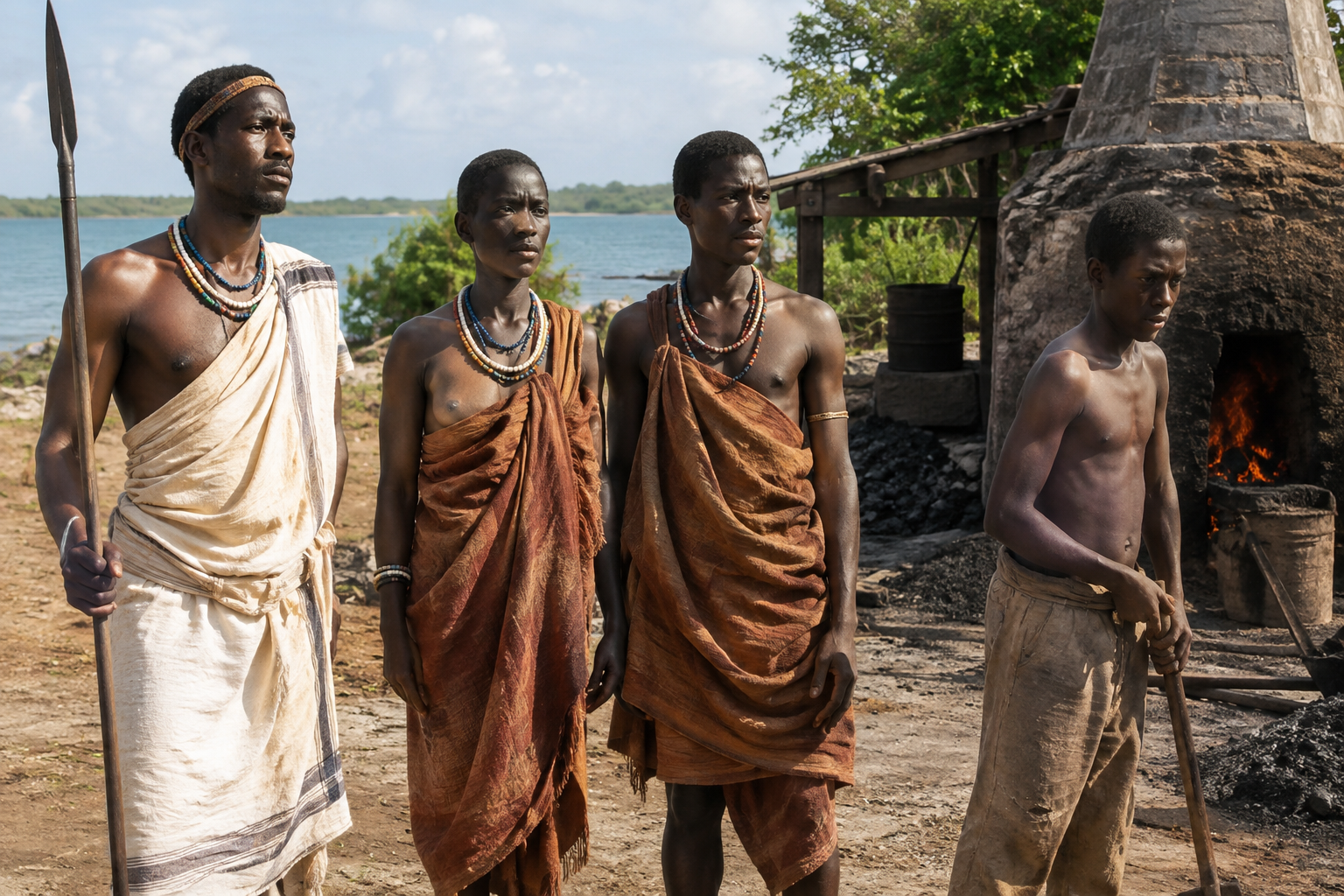
At Mtwapa on the coast of Kenya, one excavated individual dated to around AD 1600, sample I23548, carries the Y-DNA haplogroup E1b1a1a1a2a1a. That may look like an intimidating string of letters and numbers, but the setting is immediately human and historical: a Swahili coastal town at a time when East Africa was tied into the Indian Ocean world by trade, religion, migration, and slavery. A paternal lineage found here is not just a genetic label. It is a clue to the male line of one person living in a port society where African, Arabian, Persian, and later Portuguese influences met in complicated ways.
What makes this haplogroup especially interesting in the evidence here is not vast antiquity in the abstract, but the pattern of where it appears in the early modern and modern-era archaeological record supplied for this branch. We see it in coastal Kenya again at Makwasinyi in Taita Taveta, in samples I13872 and I13873 dated around AD 1750, and then in a very different setting altogether: sample I8092, an enslaved teenage male laborer from the Catoctin iron-working furnace in antebellum Maryland, dated around AD 1810. Y-DNA tracks one direct paternal line rather than a person's full ancestry, but even so, this is a striking little archive of movement between inland and coastal East Africa and, later, the Atlantic world.
Mtwapa was part of the dense chain of Swahili settlements that linked the East African shore to wider maritime networks. By around AD 1600, this was no isolated village fringe. It was a coastal world of mosques, trade connections, imported goods, local elites, and deep ties to African hinterlands as well as to the sea.
In that context, I23548 matters because E1b1a1a1a2a1a belongs within the broader E1b1a family complex that is strongly associated with many Bantu-speaking populations of sub-Saharan Africa. One must be careful here: the broader family is not the same thing as this exact terminal branch, and a single sample cannot stand for all Swahili people. But this individual does fit a wider archaeological and genetic picture in which the Swahili coast was African at its core, even while participating in a cosmopolitan Indian Ocean culture.
An ancient DNA study examining medieval and early modern eastern African populations is one of the research leads tied to these coastal finds: https://www.biorxiv.org/content/10.1101/2022.07.10.499442v1. Without overstating what can be claimed for one exact subclade, the broader importance is clear enough. Paternal lineages like this help anchor the Swahili world in the demographic history of eastern Africa, not in old fantasies that tried to explain coastal civilization as somehow imported wholesale from elsewhere.
Ancient DNA and archaeogenetics
The two later Kenyan samples, I13872 and I13873, come from Makwasinyi in Taita Taveta and are dated around AD 1750. Their importance is slightly different from Mtwapa's. They show that the same paternal branch was not confined to one famous port, but also appeared in a community inland from the coast, in a region that sat between maritime routes and interior African networks.
This matters because East African history was never simply a matter of coast versus interior. People moved for marriage, trade, labor, refuge, and war. Caravans and kinship ties connected places that modern maps too easily divide. The appearance of E1b1a1a1a2a1a in both Mtwapa and Makwasinyi suggests continuity in African paternal lines across connected but distinct local settings.
It is tempting, with two individuals from the same place and date, to start imagining a close family relationship or a local clan history. That would be going beyond the evidence provided here. What can be said more safely is that repeated detection at Makwasinyi turns a lone observation into a pattern. This branch was part of the lived male-line diversity of the region in the eighteenth century.
E1b1a1a1a2a1a sits within a large paternal lineage that expanded widely in sub-Saharan Africa, especially in regions shaped by the long and uneven histories of Bantu-language dispersals. That general background helps make sense of why a branch like this appears in East African contexts. But the exact subclade in this article should not be burdened with every migration story ever told about the parent haplogroup.
That distinction is worth keeping in view. A parent haplogroup may have a very broad geographic and chronological history, while a narrower downstream branch can reflect far more local and recent male-line developments. For family historians, that is actually the interesting bit: the finer the branch, the closer we often get to regional human history rather than textbook prehistory.
In other words, E1b1a1a1a2a1a is best approached here through the evidence we do have. That evidence places it in eastern African contexts connected to the Swahili coast and then, by the nineteenth century, in the life of an enslaved youth in North America. The line is real; the details between those points must be reconstructed carefully, not romantically.
The most emotionally forceful sample in this group is probably I8092, identified as an enslaved teenage male laborer from the Catoctin iron-working furnace in antebellum Maryland, dated around AD 1810. Here the haplogroup appears not in a coastal African town, but in the setting of American slavery and industrial labor. The paternal line had crossed an ocean, though of course not by free choice.
This is the sort of find that reminds us how ancient DNA and more recent historical archaeology can meet. A Y-chromosome lineage that appears in East African contexts also appears in the remains of a boy caught in the machinery of the Atlantic slave economy. That does not prove he came specifically from coastal Kenya, nor that his father's father's line can be traced neatly to the Kenyan individuals named above. But it does place his paternal ancestry within a larger African story that archaeology in the Americas has too often struggled to recover from the written record alone.
A second research lead associated with these later-period remains is https://www.biorxiv.org/content/10.1101/2022.06.12.495320v1. The exact contribution of that study should not be exaggerated beyond the evidence available here, yet the broader setting is important: archaeogenetics can restore some measure of personal and ancestral specificity to people who were historically stripped of both.
Taken together, these samples do not tell a fairy-tale story of one heroic bloodline. They tell something more useful. E1b1a1a1a2a1a appears here in African coastal and inland settings shaped by trade and local continuity, and then in a North American context shaped by forced migration. That is a historical pattern, not just a genetic one.
For someone researching this paternal branch today, the most responsible conclusion is that it sits comfortably within African male-line history and, in the evidence here, is especially visible in eastern African and African-diaspora contexts from the last few centuries. The archaeology does not turn the haplogroup into an ethnicity or a biography. But it does give it a setting: Swahili towns, connected inland communities, and the shattered trajectories created by slavery.
African DNA in unexpected places
That is a modest conclusion, but a strong one. This branch is not floating in genetic abstraction. It is attached to real people in documented places, and those places reveal a paternal history shaped by African continuity, regional mobility, and the brutal reach of the early modern slave trade.
Comments