Haplogroup E1b1a1a1a1b

– 5 min read


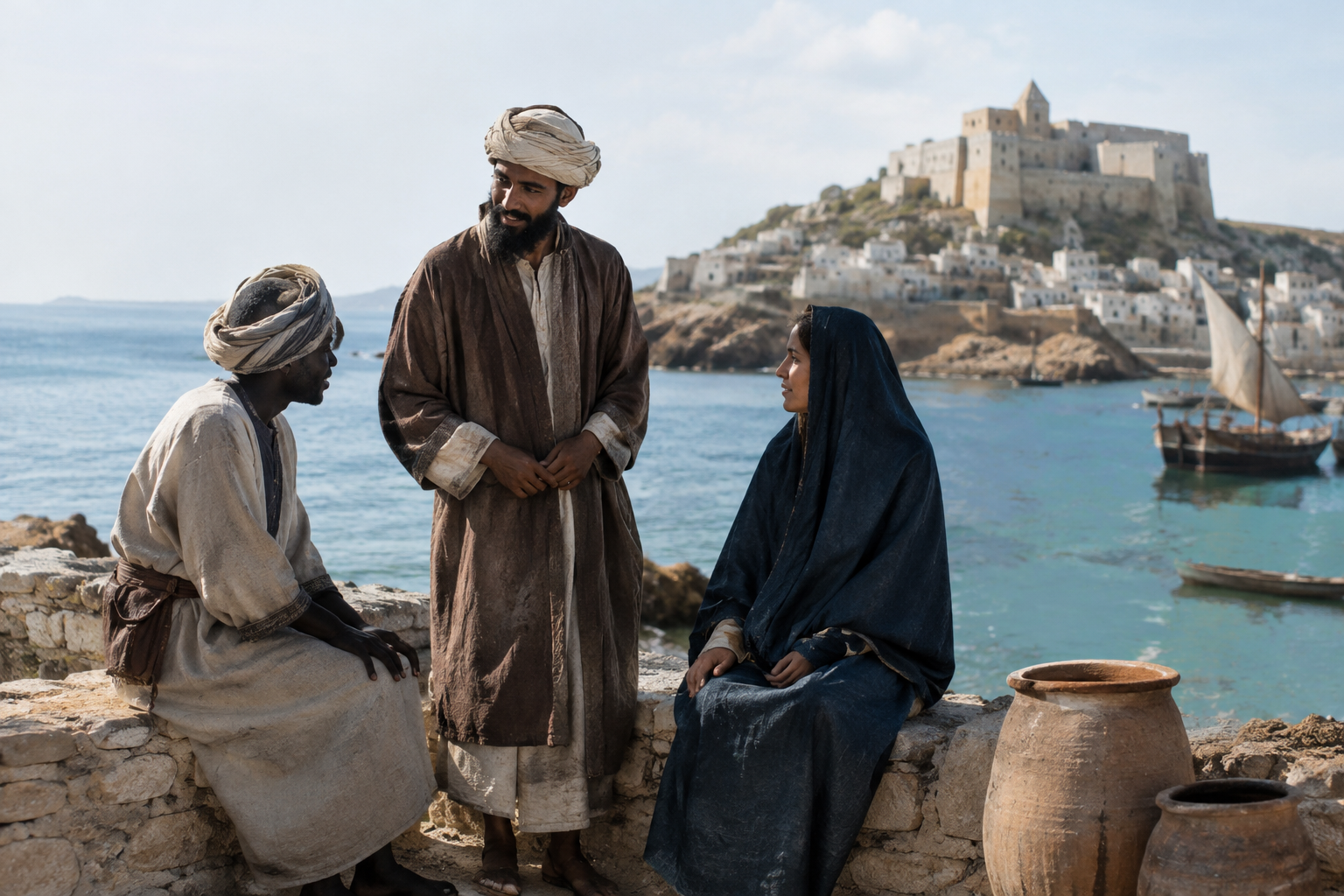
One of the most arresting ancient signals for haplogroup E1b1a1a1a1b comes from medieval Ibiza, where an individual identified as ldo121, dated to around AD 950, was classified as Al-Andalus Sub-Saharan. That is already enough to make historians sit up. Ibiza is often pictured through its Phoenician, Roman, or later Mediterranean past, but this burial points us toward a different and very real dimension of the island's history: the movement of people through the Islamic western Mediterranean, including men with paternal ancestry tracing back into Sub-Saharan Africa.
This is exactly the kind of case where Y-DNA is both illuminating and easy to oversimplify. E1b1a1a1a1b traces one direct paternal line only, not the whole ancestry or identity of the person who carried it. Still, when such a lineage appears in an archaeologically dated burial from Islamic Ibiza, it becomes a concrete reminder that medieval Mediterranean societies were not sealed worlds. They were connected by trade, slavery, military service, pilgrimage, and ordinary migration, all of which could leave descendants in places far from a lineage's deeper African heartlands.
By the 10th century, the Balearic Islands sat within the political and commercial orbit of Al-Andalus. That meant links not only with Iberia, but with North Africa and wider Islamic networks. A man buried on Ibiza with a paternal lineage in E1b1a1a1a1b belongs in that historical setting, not as an exotic exception dropped from nowhere, but as part of a broader pattern of mobility across sea routes that tied together ports, islands, and frontier zones.
The sample label itself matters here: Medieval Ibiza Al-Andalus Sub-Saharan. It suggests that researchers saw genome-wide or contextual evidence consistent with Sub-Saharan ancestry, while the Y-chromosome assignment places the direct male line in a branch widely associated today with populations in West and Central Africa. We should be careful not to flatten this into a single origin story. A lineage like E1b1a1a1a1b could have arrived in Iberia or the Balearics by several routes, and not necessarily in the lifetime of the buried man himself.
A useful companion piece for the island setting is this broader look at population history in the region:
E1b1a1a1a1b is a narrow branch within the larger E1b1a family, one of the major Y-chromosome lineages of Sub-Saharan Africa. The big historical point is not that every carrier shares the same culture, language, or recent homeland. Quite the opposite. Over time, lineages within E1b1a spread through very different societies, and the narrower the branch, the more careful we need to be about making claims unless sample-specific evidence is available.
In this case, the ancient sample from Ibiza is the anchor. The safest reading is that a direct paternal line falling under E1b1a1a1a1b, or reported in association with that branch, was present in an Islamic-period burial on the island around AD 950. That does not tell us whether the man's father, grandfather, or much earlier paternal ancestors moved through Morocco, southern Iberia, or another route. But it does place this African-linked Y-line firmly inside the lived human history of medieval Ibiza.
The western Mediterranean under Islamic rule was a zone of extraordinary circulation. Armies crossed the straits; merchants moved textiles, grain, metals, and captives; scholars and sailors moved with them. If we are trying to understand how a paternal lineage such as E1b1a1a1a1b could appear on Ibiza, this is the historical machinery that made it possible.
It is also worth resisting a tidy modern map. "Sub-Saharan" in an ancient-DNA interpretation is not the same thing as a fixed ethnicity, and "Al-Andalus" was never a single, uniform population. Medieval Iberian Islamic societies included locally rooted people, recent arrivals from North Africa, descendants of earlier migrants, converts, enslaved individuals, freed communities, and families of mixed background. A Y-chromosome result like this is interesting precisely because it shows one thread inside that larger social fabric.
Recent work on related Iberian contexts has been pushing historians in this direction for some time, especially where burial grounds reveal more diversity than old narratives allowed. One relevant example is the growing genetic evidence for varied origins in early medieval central Spain:
Diverse Origins in Medieval Spain
There is a temptation, when only one named ancient sample is available, to treat him as either a complete anomaly or as proof of a vast hidden migration. Neither approach is very good history. A single burial cannot stand in for the whole male population of Ibiza. But neither should it be dismissed as a curiosity. Archaeology is often changed by exactly these well-dated, well-placed individuals, because they force us to see communities in sharper detail.
ldo121 is valuable because he ties together three things that are too often discussed separately: island archaeology, Islamic-period Iberia, and African paternal ancestry. The burial shows that these are not abstract categories. They met in real human lives. Medieval island communities were shaped not just by local continuity, but by arrivals, inheritances, marriages, coercion, and adaptation across generations.
That broader picture sits well with recent discussion of Ibiza's Islamic-period burials and their diversity, which has helped move the island away from simplified tourist-history versions of itself:
Research on medieval Ibiza has increasingly shown that the island can be studied through ancient DNA as well as through texts and archaeology. One relevant scientific entry point is this research record, which is associated with the ancient sample evidence discussed here. It is best used as support for the existence of such findings, rather than as a license to invent more detail than the presently available summary allows.
That caution matters. We do not, from the information here alone, know the man's occupation, legal status, language, or family story. We do not know whether his paternal line had been on the island for one generation or several. But we do know enough to say something historically substantial: by around AD 950, a man associated with E1b1a1a1a1b was buried in Islamic Ibiza, and his presence fits a Mediterranean world linked to Africa in deep and practical ways.
If your Y-DNA belongs to E1b1a1a1a1b, the most responsible takeaway is not a fantasy of one dramatic voyage, but a recognition that this paternal branch belongs to the long history of African male lineages whose descendants could appear in many settings far beyond their earlier centers of expansion. The medieval Ibiza evidence is striking because it places one such line in a specific time and place: an island society of Al-Andalus connected to Iberia, North Africa, and the wider Islamic world. For family historians, that is a small but vivid window into how direct paternal ancestry can intersect with the real movement of people across medieval seas.



Comments