Haplogroup CTS9993
– 4 min read


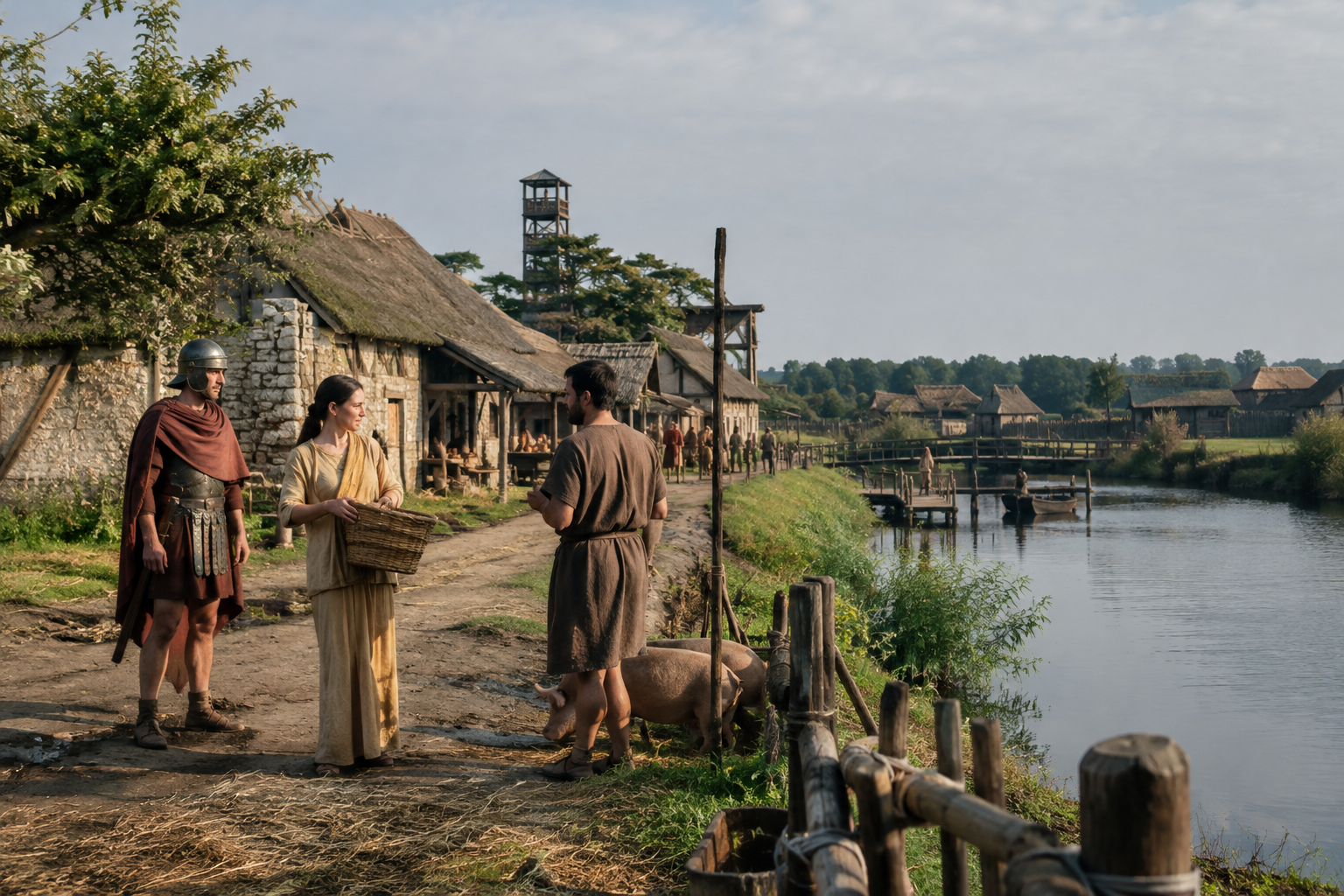
At Fenstanton in Cambridgeshire, a Roman-era burial dated to around AD 100 has given us a small but rather telling clue about haplogroup CTS9993. The individual recorded as FEN003 is not a king, not a legendary conqueror, and not the founder of a dynasty. He matters precisely because he seems to have been an ordinary man living in a provincial landscape where local traditions, imperial power, and population movement were all rubbing up against one another.
That is often how Y-DNA becomes historically useful. A paternal lineage such as CTS9993 traces one direct male line only, not a person's whole ancestry, but when it turns up in a securely dated archaeological setting it helps pin that line to a real place and time. In this case, the anchor point is Roman Britain, in a region that was both deeply local and thoroughly connected to the wider empire.
Fenstanton sits in a part of eastern England that, in the Roman period, was anything but remote. Cambridgeshire lay within a busy agricultural zone, linked by roads, river systems, and market exchange to larger Roman networks. A man buried there around AD 100 was living in the first century or so after the conquest of Britain, when Roman administration had arrived, but older regional identities had certainly not vanished.
That makes FEN003 especially interesting. A Y-chromosome assignment to CTS9993 places this paternal line firmly in Roman-period Britain, but without forcing a simplistic label onto the man himself. He may have come from a family rooted in Britain before the conquest, or from a line that had moved within northwestern Europe before ending up in Cambridgeshire. The point is not to oversimplify him into "native" or "migrant", but to see how one paternal branch was present in the lived world of early Roman Britain.
An ancient DNA study examining Roman and early medieval Britain has helped show just how varied that world could be, with biological continuity in some places and substantial mobility in others. Fenstanton belongs to that wider picture of provincial life in which genetics and archaeology together reveal a population more mixed, layered, and local than older textbook categories allowed in research on ancient genomes from Britain.
Roman and Early Medieval Britain DNA
With some haplogroups, the temptation is always to tell a grand migration story first and ask questions later. That would be a mistake here. CTS9993 is the branch we are discussing, and it should not simply inherit every sweeping claim ever made about its broader parent lineage. What FEN003 gives us is something much more solid: evidence that this paternal branch, or a very near reported association to it, was present in Roman Cambridgeshire around the turn of the 2nd century AD.
For family historians, that matters because archaeology gives depth to the lineage. Instead of imagining an abstract SNP floating in a chart, we can place it in a real community under Roman rule, in a county that would later become central to the making of medieval England. A branch like CTS9993 does not tell us that every bearer shared the same language, culture, or legal status. It tells us that one paternal line was part of the human patchwork of Roman Britain.
It is worth lingering on that phrase, "Roman Britain", because it can sound far tidier than the evidence really is. The province included soldiers from abroad, local farming families, traders, officials, craftspeople, and people whose ancestors had been moving around the North Sea zone long before Rome arrived. Cambridgeshire, lying between lowland routes and productive countryside, was exactly the sort of place where empire did not erase the local world but reorganised it.
So FEN003 should be read against that broader archaeological setting. A burial in Roman-era Fenstanton is not a badge of one identity. It is a reminder that early Roman Britain was made up of many overlapping histories: indigenous Iron Age communities adapting to conquest, newcomers from elsewhere in Britain, and some movement from the continent as well. Y-DNA helps because paternal lines can persist through those historical changes even when language, material culture, or political allegiance shift dramatically.
One of the most useful ways to think about CTS9993 at Fenstanton is through continuity rather than spectacle. The Roman conquest did not wipe the demographic slate clean in eastern Britain. In many regions, local populations remained in place while new institutions, roads, taxes, military demands, and cultural habits altered daily life around them. A paternal lineage found in a Roman burial may therefore reflect deeper roots in Britain or nearby parts of Europe that predate the formal provincial system.
That is also why single-sample evidence needs careful handling. FEN003 is valuable because he is securely situated in time and place, not because one burial can define the whole history of CTS9993. But even a lone sample can be important when the branch is otherwise thinly represented in published ancient contexts. It marks a documented stop on the long route by which a male line moves from prehistory into named history.
Cambridgeshire has proved especially rich for that sort of work, because burials from different centuries allow scholars to compare changing ancestry patterns over time. When later medieval and post-Roman populations are brought into view, the region becomes a useful laboratory for watching continuity, admixture, and local survival play out across many generations.
For someone researching a modern CTS9993 paternal line, the Fenstanton evidence offers a grounded historical hint rather than a fantasy pedigree. It suggests that this branch had reached, or persisted in, eastern Britain by the Roman period. That does not prove that every present-day bearer descends from Roman Britain specifically, nor does it identify a tribe, surname, or noble house. But it does place the lineage in one of the most consequential historical settings in early British history: a province where local and imperial worlds met face to face.
That is, in truth, the most interesting thing about FEN003. He shows that a haplogroup can become historically meaningful without being famous. CTS9993 is not illuminated here by royal propaganda or later genealogy, but by one excavated man in Roman Cambridgeshire, living at a moment when Britain was being remade yet remained stubbornly, recognisably itself.
A Romano-British Life Reconsidered
If your paternal line falls under CTS9993, the strongest ancient foothold currently visible here is Roman-era Fenstanton through sample FEN003. That is a modest finding, but a very real one: this branch belonged to at least one man living in Cambridgeshire around AD 100, in the thick of Britain's transformation under Rome. Sometimes the most valuable ancient DNA evidence is not a grand dynasty at all, but an ordinary burial that fixes a lineage to the map of history.






Comments