Haplogroup C2b1b

– 5 min read


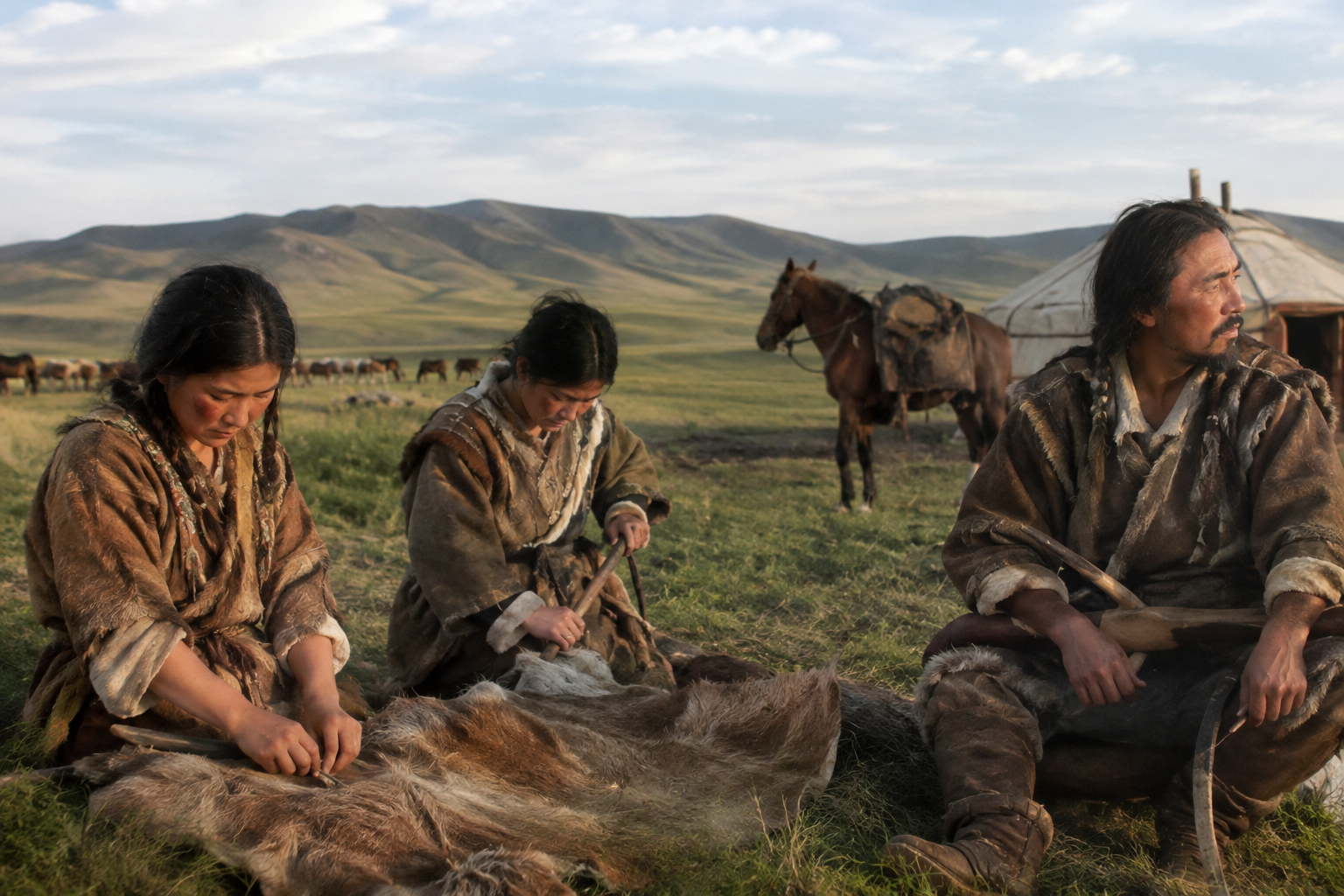
At Miaozigou, in what is now Inner Mongolia, two men dated to around 3500 BC stand out for anyone interested in the deep history of Y-DNA haplogroup C2b1b. They are recorded as MZGM10-1 and MZGM16, and they come from a world far older than empires, tribes named in chronicles, or the familiar political map of East Asia. Here the interest is not dynastic glamour but something more fundamental: a paternal line appearing in a Neolithic community on the northern edge of the Yellow River world.
That matters because Y-DNA traces one direct male line only, not a person's whole ancestry, yet even that single line can be historically revealing. In the case of C2b1b, the ancient evidence supplied here places it in northern China and the Mongolian steppe zone across a very long span, from the late Neolithic into the Han period. The pattern is modest in sample count, but it is precisely the sort of pattern archaeologists like: sparse, scattered, and therefore worth taking seriously when it repeats.
MZGM10-1 and MZGM16 are the earliest anchors in this small dossier. Both are associated with Miaozigou Uraharura Qahar Youyi Qianqi and dated to around 3500 BC. That places them in a formative age when northern China was not a single cultural bloc but a mosaic of farming communities, frontier zones, and contacts stretching toward the eastern steppe.
A genetic study of northern East Asian populations published in Nature Communications has helped clarify just how dynamic these northern regions were over millennia. Even without forcing a grand migration tale onto two men, their value is clear enough: they show that a paternal line connected here with C2b1b was present in the deep prehistoric north long before later steppe confederations, imperial expansions, or medieval clan traditions.
That is an important corrective to the way people sometimes imagine haplogroups. A branch later associated in the popular mind with steppe populations or historically documented Inner Asian peoples may turn up, in ancient DNA, among much earlier communities whose social world was entirely different. The Miaozigou men belong to that earlier horizon.
It is worth pausing over the label itself. C2b1b is a specific branch within the wider C2 paternal family, a lineage with a broad history across parts of northern and eastern Asia. But one should not lazily pour the whole history of C2 into this narrower subclade. The evidence here supports a more careful claim: men reported in connection with C2b1b appear in two quite different archaeological settings, one Neolithic and one much later steppe-Han frontier context.
That distinction matters because archaeology works by context. A Y-chromosome branch is not an ethnicity, not a language, and certainly not a ready-made tribal badge. What it can do is reveal continuity, recurrence, or movement in paternal lines across time. With C2b1b, the most striking feature in the present evidence is not a single famous ruler but the durability of a northern paternal thread over more than three millennia.
The later pair of samples, YK15 and QL11, are dated to about 100 BC and described as Han Chinese from the Mongolian steppes. That phrase alone captures a historically interesting frontier. By the late 2nd and 1st centuries BC, the Han empire was increasingly engaged with the steppe world to its north, through war, diplomacy, trade, colonization, and shifting border societies. This was not a neat line between "China" and "the steppe", but a contact zone full of mixed local histories.
In that setting, the appearance of the same haplogroup branch is suggestive. It does not prove that YK15 or QL11 descended directly from the Miaozigou men, nor that one stable ethnic population simply sat in place for 3,400 years. What it does suggest is that paternal lines associated with C2b1b remained part of the human landscape of the northern frontier, even as economies, political systems, and identities changed radically.
An article discussing ancient DNA from steppe populations, including lineages from the Mongolian steppe world, gives useful broader context for how often paternal history in this region can be both concentrated and historically durable: https://indo-european.eu/2018/04/ancient-nomadic-tribes-of-the-mongolian-steppe-dominated-by-a-single-paternal-lineage/. One should be careful with broad analogies, but the larger point is sound: steppe and frontier populations often preserve strong signals in male-line descent even while their wider genetic ancestry and political identities remain mixed and changing.
There is a temptation, when faced with only four ancient samples, to treat them as too few to say anything useful. Archaeologically, that would be a mistake. The 3500 BC Miaozigou individuals and the c. 100 BC steppe individuals do not form a complete history, but together they frame a real historical question: how did paternal lineages persist, spread, or reappear across northern East Asia as farming communities, mobile pastoral groups, and imperial systems interacted?
The gap between the samples is not a weakness so much as a reminder of how fragmentary the ancient record still is. For this particular haplogroup, the available evidence hints at longevity in the north rather than a brief, isolated appearance. It places C2b1b in a landscape where contact between the Yellow River sphere and the steppe was not a late accident, but an enduring structural feature of history.
That also fits well with broader discussions of prehistoric interaction zones north of the Chinese heartlands. The frontier was never merely a wall's edge; it was a belt of exchange, adaptation, and demographic layering. Haplogroups such as C2b1b become interesting precisely because they can outlast those political labels and give us a glimpse of deeper continuities under changing regimes.
Seen together, these samples draw a small but vivid map. MZGM10-1 and MZGM16 belong to a Neolithic northern community around 3500 BC; YK15 and QL11 belong to a frontier world around 100 BC in which Han political reach met steppe realities. The social worlds are utterly different, yet the paternal signal linked here with C2b1b appears in both.
That is the real historical interest of this haplogroup in the present evidence. Not that it can be tied to a single named people, and not that it offers a simplistic badge of identity, but that it seems at home in northern East Asia across very different eras. If your own paternal line falls within C2b1b, these ancient men suggest a deep connection to the long human history of the northern Chinese and steppe-border zone: a place of persistence, movement, and repeated remaking.
The strongest insight from the current evidence is simple and rather elegant: C2b1b is attested here not in one dramatic royal burial, but in ordinary ancient people from two major northern contexts separated by thousands of years. That makes it a lineage of historical depth in northern East Asia, especially around the frontier between the agricultural north and the steppe. For family historians, that is often the more valuable kind of result - less legend, more landscape.






Comments