Haplogroup C2a1a1b1b1

– 4 min read


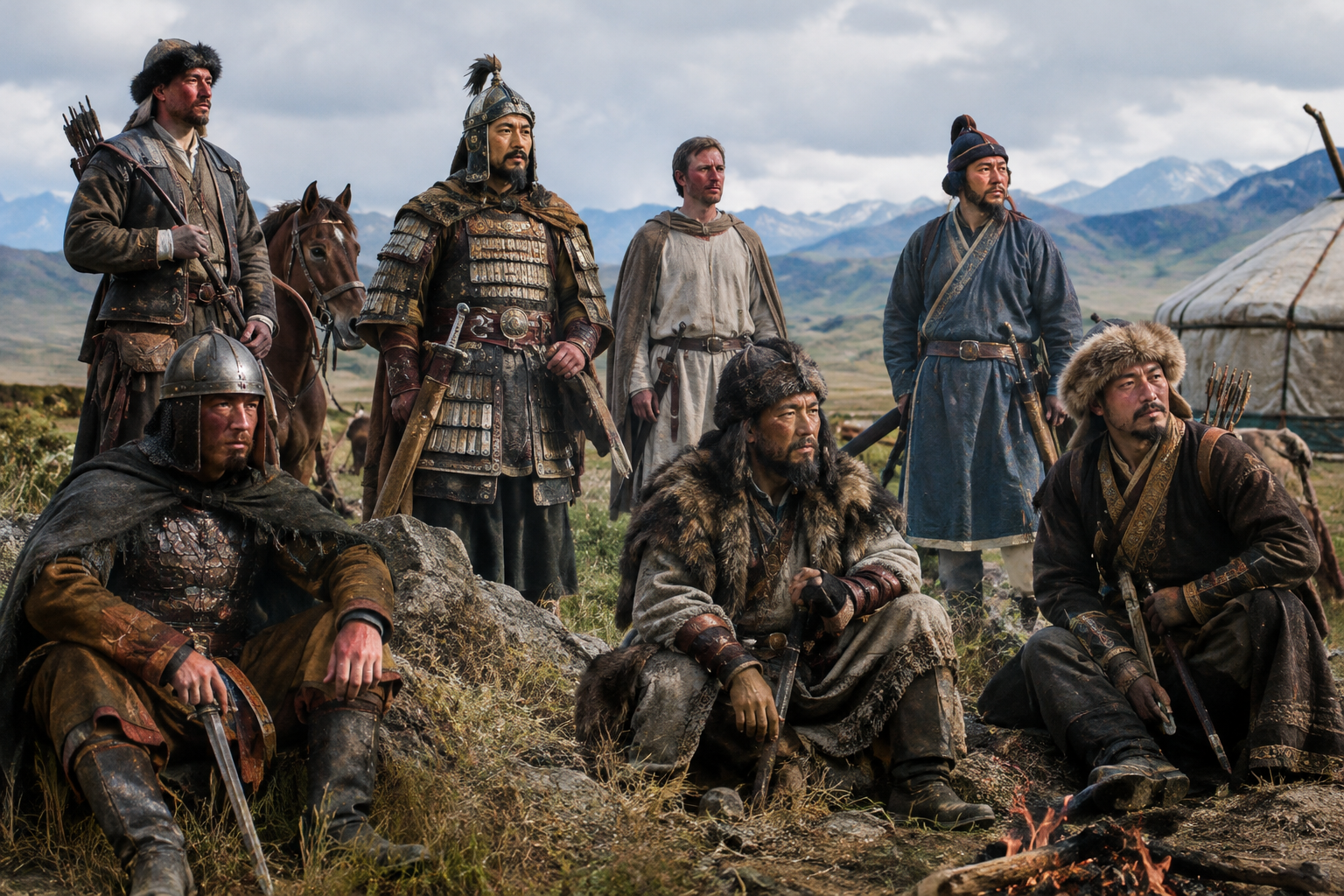
One of the more arresting appearances of haplogroup C2a1a1b1b1 in this set of ancient finds comes from the eastern edge of medieval Europe: sample UKR137, dated around AD 850, from the Saltiv context in the forest-steppe zone of Ukraine. That is already a suggestive combination. Saltiv or Saltovo-Mayaki archaeology belongs to the frontier world around the Khazar sphere, where steppe nomads, local farming populations, merchants, and military groups met in ways that were rarely neat or ethnically pure.
That matters because Y-DNA follows one direct paternal line only, not a person's whole ancestry, yet paternal lines can still be historically revealing when they turn up in the right places. In the case of C2a1a1b1b1, the most striking feature of the evidence here is not a single dynasty or kingdom, but a chain of appearances stretching from the eastern steppe and Inner Asia into the medieval western steppe, linking this branch to mobile societies that crossed enormous distances.
UKR137 sits in a region that was anything but isolated. By the ninth century, the Ukrainian forest-steppe was tied into political and trading networks that reached the Caucasus, the Volga, the Black Sea, and the steppe beyond. A study of mobility in the North Pontic region, including material from Ukraine, helps frame this landscape as one of repeated movement and contact rather than sealed populations here.
So what does it mean to find C2a1a1b1b1 in that setting? Not that one can name the man's language, tribe, or biography from a Y-chromosome alone. But it does suggest that a paternal lineage more often associated with eastern Eurasian and steppe histories had reached, and become part of, communities on the western steppe frontier by the early medieval period. In other words, this is not just a marker of distant origin; it is evidence of incorporation into a real frontier society.
The Saltiv world is especially useful for understanding such a haplogroup because it resists tidy labels. Archaeology there repeatedly shows mixed material traditions and varied biological backgrounds. A paternal branch like C2a1a1b1b1 fits that picture rather well: not a badge of a single people, but a thread in the larger fabric of steppe-era mobility.
If we move east and back in time, the same haplogroup appears in a much older sequence of steppe and frontier populations. Sample JAG001, from Jargalantyn Am in Mongolia and dated around 100 BC, belongs to the Early Xiongnu period. Another, CHN010, from the Wusun context at Uyuk-Sagly, Chandman Mountain, is dated around AD 25. Then there is MGS-M7R from Mogushan, Inner Mongolia, around AD 150, identified with the Xianbei horizon.
These are not the same polity, nor should they be flattened into one ethnic block. The Xiongnu confederation, the Wusun, and the Xianbei each occupied different moments and different positions in the history of eastern Central Eurasia. Yet taken together, they show something important: C2a1a1b1b1 appears again and again in precisely those regions where mounted pastoralism, imperial expansion, alliance-building, and population mixture shaped history.
Research on the Mongolian steppe has made this broader point forcefully. Ancient DNA has shown that eastern steppe populations changed over time, but also that certain lineages and ancestry profiles persisted within highly mobile political worlds rather than vanishing with each new confederation. A major study of the region can be found here.
For someone exploring this haplogroup today, that eastern cluster is the real anchor. It places the branch in the long history of Inner Asian populations well before its later appearances farther west. The western finds are historically exciting, but the deeper pattern points back to the steppe heartlands.
One of the most interesting samples in this group is I41205, dated around AD 400, from a Gothic grave at the Aul of Kan Omurtag, Han Krum Village, Bulgaria. On the face of it, that may seem surprising. "Gothic" in popular history often conjures a migrating people from northern Europe, as though archaeology ought to deliver a clean northern package every time. But ancient DNA has been busily dismantling that expectation.
A person buried in a Gothic archaeological context did not have to carry a stereotypically "Gothic" paternal line, because late antique Gothic communities were themselves composite. They could absorb men and women from different local and long-distance backgrounds while maintaining a shared political identity, burial custom, or military affiliation. That is one reason a lineage like C2a1a1b1b1 can turn up in Bulgaria without requiring a melodramatic tale of one solitary wanderer from Mongolia. The late Roman and post-Roman Balkans were full of mixed frontier communities.
Goths in Late Antique Bulgaria
That is the larger lesson of I41205. Cultural labels in graves describe archaeological and historical settings; they do not guarantee a single genetic profile. Here again, the haplogroup is most useful when read as evidence of contact, recruitment, and incorporation across steppe and Balkan worlds.
The medieval and post-classical record strengthens that impression. Sample DA106x, from Boz Adyr in the Tian Shan, Kyrgyzstan, is dated to about AD 1171. Closely related in historical setting is DA106, identified more generally as a medieval Turkic-speaking nomad from Kyrgyzstan, dated around AD 1250. These are not just eastern echoes of a much older story. They show the branch continuing within mobile societies of Central Asia well into the medieval period.
This matters because the Tian Shan corridor was one of Eurasia's great contact zones. It linked the steppe, oasis worlds, mountain pastures, and Silk Road routes. A paternal lineage appearing there in medieval nomadic contexts sits exactly where one might expect a durable steppe-associated branch to survive, recombine with new populations, and travel onward.
There is a temptation, of course, to make every Central Asian Y-line into a label for Turks, Mongols, Huns, or some single named confederation. That is much too blunt. What the evidence actually gives us is continuity of one paternal branch across several different historical formations in Inner Asia, followed by appearances in western frontier zones where steppe influence was unmistakable.
The strongest supported insight from these samples is that C2a1a1b1b1 belongs to a paternal history shaped by Inner Asian and steppe mobility. Its ancient appearances run from the Xiongnu-era Mongolian world through Wusun and Xianbei settings, on into medieval Central Asian nomad contexts, and then into western steppe and Balkan frontier communities such as UKR137 and I41205.
For a modern tester, that does not prove descent from any one famous tribe or ruling house. What it does suggest, responsibly, is a paternal line with credible roots in the broad historical zone of eastern Eurasia and the steppe networks that repeatedly carried people, languages, and allegiances across continents.






Comments