Haplogroup C2a1a1

– 5 min read


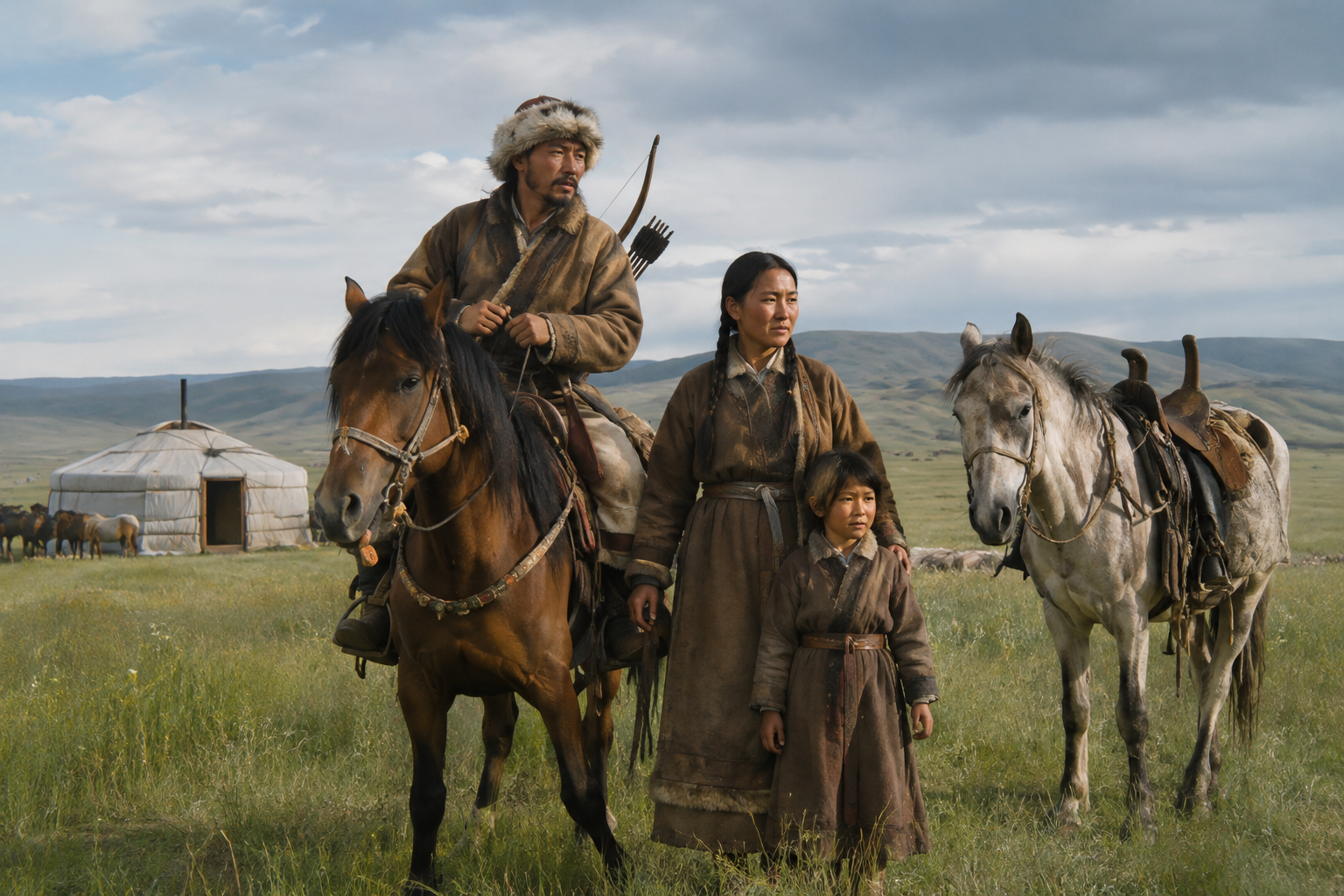
One of the clearest ancient signposts for Y-DNA haplogroup C2a1a1 in this material is sample GG3, dated to around 460 AD and described as an individual from the ancient nomadic Mongolian steppes. That is already enough to make the case historically interesting. We are not looking at a sedentary farming village or a courtly pedigree, but at a man from a mobile steppe world in late antiquity, a period when Inner Asia was full of political confederations, shifting alliances, and movements of people across enormous distances.
For anyone researching this paternal line today, GG3 matters because C2 lineages are deeply associated with eastern Eurasia and especially with populations of the steppe and adjoining regions. But it is worth being precise: Y-DNA traces one direct paternal line only. It does not by itself define an entire ancestry, language, or identity. What this sample gives us is something more modest, and in some ways more valuable: a real ancient man, in a real historical landscape, whose paternal line falls within the branch discussed here.
The date of about 460 AD places GG3 in a fascinating and unsettled age. Across Inner Asia, the centuries around the fall of the Xiongnu world and the rise of later steppe powers saw repeated reorganization of communities, leadership groups, and tribal confederations. The Mongolian steppe was not a blank expanse waiting for empire. It was already a densely historical zone, where herding lifeways, seasonal mobility, exchange networks, and political competition had been shaping populations for centuries.
That matters for how we read haplogroup C2a1a1. A lineage found in such a context is not just a marker on a phylogenetic tree. It belongs to a social world in which paternal descent could matter greatly, especially in mobile pastoral societies where clan memory, alliance, and ancestry claims often had political weight. Yet archaeology also warns us not to over-romanticize this. One sample does not reveal a whole clan, still less an empire; it gives us one secure foothold in a broader pattern.
A study of ancient populations from Mongolia and surrounding steppe regions has helped show just how dynamic that wider pattern could be, with eastern Eurasian lineages appearing in changing combinations across time and place. For readers wanting the broader regional backdrop, MyTrueAncestry has also covered Ancient DNA and Genetic History of the Mongolian Steppe.
At a broad level, haplogroup C is one of the old and important Y-chromosome branches of Eurasia, and C2 in particular has a strong history in eastern and northern Asia. The more specific label C2a1a1 is a narrower paternal branch within that wider family. That distinction is crucial. We should not casually assign to C2a1a1 every migration, expansion, or historical association ever proposed for C2 as a whole.
Even so, the setting of GG3 fits the larger picture rather well. Late antique Mongolia sits in a region where C2-related paternal lines have often been historically relevant, especially in populations connected to steppe mobility, eastern Inner Asia, and later Mongolic-speaking spheres. The important point is not that one man can stand in for all of that history, but that he shows this branch was present in the right sort of landscape, at the right sort of time, to belong to those long steppe continuities.
That is one of the pleasures of archaeogenetics when used carefully. It does not replace archaeology or history; it pins them down. A label like C2a1a1 becomes more than a modern testing result once it is anchored to an actual person from the fifth-century steppe.
It is tempting to imagine the Mongolian steppe as remote, but historically it was the opposite: a corridor linking eastern Siberia, northern China, the Altai, and the wider Inner Asian world. People, animals, technologies, and political loyalties moved through it. So did paternal lines. A lineage like C2a1a1 found in this setting fits a world of movement rather than isolation.
This does not mean that every bearer of the haplogroup was a conqueror or belonged to a famous ruling house. Ancient DNA often works against that sort of grand simplification. What it shows instead is that the paternal landscape of the steppe included lineages that could persist locally, spread with mobile groups, and reappear in very different later populations.
That larger eastern Eurasian background is explored from another angle in MyTrueAncestry's piece on Prehistoric Interactions from Central China to the Mongolian Steppe, which helps frame the deep regional connections behind later historical societies.
Now, one may reasonably ask: with only GG3 named here, how much can we really say? Quite a lot, provided we say the right things. A single ancient Y-DNA result cannot define the full range of C2a1a1. But it can demonstrate that this paternal branch, or an assignment associated with it, was present among late antique steppe nomads in Mongolia. That is already historically meaningful.
It also helps counter a common misunderstanding in public DNA discussions. Modern haplogroups are often treated as if they belong neatly to present-day nations. Ancient evidence rarely behaves so tidily. A fifth-century man from the Mongolian steppe reminds us that paternal lineages belong first to human histories of movement, mixture, and local continuity, not to modern passport categories.
The research trail attached to this sample points to an ancient DNA study of Inner Asian skeletal remains. Without overstating details beyond the evidence at hand, this kind of work is precisely what has made it possible to connect named archaeological individuals to broader questions about population history on the steppe.
Although this article is centered on Mongolia, the significance of C2-related lineages extends more widely across northern Eurasia. Over long periods, the steppe and forest-steppe zones connected communities from the Baikal region to the Altai and beyond. Some paternal branches spread with local expansions; others were folded into later confederations and new ethnic formations. That is why a steppe-era sample can be relevant to people whose more recent paper trail lies elsewhere in Asia.
MyTrueAncestry's article on Ancient DNA Unveils Eastern Roots of Uralic Languages, Bridging Siberia and Europe offers a useful comparison here. Not because C2a1a1 should be equated with Uralic-speaking history, but because it shows how ancient northern Eurasia was made of overlapping demographic zones rather than isolated cultural boxes.
Eastern Roots in Northern Eurasia
Another relevant comparison is the growing body of evidence from neighboring steppe and frontier populations, where ancestry can shift while cultural labels remain frustratingly broad. That is one reason not to force GG3 into a named tribe or polity unless the archaeology explicitly does so. "Nomadic Mongolian steppes" is already a meaningful historical description. It places this man in the mobile societies of Inner Asia without pretending we can identify his banner, language, or allegiance from one Y-chromosome line.
If your paternal line is C2a1a1, GG3 offers a sober but compelling connection: this branch was present in the late antique Mongolian steppe, among nomadic populations living in one of the great historical crossroads of Eurasia. That does not prove descent from any famous khan, nor does it turn every carrier of the haplogroup into the same story. What it does suggest is that your direct paternal line belongs to a lineage with genuine roots in the eastern Inner Asian world documented by ancient DNA.
In other words, the value of GG3 is not glamour but placement. He helps locate C2a1a1 in a real time and place: the fifth-century steppe, where mobility, kinship, and political change shaped the lives of men whose descendants, or collateral relatives, may now be scattered far beyond Mongolia.
Comments