Haplogroup C1a2a1

– 5 min read


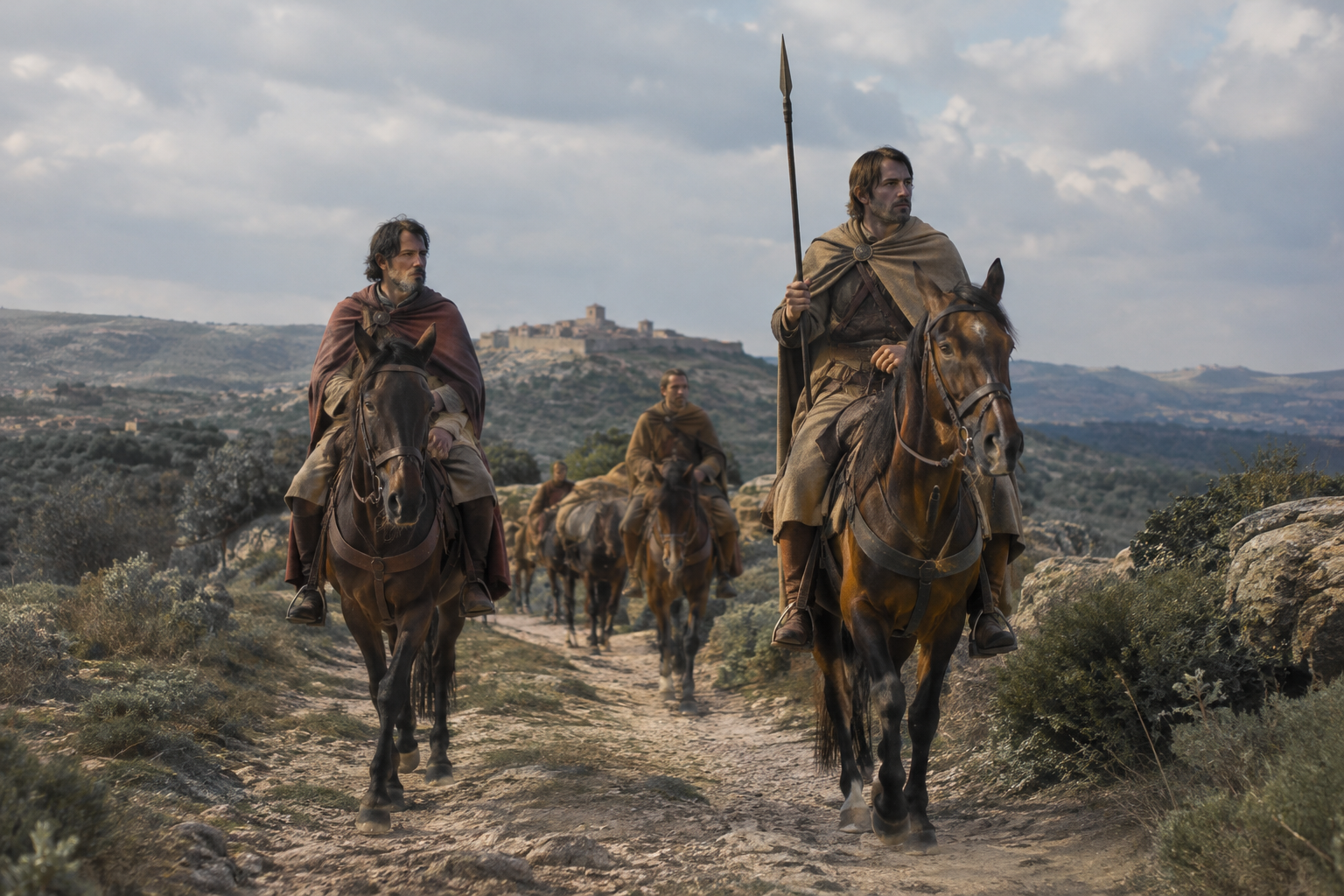
At Camino de las Yeseras, near Madrid, one man from around AD 794 has turned up with a surprisingly deep paternal signature. The individual identified as CGG022028, classified here under Y-DNA haplogroup C1a2a1, comes from Visigothic-period Spain - or, more precisely, from the long and complicated world that followed the Visigothic kingdom and overlapped with early medieval Iberia's political upheavals. That matters because C1a2a1 is not the sort of lineage most readers expect to meet in an early medieval burial from central Spain.
That first surprise is the right place to begin. Y-DNA traces one direct paternal line only - father to son across generations - so it does not define a person's whole ancestry, language, or identity. But when a lineage that is rare today appears in an archaeological burial from a well-studied region, it can illuminate just how mixed and historically layered that region really was.
Camino de las Yeseras is already an important archaeological name in Iberia, better known for its long sequence of prehistoric occupation. The presence there of an individual dated to around AD 794 reminds us that ancient sites often had afterlives: places were reused, reoccupied, and reimagined across millennia. By the late eighth century, central Iberia was not living inside a neat textbook chapter. The Visigothic kingdom had fallen in the early eighth century, and the region was part of the shifting frontier world that followed.
So when a burial is described as "Visigoth period Spain," that label should be handled carefully. It signals an archaeological and historical horizon rather than a simple ethnic identity. A man carrying C1a2a1 at this site was not therefore "a Visigoth" in any straightforward biological sense. He belonged to an early medieval population shaped by the legacies of Roman Hispania, post-Roman mobility, local Iberian continuity, and the new political realities of Islamic and Christian power in the peninsula.
An ancient DNA study of burials from the Madrid area has helped underline exactly this point: early medieval central Spain was not genetically uniform, and communities could include people with quite varied backgrounds. That broader setting is more useful than any old-fashioned attempt to match one Y-chromosome to one people. See also this related discussion of the same regional picture:
The wider haplogroup C is ancient and geographically broad, but C1a2a1 is a much narrower branch and should not be treated as if it carried the whole history of haplogroup C on its back. In European archaeogenetics, lineages within C1a have attracted attention because they appear in some very early prehistoric contexts, especially among ancient hunter-gatherers and early populations of Eurasia, yet are rare in most present-day European paternal profiles.
That is what makes a medieval Iberian example so interesting. It does not mean that CGG022028 was a direct, unmixed survival of some Mesolithic population, nor that one burial proves uninterrupted local descent from deep prehistory. What it does show is that rare paternal lines could persist, reappear in the record, or survive quietly within populations that otherwise changed substantially over time.
In other words, the Y chromosome can behave like an archaeological stray coin: a small object, easy to overread, but genuinely revealing when placed in context. A rare paternal branch in early medieval Spain tells us less about a grand tribal label than about the sheer unevenness of male-line survival across centuries.
For a long time, popular history treated post-Roman Iberia in very blunt terms: Romans, then Visigoths, then Muslims, with each replacing the last in tidy succession. Ancient DNA has been steadily ruining that sort of story, and rightly so. The people buried around early medieval Madrid were not arranged by modern expectations. Some lineages look regionally familiar; others point to long-distance connections; still others, like C1a2a1, seem unexpectedly deep or uncommon.
Research published on ancient populations from Iberia has increasingly shown that Roman and post-Roman centuries left a durable genetic legacy in the peninsula rather than a simple series of total replacements. That broader perspective helps explain why a rare Y-line can turn up in a central Spanish burial without needing a melodramatic migration tale attached to it. A useful companion piece on that continuity and reshaping is here:
The strongest point is therefore not that C1a2a1 was common, but that it was present. Presence matters. It enlarges the known range of paternal diversity in Iberia at the close of the eighth century, precisely in a region where political boundaries and cultural identities were under active renegotiation.
Readers sometimes assume that a single ancient sample is too slight to be meaningful. Sometimes that is true. But a lone individual can still be historically valuable when he comes from a well-defined place and period, and when his lineage is unusual enough to sharpen a larger question. CGG022028 does exactly that.
He gives us a fixed point: central Spain, around AD 794, an early medieval burial context, and a paternal line classified here as C1a2a1. Even without a dramatic grave assemblage or an identified historical name, that is enough to say something important about how population history actually works. The past is not made only of majorities. Sometimes it is the survival of a minority line - one family, one branch, one burial - that shows how incomplete our assumptions have been.
The scientific paper linked to this sample's research context is here. Without overstating what one publication can prove on its own, the wider genetic work on early medieval Iberia supports a picture of diversity, mobility, and local complexity rather than a single-line descent narrative.
Because this burial is associated with "Visigoth period" Spain, it is tempting to force the evidence into a Gothic story. That would be too simple. The Visigoths were a historical ruling formation, not a genetic essence, and late antique as well as early medieval Gothic communities themselves were far from biologically uniform. Genetic studies of Gothic-associated cemeteries elsewhere in Europe have repeatedly shown mixed origins rather than a single paternal or autosomal profile.
That broader caution is worth keeping in mind here. A man buried in early medieval central Spain could participate in a society shaped by Gothic legal traditions, Christian institutions, post-Roman landholding, and newer Islamic-era realities without his Y-DNA needing to match any imagined "Gothic type." For readers interested in that larger issue of Germanic-speaking expansions and genetics, this related post is especially useful:
And if one wants a more specific comparison with Gothic-period genetic diversity beyond Iberia, this is also relevant:
Mixed Origins of Gothic Communities
For someone researching a present-day paternal line, the real value of C1a2a1 is not a fantasy of instant identification with one tribe or kingdom. It is something both smaller and more exciting: the knowledge that this lineage, though rare, was present in early medieval Iberia and formed part of the lived human diversity of that world. The burial of CGG022028 at Camino de las Yeseras shows that even in a region often described through conquests and dynasties, older and less expected male lines could still persist within real communities.
If your own paternal line falls under C1a2a1, this sample is a reminder that rarity does not mean historical irrelevance. Sometimes the rarest branches are the ones that most clearly expose how tangled, local, and unexpectedly durable the human past can be.






Comments