Haplogroup A1b1b2b

– 4 min read


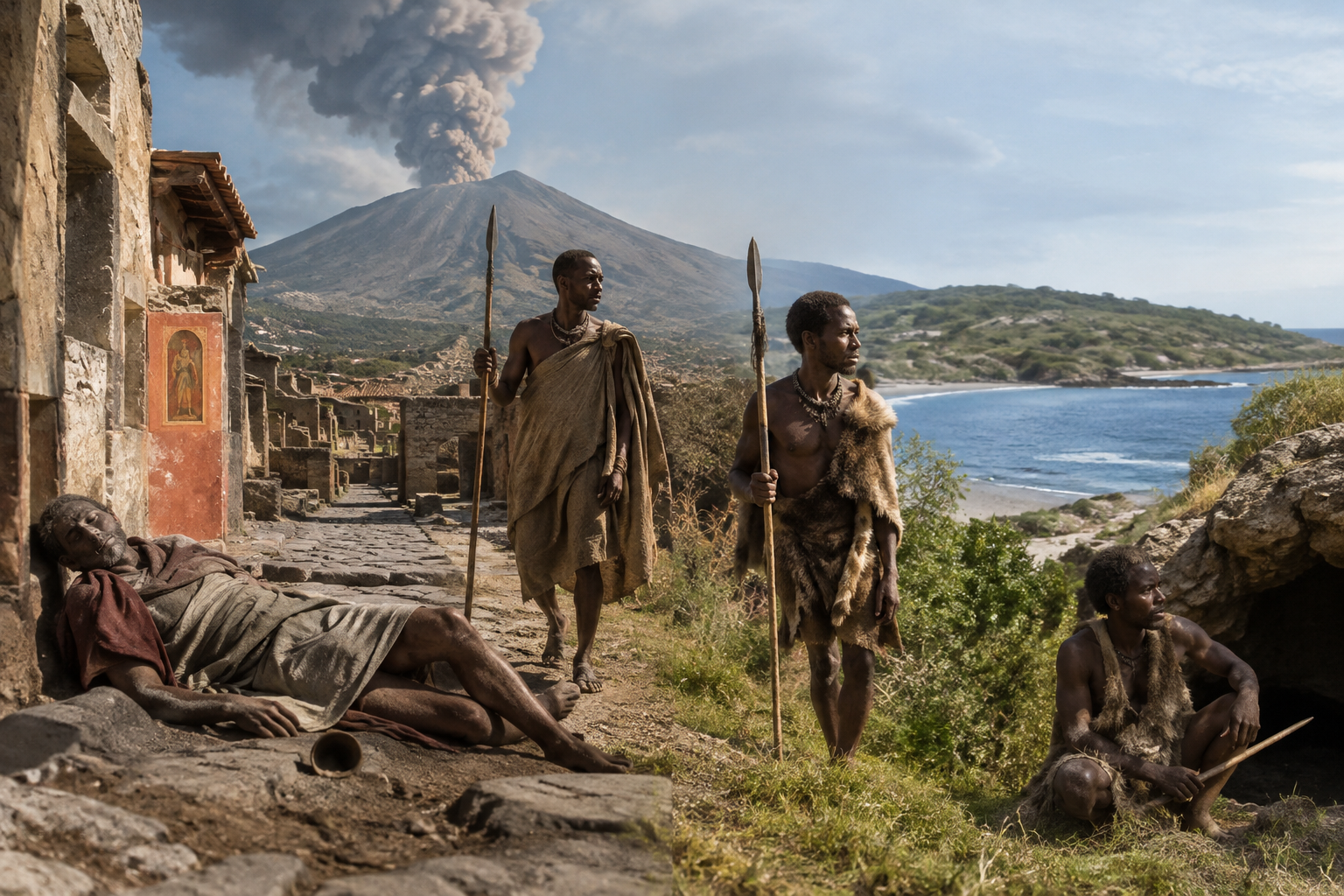
One of the most arresting appearances of haplogroup A1b1b2b in the ancient record comes from a victim of the AD 79 eruption of Vesuvius: sample f1R, identified from the Casa del Fabbro at Pompeii. That is a remarkable setting for such a lineage. Pompeii is often imagined as a neatly Italian town frozen in ash, but ancient DNA keeps reminding us that Roman cities were full of people whose family histories reached far beyond any simple local label.
That is where this Y-chromosome branch becomes interesting. Y-DNA follows one direct paternal line only, not a person's whole ancestry, yet even that narrow line can reveal movement, survival, and contact. In the case of A1b1b2b, the ancient examples attached to this branch point us most clearly toward Africa, and especially eastern and southern Africa, with one especially striking appearance in Roman Italy.
Sample f1R belongs to one of the people killed when Vesuvius buried Pompeii in AD 79. The site itself hardly needs embellishment: this was a bustling Roman town in Campania, tied into trade, slavery, migration, military movement, and the ordinary churn of empire. The significance of an A1b1b2b paternal line here is not that it makes Pompeii "African" or "foreign," but that it sharpens a truth historians have long suspected from inscriptions, trade evidence, and literature. Roman urban life was cosmopolitan in a very literal biological sense.
Research on Pompeii's ancient inhabitants has helped complicate older, simpler pictures of population history in Roman Italy. A study connected with these remains can be found here: https://www.nature.com/articles/s41598-022-10899-1. Even without forcing more certainty than the evidence allows, f1R sits comfortably within a wider Roman-world pattern in which people, and not just goods, crossed the Mediterranean and beyond.
It is worth pausing over what we can and cannot say. A Pompeian man with Y-DNA A1b1b2b was not simply a walking flag for one continent or one identity. He may have had recent paternal ancestors from Africa, or a deeper paternal history embedded in several generations of mobility around the Roman world. The important point is that this lineage in Pompeii is direct evidence against any fantasy of a closed, biologically uniform Roman population.
If Pompeii gives us the surprise, Ballito Bay South Africa sample baa001, dated here to around AD 110, gives us depth. Ballito Bay is famous in ancient DNA because southern African genomes have been central to discussions of deep human population history. In this case, the presence of A1b1b2b in a South African setting matters because it places the lineage within a much broader African frame rather than leaving it as a curiosity from Roman Italy.
Southern Africa's ancient individuals are especially valuable because they help anchor lineages that later appear elsewhere. In other words, when a branch like A1b1b2b turns up in Pompeii, it is far more meaningful if we also see related evidence from African contexts. That does not give us a direct biography for f1R, but it does remind us that the paternal line itself belongs to a human history far older and geographically wider than the Roman Empire.
An ancient DNA study that transformed discussion of southern African population history is linked here: https://science.sciencemag.org/content/358/6363/652/tab-figures-data. For readers tracing A1b1b2b today, that broader African background is essential context.
The most informative cluster in this small dataset may actually be the pair of Kenyan samples: I8830 from Naivashi, labelled PN Cushitic and dated here to around 300 BC, and I8804 from Keringet Cave, also labelled PN Cushitic and dated here to around 500 BC. These are not imperial urban dead, and they are not from the far south. They belong instead to eastern Africa's Pastoral Neolithic world.
That phrase, Pastoral Neolithic, deserves a plain explanation. It refers to communities in eastern Africa who herded livestock and lived through important cultural and demographic changes long before Roman power reached its Mediterranean height. The "Cushitic" label used in the sample descriptions is archaeological and linguistic shorthand for a broader regional setting; it should not be confused with a precise ethnic identity for the individuals themselves.
Why do I8830 and I8804 matter so much here? Because they show A1b1b2b not as a stray anomaly but as part of eastern Africa's ancient paternal diversity. Two finds from Kenya, in related pastoral contexts and centuries before the Pompeian eruption, create a much firmer historical picture than a single isolated sample ever could.
They also help us avoid a common mistake. One Roman-era appearance in Italy might tempt people into telling an over-neat migration story from point A to point B. The Kenyan evidence warns against that. A1b1b2b was present within eastern African populations in the first millennium BC, and that makes the Roman example more plausibly part of long, complex networks of mobility linking Africa with the Mediterranean.
Africa, Settlement, and Disease
With only four ancient individuals attached here to A1b1b2b, caution matters. We are not looking at a dominant imperial lineage, a royal house, or a single family spreading across continents. What we do have is something more archaeologically satisfying: a small but telling pattern. Two eastern African Pastoral Neolithic individuals, one southern African individual, and one Roman-period individual in Pompeii together suggest that this paternal branch belongs to an ancient African landscape and also appears within the mixed populations of the Roman Mediterranean.
That pattern fits what historians know from other evidence. The Roman world was deeply entangled with Africa, through Egypt, the Red Sea, North Africa, Nubia, trade routes into the Horn, military service, enslavement, and voluntary movement. A Y-line such as A1b1b2b appearing in Pompeii is therefore notable, but not unbelievable. It is exactly the sort of finding that makes Roman history look less like a map of tidy provinces and more like a jumble of real human lives.
For someone researching haplogroup A1b1b2b today, the most responsible takeaway is quite crisp. The ancient evidence here gives this branch an unmistakable African center of gravity, especially in eastern and southern Africa, while also showing that men carrying this paternal line could be present in the Roman Mediterranean. That does not tell every bearer of A1b1b2b exactly where his recent ancestors lived, but it does place the lineage in a real historical landscape: African antiquity, pastoral communities in Kenya, and the mobile world of Roman Pompeii.

Comments