Haplogroup A1b1

– 4 min read


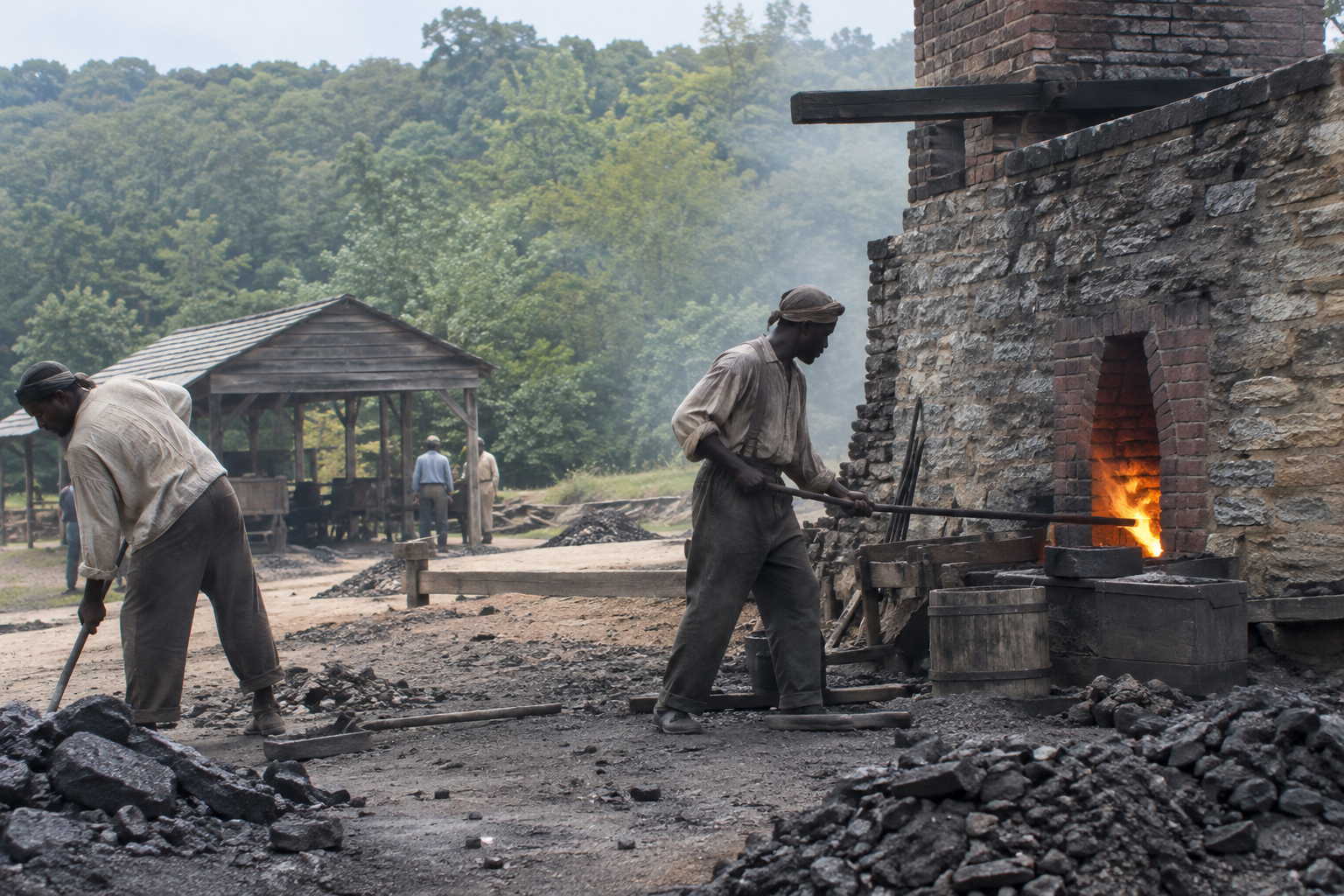
At the Catoctin Furnace ironworks in antebellum Maryland, one of the most arresting ancient-DNA recoveries is not from a prince, a warrior, or a richly furnished grave, but from an enslaved laborer. The individual identified as I8084, dated around 1810 AD, carries the Y-DNA haplogroup A1b1 - a lineage with especially deep roots in Africa. That matters because Catoctin Furnace is one of those places where archaeology and history collide rather brutally: an industrial site tied to early American expansion, and at the same time a place built in part by coerced Black labor.
For readers tracing haplogroup A1b1, this is a reminder that a Y-chromosome branch is not a nationality badge or a full portrait of ancestry. It follows one direct paternal line only. But in a site like Catoctin, that single line can still be historically powerful, because it places a named paternal branch inside the documented world of slavery, forced migration, and industrial labor in the early United States.
Catoctin Furnace, in Frederick County, Maryland, was an iron-producing community active from the eighteenth century onward. By the early nineteenth century, when I8084 lived, the furnace complex was part of a hard, dangerous industrial landscape. Enslaved men, women, and children were integral to its operation. They labored in ore extraction, charcoal production, transport, and furnace work, as well as in the domestic and agricultural systems that kept the enterprise running.
That context is crucial. The significance of I8084 is not simply that a rare and ancient Y-lineage appears in North America, but that it appears in a precisely historical setting shaped by the Atlantic slave trade and the plantation-industrial economy. A genetic study connected to the people buried at Catoctin Furnace helped illuminate the ancestry of this community and the human cost behind early American industry; the research is linked here in a study of the Catoctin Furnace burials.
Haplogroup A is one of the deepest-rooting branches on the human Y-chromosome tree, and A1b1 belongs within that broad and ancient African framework. That does not mean every man with A1b1 shares a recent common origin in the everyday genealogical sense, nor does it let us jump from one Maryland burial to a specific ethnic group, kingdom, or language community in Africa. The point is subtler, and more historical.
In the case of I8084, A1b1 is best understood as evidence that an African paternal lineage endured through the dislocations of slavery and arrived, still traceable, in an American industrial cemetery. That is already remarkable. In many parts of the Americas, the paper trail for enslaved families was deliberately broken or never properly kept at all. Genetics cannot repair every loss, but it can sometimes preserve one thin but durable thread of paternal descent where the archive has failed.
There are haplogroup articles that can range across millennia and half a dozen excavated sites. A1b1, as represented here, tells a more focused story. We have one supplied ancient individual, one exact identifier, one site, and one stark historical setting. Rather than being a weakness, that narrowness gives the evidence a certain force: it stops us drifting into vague claims and keeps the article anchored to a real person in a real place.
I8084 was not buried in a prehistoric cave or an elite tomb. He belonged to the working and unfree population of an early American furnace community. That alone makes him important in archaeogenetics, because ancient DNA has too often been dominated by the spectacular - royal burials, weapon graves, famous dynasties, and monumental cemeteries. Sites like Catoctin widen the field. They recover the biology of people who are central to history but often marginal in the written record.
The deeper significance of A1b1 at Catoctin lies in the broader archaeology of African-descended communities in the Atlantic world. Burial grounds, plantation landscapes, workshops, and colonial towns have increasingly shown that the populations created by slavery were never biologically uniform. They brought together people from different African regions, different family histories, and different paternal and maternal lines, then subjected them to a system designed to erase those distinctions while exploiting their labor.
Y-DNA can therefore be especially poignant in these contexts. Because it follows one father-to-son line, it sometimes preserves a fragment of ancestry that historical violence tried to sever. But there is no neat straight line from A1b1 to a single modern identity label. What archaeology gives us instead is a layered picture: a man in Maryland, around 1810, carrying a paternal branch with deep African antiquity, living in a community shaped by enslavement and industrial extraction.
This is also why articles on mobility and mixed communities elsewhere in the ancient world remain relevant reading, even when they are far removed in time and place. The lesson is methodological as much as historical: genomes often reveal complex origins in settings where older narratives expected simple categories.
For members of the MyTrueAncestry community, A1b1 is not the sort of haplogroup best explained through castles, noble pedigrees, or medieval heraldry. Its most compelling appearance here is in a cemetery tied to labor, coercion, and survival. That makes it historically no less important - if anything, more so. It brings paternal-line research into contact with the lives of people who built economies without receiving the dignity of full historical recognition.
The Catoctin evidence also fits a larger trend in archaeogenetics: the field has moved beyond origin myths and prestige lineages toward fuller social history. Studies of colonial and post-medieval communities increasingly show how DNA can complement archaeology in recovering kinship, migration, and ancestry among people left at the edges of traditional narratives.
If your paternal line falls within A1b1, the most responsible historical takeaway is not a grand claim about one tribe or one famous ancestor. It is something both narrower and more substantial: your Y-line belongs to one of the oldest surviving branches in the human paternal tree, and in the MyTrueAncestry ancient sample record here, that branch appears in the body of an enslaved man at Catoctin Furnace in Maryland around 1810 AD. That is a hard, specific, and deeply human piece of history. It links a paternal lineage not to fantasy prestige, but to the real archaeology of African endurance in the Atlantic world.






Comments