The House of Colonna
– 3 min read


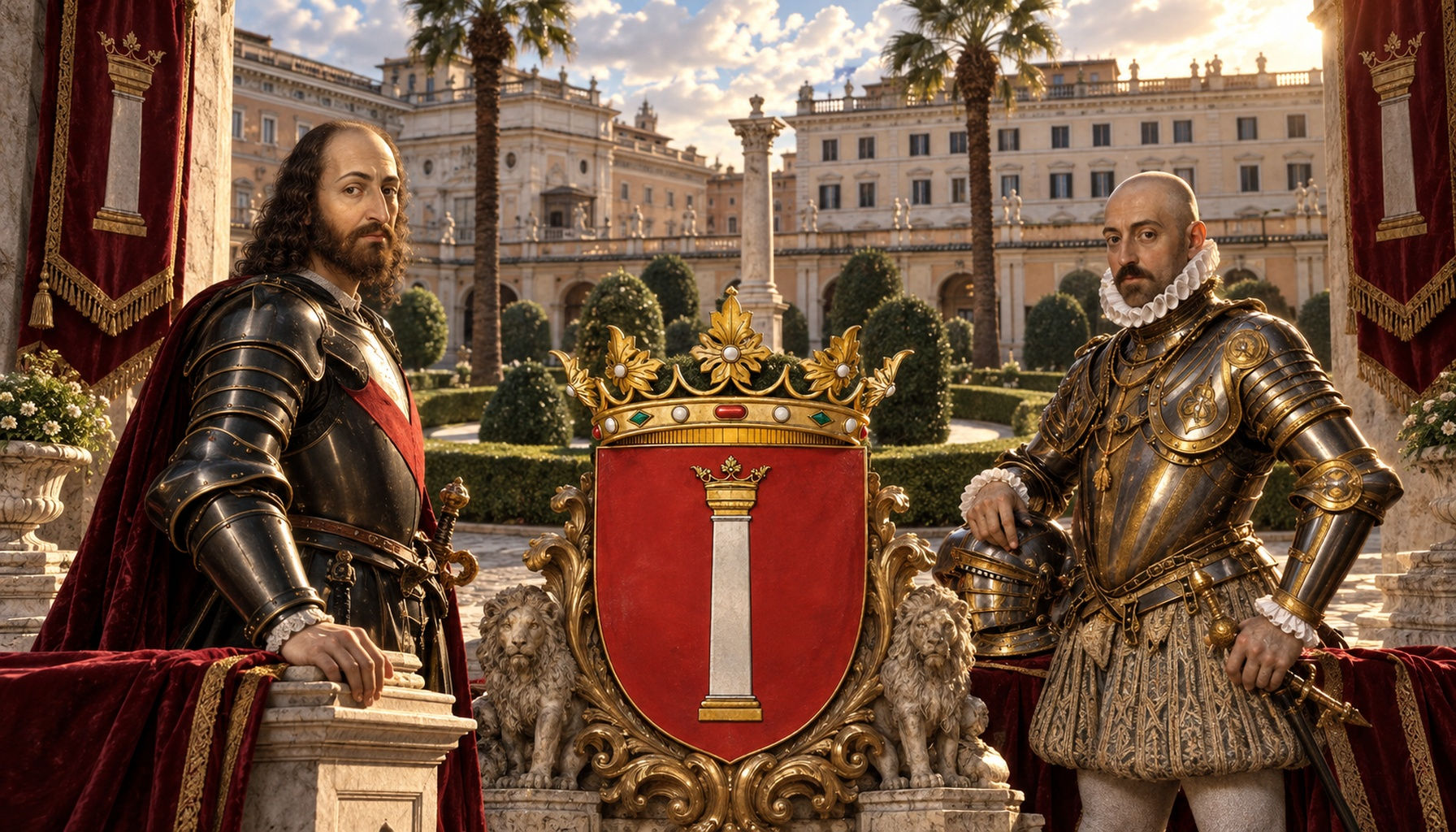
The House of Colonna was one of the great baronial dynasties of Rome and central Italy, a family whose story is woven through medieval warfare, papal politics, church office, and the stubborn survival of noble power across centuries. Traditionally associated with the town of Colonna in the Alban Hills southeast of Rome, the family emerged in the charged world of the high Middle Ages, when great Roman houses built influence not simply through titles but through castles, armed followings, marriage alliances, and carefully placed relatives in the Church. Their primary family haplogroup is linked here as I2a1a1a1a1a1a1e6a, adding a genetic tag to a lineage better known from chronicles, palaces, and feuds than from quiet domestic history.
What made the Colonna so important was not just rank, but range. They could produce cardinals and captains, diplomats and princes, while also behaving like what they were at heart: territorial lords with real muscle in Latium. They were deeply involved in the rough-and-tumble politics of the Roman baronage and often found themselves in rivalry with other great families, especially when papal succession or control of land and office was at stake. Figures such as Stefano Colonna il Vecchio (1265-1348), Giacomo Sciarra Colonna (1270-1329), and Stefano Colonna il Giovane (1300-1347) stand out in this drama-filled history. Sciarra in particular became famous for his fierce opposition to Pope Boniface VIII, while the Stefanos belonged to that distinctly Roman world in which noble reputation was built as much by endurance and factional skill as by inherited glory.
If you want one place that still anchors the family in the landscape of Rome, it is Palazzo Colonna. This vast palace complex, near the Quirinal Hill, is one of the oldest and grandest private palaces in the city and remains a visible statement of Colonna continuity. Its fabric reflects centuries of expansion rather than a single neat building campaign, which is exactly what one would expect from an old Roman princely house: layer upon layer of ambition, taste, inheritance, and adaptation. The palace is especially famous for the Galleria Colonna, a magnificent Baroque showpiece filled with paintings, mirrors, rich decoration, and the sort of theatrical architecture designed to remind visitors that this was no ordinary household. It has long served as both residence and dynastic monument, turning family memory into stone, fresco, and ceremonial space. Palazzo Colonna can still be visited, with parts of the palace and gallery open to the public, making it one of the rare places where the medieval and early modern power of a Roman noble family can still be encountered directly.
Read about Medieval Paleogenomics in Northern Latium
From an ancient DNA point of view, the Colonna haplogroup tag I2a1a1a1a1a1a1e6a is interesting because related or linked branches appear in a spread of ancient samples from Iron Age western Europe. Among them are Sequani-associated individuals from Gallic France at Parancot and Les Moidons, including samples CGG023678, CGG023687, CGG023698, CGG023723, CGG023691, CGG023709, and CGG023692, as well as Late Iron Age Gloucestershire Britain sample I12931. These do not prove direct descent from the House of Colonna, and it is important not to pretend otherwise. What they do offer is a broader deep-time backdrop: they show that related paternal lineages were present in Celtic and Iron Age populations far to the northwest of Italy long before the medieval Roman nobility took the shape we recognize from written history. That is one of the pleasures of archaeogenetics - it does not flatten history into a simple family tree, but opens up the much older human landscape behind later dynasties.
Explore Late Iron Age Celtic Switzerland
The House of Colonna is a reminder that noble families were not abstract names in genealogy charts. They were physical presences in towns, fortresses, churches, and streets; they argued with popes, married for advantage, fought for survival, and left buildings that still dominate Rome today. If you have taken a DNA test, you can upload your results to MyTrueAncestry and see whether you match the House of Colonna, or related ancient DNA samples linked to haplogroup I2a1a1a1a1a1a1e6a.

Comments