Haplogroup T1a1a1b2
– 5 min read


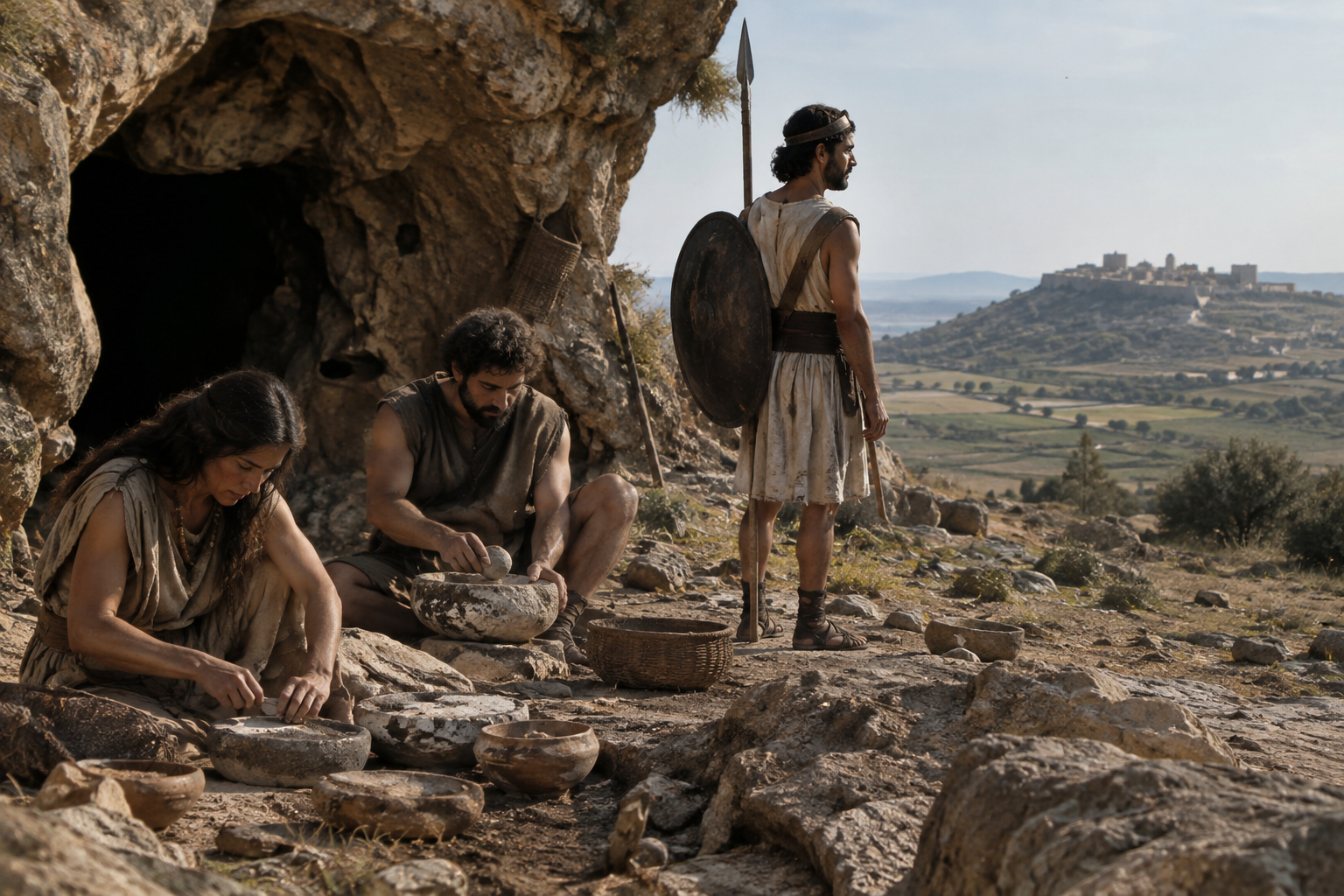
At Megiddo, one of the great tells of the southern Levant, a Late Bronze Age man catalogued as I4518 was buried in a world of palaces, trade routes, and imperial pressure. Dated to around 1425 BC and identified as a Canaanite from Megiddo, he matters here because his paternal line has been associated with T1a1a1b2, a branch within haplogroup T that is far less common in most present-day European discussions than the better-known lineages of the Bronze Age.
That immediately makes this haplogroup interesting, not because one burial can stand for an entire people, but because it places a direct paternal line in a very particular historical landscape: urban Canaan in the Late Bronze Age. Y-DNA tracks one narrow line of descent, father to son to son, so it does not define a person's whole ancestry or identity. But when the same broader paternal background appears again in earlier Levantine contexts, it gives us a rare thread to follow across millennia.
Megiddo is not just any archaeological site. It sits at a strategic crossing in northern Israel, long famous for its deep sequence of occupation and for its place in the politics of the Bronze and Iron Ages. By the fifteenth century BC, the town stood within the orbit of Egyptian power while remaining locally Canaanite in population, language, and material culture.
The value of sample I4518 is therefore contextual as much as genetic. A man linked to T1a1a1b2, or to a closely relevant reported branch assignment, turns up not in some vague "Near Eastern" past but in a named urban center with a solid archaeological identity. Research on ancient populations from the region, including work connected to Bronze Age Levantine genomes, has helped clarify how local continuity and outside contacts could coexist in Canaanite cities without reducing them to a single biological type or origin story.
An especially relevant ancient DNA study on Bronze Age Levantine populations can be found here: https://pubmed.ncbi.nlm.nih.gov/32470400/. For a haplogroup like T1a1a1b2, the point is not that one paper "solves" the lineage, but that it places paternal findings into the much bigger archaeological picture of Levantine urban society.
Burial archaeology in ancient Israel
If Megiddo gives us a Late Bronze Age urban setting, Peqi'in Cave takes us much further back. Two individuals from the Chalcolithic Levant, I1160 and I1165, are dated to around 3900 BC. That is a very different world: before Canaanite city-states, before the Late Bronze Age diplomatic system, and before the political map that later texts make more familiar.
Peqi'in Cave is one of the most discussed Chalcolithic burial sites in the Levant because it belongs to a period of striking social and material change. This was an age of increasingly elaborate ritual behavior, new craft specializations, and growing regional complexity. Ancient DNA from the cave has made the site especially important for understanding how communities in the Levant were connected, how distinct they could be, and how some genetic patterns seen later may have deeper local roots.
The key thing for T1a1a1b2 is not that we can draw a neat straight line from Peqi'in to Megiddo. We cannot. These men lived roughly two and a half millennia apart, in very different societies. But the appearance of this paternal background in both Chalcolithic and later Bronze Age Levantine settings suggests that the lineage belongs in the region's long history rather than being explained only by a single late movement or a one-off intrusion.
A major study connected to Peqi'in Cave and Chalcolithic Levantine population history is here: https://www.nature.com/articles/s41467-018-05649-9. It is one of the studies that made the cave so central to discussions of population structure in the prehistoric Levant.
The Chalcolithic is sometimes overshadowed by the drama of later kingdoms, but archaeologically it is one of the most revealing periods in the Levant. Communities were experimenting with new forms of settlement, burial, exchange, and symbolic display. That matters for Y-DNA because paternal lineages are not floating abstractions: they belonged to men living inside real households, local alliances, and changing social systems.
So when we see T-related paternal lines at Peqi'in Cave, we are not merely adding an old pin to a map. We are seeing that haplogroup T, at least in broader form and perhaps in branches relevant to T1a1a1b2, was already part of the human landscape in a formative prehistoric period. That helps anchor the lineage in the Levant's deep past, even if the exact branching path from those ancient men to later subclades remains uncertain.
Ancient DNA and archaeogenetics
Set side by side, Peqi'in Cave and Megiddo show something rather elegant. The earlier evidence comes from a prehistoric burial cave in the Chalcolithic Levant; the later evidence comes from a named Canaanite center in the Late Bronze Age. The settings are different, but the broader geography is not. That gives T1a1a1b2 a distinctly Levantine archaeological frame in the material presented here.
It is also worth being precise about scale. T1a1a1b2 is a narrow subclade name, while ancient reports do not always achieve the same level of Y-chromosome resolution for every sample. In popular discussion there is a constant temptation to speak as though every ancient man can be slotted confidently into the exact modern terminal branch. Sensible archaeology asks for more restraint. What the evidence supports most clearly is a paternal presence connected to haplogroup T in Chalcolithic and Bronze Age Levantine contexts, with reported relevance to the branch T1a1a1b2 for the samples listed here.
That is still historically significant. Levantine archaeology often reminds us that continuity and change go together. Cities rose, trade expanded, empires interfered, ritual life shifted, and yet some lineages clearly persisted through these transformations. A paternal line can survive the collapse of a settlement, the arrival of a new ruling power, or the adoption of a new language by simply continuing through ordinary families.
Bronze and Iron Age Mesopotamia DNA
None of this means T1a1a1b2 was exclusive to the Levant, nor that every later carrier must descend from a specifically Canaanite line in the historical sense. The eastern Mediterranean was connected by mobility, marriage, commerce, war, and resettlement. But the samples here do give the haplogroup a credible ancient setting in the southern Levant across a long timespan.
For family historians, that is often the most useful kind of result. Not a fantasy pedigree, not a claim to a biblical tribe or a royal house, but a grounded historical horizon: men carrying this paternal background were present in the Levant from at least the Chalcolithic into the Late Bronze Age, across both cave-burial and urban Canaanite contexts.
Eastern Mediterranean DNA journeys
On the evidence here, T1a1a1b2 is best approached as a paternal line with a meaningful ancient foothold in the Levant, visible in both the Chalcolithic Peqi'in Cave individuals I1160 and I1165 and the Late Bronze Age Megiddo individual I4518. That does not give every modern carrier a simple ethnic label. What it does offer is something better: a historically situated connection to one of the oldest continuously important regions in the archaeological record, where prehistoric communities and Bronze Age towns alike preserved traces of the same deeper paternal heritage.






Comments