Haplogroup T1a

– 5 min read


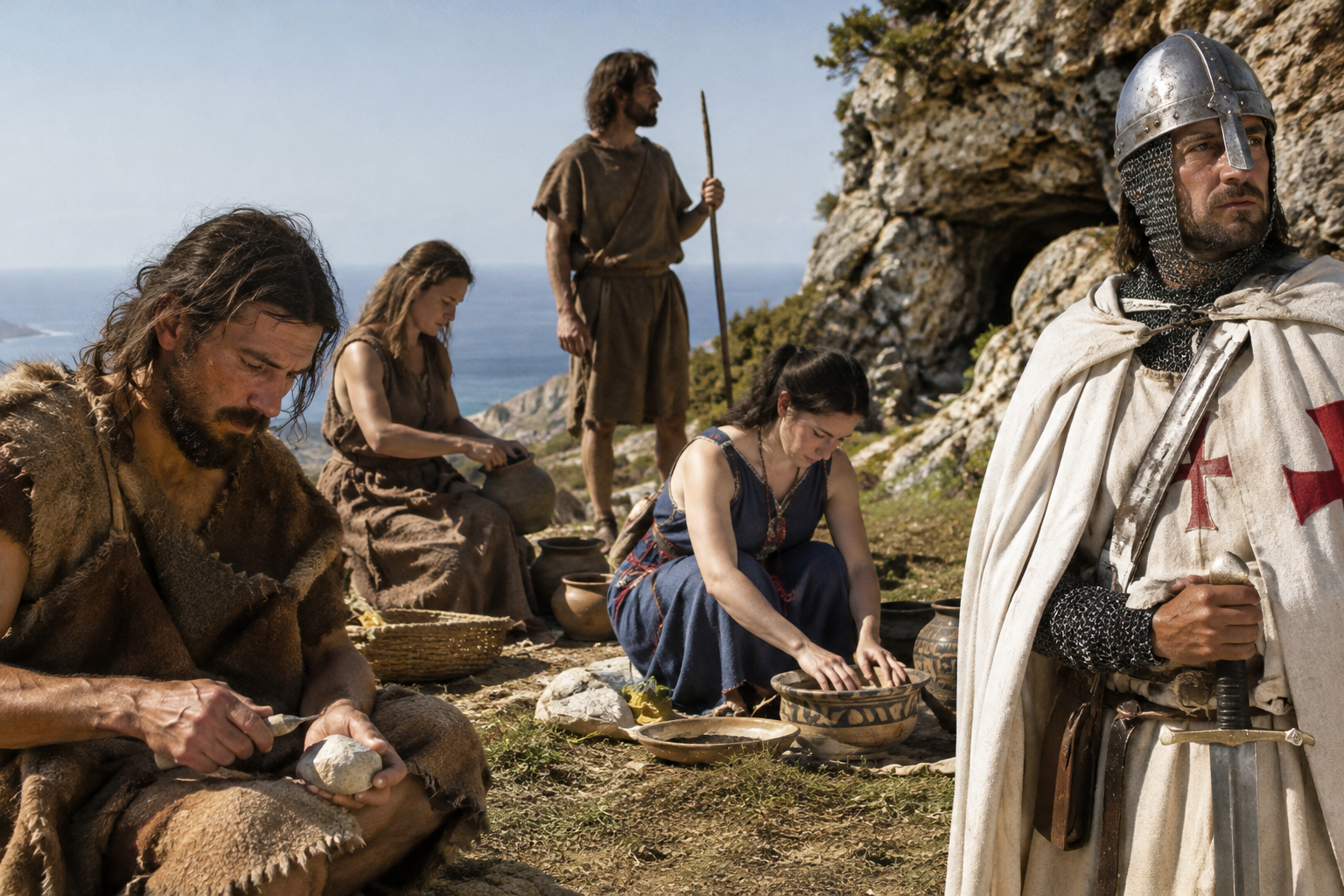
In a cave on Crete, among the commingled remains from Hagios Charalambos, one Bronze Age man stands out for anyone interested in Y-DNA haplogroup T1a. The sample known as HGC010, dated around 1900 BC, links this paternal line to the Minoan world: an island society of palaces, seaborne exchange, and very local burial traditions. That matters because T1a is not one of the big headline Y-chromosome lineages in European prehistory. When it appears, it tends to do so in places that remind us how much ancient history depended on movement across the eastern Mediterranean and southeast Europe.
The small cluster of ancient men associated here with T1a does not tell a simple story of one people marching across a map. Instead, it gives us something more interesting: early farmers in Neolithic central Europe, a Bronze Age individual from Minoan Crete, and a medieval Crusader from the Levant. Y-DNA tracks one direct paternal line only, not a person's whole ancestry, but even that narrow thread can reveal how unexpectedly durable some lineages were.
The earliest sample in this group is TR130 from Trebur Grossgartach in Germany, dated to about 4800 BC. Trebur belongs to the early Neolithic farming horizon of central Europe, in a period when the descendants of Anatolian-origin farming communities had already spread deep into the continent. The importance of a T1a-associated male here is not that he represents a dominant lineage, but that he shows this branch present within the social and biological mix of Europe's first agricultural societies.
A second German sample, I0795 from Karsdorf, dated around 3510 BC, pushes that presence later into the Neolithic. Karsdorf is well known from ancient DNA work on central European prehistory, including research published in a major genetic study of ancient European populations. Taken together, Trebur and Karsdorf suggest that T1a was not a one-off curiosity in Neolithic Europe. It was there, if at low frequency, among settled farming communities whose lives were tied to fields, livestock, and village landscapes rather than heroic migration legends.
That is worth pausing over. Popular discussions of ancient Europe often focus on the largest paternal turnovers and the most dramatic expansions. But archaeology is full of smaller continuities and lesser-known lineages. T1a in Neolithic Germany hints that some paternal branches moved with, or alongside, the spread of farming from the Near East into Europe and then remained embedded in local communities for millennia.
The sample HGC010 brings the story to Bronze Age Crete. Hagios Charalambos Cave is not a palace archive or a royal tomb; it is a cave burial context associated with Minoan-era communities. That already tells us something important about how uneven the archaeological record can be. Grand architecture survives in one place, while in another the evidence comes from human remains deposited in a cave, preserving a different side of life and death in the Aegean.
For T1a, this Cretan case matters because Crete sat at the crossroads of the eastern Mediterranean. Minoan society maintained ties with the Greek mainland, the Aegean islands, Anatolia, Cyprus, and the Levant. A T1a paternal line in this setting fits a broader picture in which Bronze Age island populations were locally rooted yet connected to a much wider maritime world. It does not prove that HGC010 or his immediate paternal ancestors had recently arrived by ship from any particular coast. What it does show is that T1a belonged within the range of lineages present in the Aegean during the age of the Minoans.
That broader prehistoric Aegean background has become much clearer through archaeogenetics over the last decade. The value of a sample like HGC010 is precisely that it adds a paternal detail to a region where ancestry was shaped by both continuity and exchange.
Haplogroup T is a wider Y-chromosome branch with a distribution that has long drawn attention because it appears, at generally modest frequencies, across parts of the Near East, northeast Africa, the Mediterranean, and into Europe and South Asia. T1a is one part of that broader family. The crucial point is not to blur the levels: evidence for haplogroup T as a whole is not automatically evidence for every narrower branch within it, and the samples here should be treated as evidence for reported association with T1a rather than as a license to generalize wildly.
Still, the pattern is suggestive. Neolithic Germany and Bronze Age Crete are exactly the sorts of places where one might expect to encounter lineages connected to the spread of early farmers and to long-running Mediterranean interaction. T1a looks, in this small ancient record, less like a lineage of a single ethnic bloc and more like one of those paternal lines carried through several worlds: early agrarian Europe, the Bronze Age Aegean, and later the eastern Mediterranean frontier.
The latest sample in this set is the most obviously historical in the traditional sense: SI-42, identified as a Crusader Knight from Syria / Lebanon, dated around 1250 AD. Here T1a appears not in a prehistoric farming settlement or Bronze Age burial cave, but in the militarized, multilingual world of the Crusader states. This was a landscape of castles, ports, monasteries, markets, and burial grounds used by people of very different geographic origins.
A study presented on these Crusader-era remains, available through the European Association of Archaeologists abstract repository, highlights exactly why such burials matter. They sit at the intersection of migration, warfare, and local mixture. In that context, a T1a paternal line does not instantly tell us whether SI-42's direct male ancestry lay in western Europe, the Mediterranean, or further east. Medieval armies and settler populations were more heterogeneous than tidy national stories would like to admit.
And that, frankly, is one of the pleasures of ancient DNA. A "Crusader knight" sounds like a stock character from later romance and nationalist history. A Y-lineage such as T1a complicates the picture. The medieval eastern Mediterranean was full of people whose paternal roots did not fit modern stereotypes, even when their social role at death seemed perfectly legible to chroniclers.
Medieval Mediterranean Diversity
If we step back from the individual sites, the geographical shape of the evidence is striking. TR130 at Trebur and I0795 at Karsdorf place T1a in the world of Neolithic Europe. HGC010 places it in Bronze Age Crete. SI-42 places it in the high-contact frontier of the medieval Levant. These are not random dots. They form a loose corridor through regions repeatedly tied together by farming dispersal, trade, seafaring, empire, and war.
That does not mean the four men belonged to one uninterrupted historical population. They were separated by thousands of years and by very different cultural settings. But the recurrence of T1a across these settings suggests a paternal branch with a long history in Mediterranean-adjacent and southwest Eurasian networks, sometimes reaching central Europe and sometimes appearing in island or Levantine contexts where mobility was a fact of everyday history.
For someone researching haplogroup T1a today, the best-supported insight is not a single origin myth but a pattern of persistence in connected worlds. Ancient examples link this paternal line to early farmers in Germany, to a Minoan-era burial cave on Crete, and to a medieval Crusader context in the Levant. That makes T1a a reminder that some Y-lineages travelled through history not by becoming numerically dominant, but by enduring in communities shaped by migration, trade, and constant regional contact.
Comments