Haplogroup S1a1b1d

– 5 min read


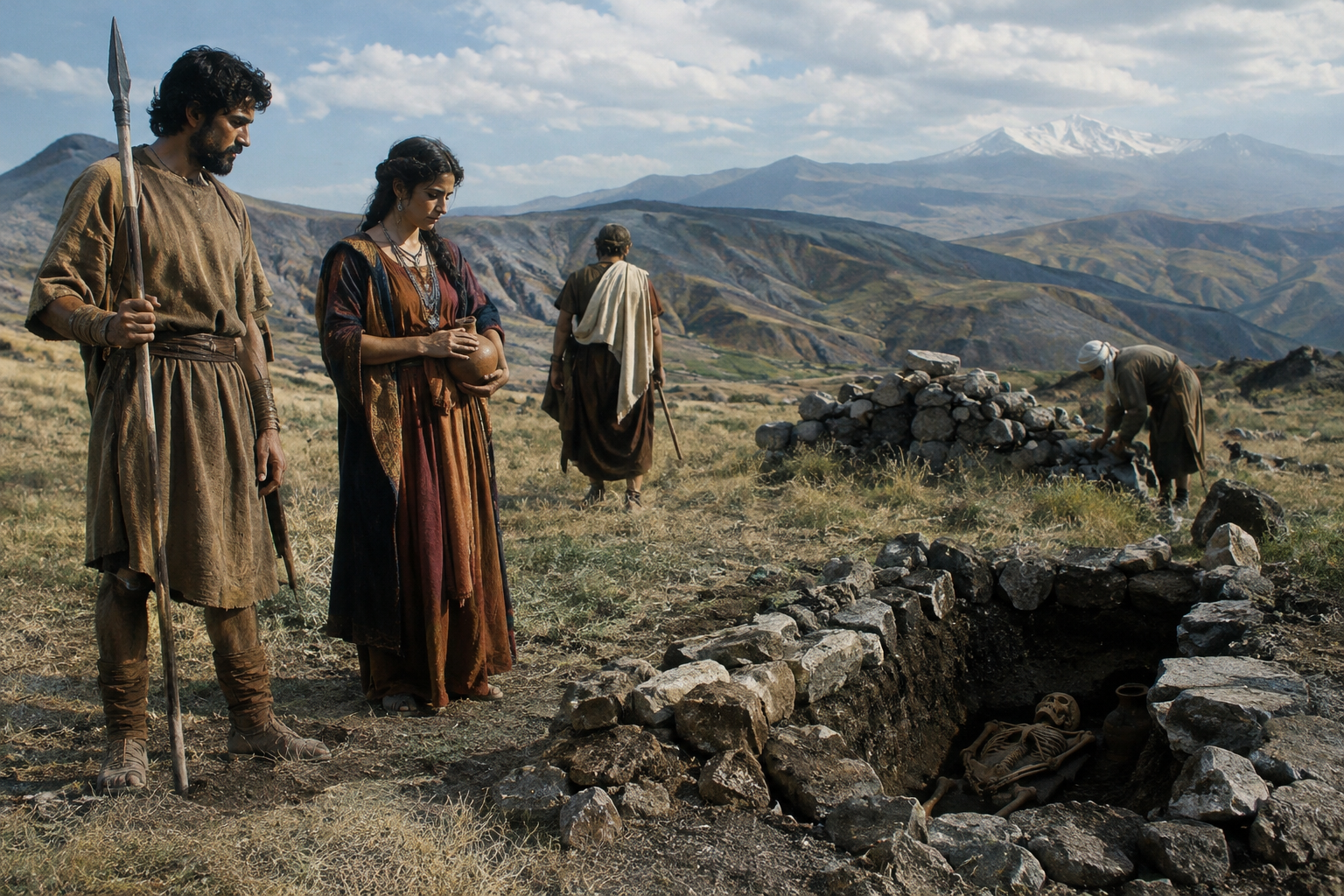
At Karashamb in Armenia, a Late Bronze Age burial dated around 1335 BC produced an ancient male identified as I19348. On paper that may look like a dry catalogue line. In practice, it is a small but valuable anchor point for the Y-DNA haplogroup S1a1b1d, placing this paternal line in the South Caucasus during a period when Armenia sat in the middle of bigger worlds: the highland societies of the Caucasus, the kingdoms of Anatolia, and the long political shadow of the ancient Near East.
That matters because a Y-chromosome lineage is not a whole people, a language, or a kingdom. It is one direct paternal thread. But when that thread appears in a securely dated archaeological context, it gives us something better than legend: a man, a place, and a historical landscape in which this branch was genuinely present.
The Karashamb cemetery is one of those sites that reminds us how much of ancient history happened away from the famous imperial capitals. By the 14th century BC, the Armenian highlands were not isolated uplands at the edge of civilization. They were part of a densely connected zone of herding, farming, exchange, and local elite power, with material culture and political contacts running in several directions at once.
Sample I19348 comes from that world. The available evidence here is spare, so it is important not to embroider it with imaginary grave goods or family drama. What we can say is simpler and more useful: this individual places the haplogroup S1a1b1d in Late Bronze Age Armenia, and therefore in a region long recognized as a crossroads between the Caucasus, eastern Anatolia, and the Iranian plateau.
Research on ancient DNA from the wider South Caucasus has transformed this picture over the last few years, showing long-term regional continuity mixed with episodes of movement and admixture rather than any single tidy migration story. One important study of this broader history is linked here: research on ancient populations of the South Caucasus and neighboring regions. Even without forcing the paper to say more than it does, the broader lesson is clear enough: the Bronze Age Caucasus was dynamic, connected, and genetically varied.
The exact label in this article is S1a1b1d, a narrow paternal subclade. That precision is useful, but it also calls for caution. A deep parent haplogroup may have a much wider history than one of its late-forming branches, and it would be wrong to borrow the full geographical story of the larger lineage and paste it onto this more specific one without direct evidence.
So the secure point is modest but important: a man associated with this branch, or with the reported assignment used by MyTrueAncestry, was present at Karashamb in the Late Bronze Age. For someone researching their own paternal ancestry, that does not prove descent from a named tribe, a kingdom, or a noble line. It does suggest that one historically attested setting for this paternal branch lies in the ancient highland societies of Armenia.
This is exactly how ancient Y-DNA is most helpful when treated properly. It does not hand us a romantic biography. It pins a paternal line to a real archaeological horizon.
If we want to understand why Karashamb matters, we have to think about geography. Bronze Age Armenia was neither a sealed mountain refuge nor merely a corridor people rushed through. It was both a homeland and a meeting ground, linking the Black Sea hinterlands, the South Caucasus, eastern Anatolia, and the lands stretching toward Iran and Mesopotamia.
That makes a lineage like S1a1b1d historically interesting even from a single ancient occurrence. A paternal branch found here may have belonged to a family rooted locally for generations, to newcomers absorbed into a local community, or to a population shaped by earlier mixtures that archaeology alone cannot disentangle. The point is not to pick one dramatic scenario. The point is that the setting itself makes movement and continuity equally plausible parts of the same history.
That wider Armenian and Iranian world has become much clearer through recent archaeogenetic work, including studies focused on ancient Iran and adjacent regions. For context on how genetic evidence is being used in that neighboring sphere, see this related discussion of Ancient Iranian mtDNA and skeletal identification.
People sometimes assume that one sample is too little to say anything meaningful. That is only partly true. One sample cannot define the whole population of Late Bronze Age Armenia, and it certainly cannot tell us that everyone at Karashamb shared the same paternal ancestry. But one well-placed burial can establish a minimum fact of presence, and that is often how the serious business of historical genetics begins.
Archaeology is full of such modest but decisive moments. A lone inscription proves a language was used in one district. A single imported object proves contact. In the same way, one ancient Y-chromosome assignment can show that a paternal line existed in a specific region at a specific time. For S1a1b1d, Karashamb is precisely that kind of evidence.
It also helps that the Late Bronze Age is not some vague prehistoric blur. Across western Eurasia, this was an age of regional systems, political competition, metal exchange, shifting alliances, and local identities that did not map neatly onto later ethnic labels. That is why it would be careless to call I19348 "Armenian" in any modern national sense, or to force him into a later textual people. Better to keep him where the evidence keeps him: in a Late Bronze Age cemetery in the Armenian highlands.
One of the most useful habits in ancient DNA is to resist treating every lineage as if it belonged to a single migration event. The South Caucasus repeatedly participated in larger regional transformations without losing its own local character. Ancient communities there could preserve long-settled ancestry while also taking part in exchange networks and demographic shifts that tied them to neighboring lands.
That is particularly relevant for a branch like S1a1b1d, where the current article rests on a specific Bronze Age Armenian example rather than a large series of identical finds. The sensible reading is not that we have uncovered a marching route. It is that this paternal branch belonged, at least in one known case, to the human mosaic of the Late Bronze Age Caucasus.
Readers interested in how archaeogenetics handles mobility, mixture, and regional change without collapsing them into crude ethnic stories may also find value in broader MyTrueAncestry pieces on ancient population movement. A useful comparison in a very different setting is the article on Ancient DNA and Migrations in the Northern Black Sea Region.
For haplogroup S1a1b1d, the most solid ancient foothold in the material provided here is Late Bronze Age Karashamb in Armenia, through sample I19348. That is a small clue, but a good one: it places this paternal line in the South Caucasus during a historically connected and archaeologically important age. If your own paternal line falls within S1a1b1d, the evidence does not make you the heir to a lost dynasty. It does, however, place one branch of your direct male-line story in a real Bronze Age highland community at the crossroads of Armenia and its neighboring worlds.






Comments