Haplogroup R2a2b1b2b

– 5 min read


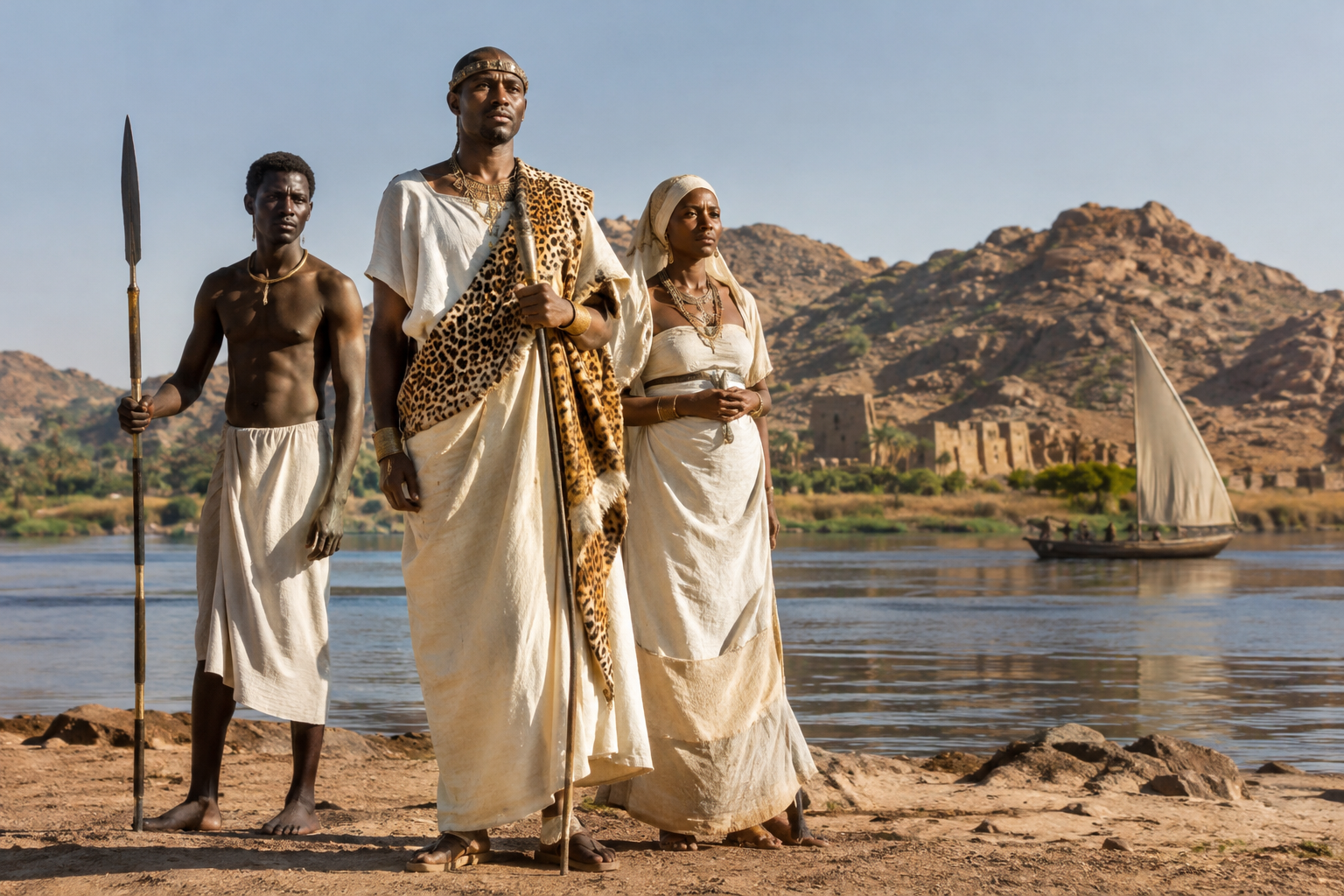
At Kulubnarti in medieval Nubia, one man identified as I6254 offers a surprisingly precise glimpse into the paternal history behind the Y-DNA branch R2a2b1b2b. He dates to around AD 810 and comes from Makurian Nubia, the Christian kingdom that flourished along the Nile in what is now northern Sudan. That alone is enough to make him interesting. R2 is not the Y-chromosome lineage most people expect to meet first in a medieval Nubian burial.
And that is exactly why this sample matters. Ancient DNA does not tidy the past into neat ethnic boxes; it usually does the opposite. A single paternal line can turn up far from where modern readers imagine it "belongs", and Kulubnarti is one of those places where archaeology and genetics together show how connected the medieval Nile valley really was. In this case, the haplogroup label points to one direct male line only, not to the whole ancestry or identity of the man himself, but even that narrow line can still tell a very historical story.
Kulubnarti is well known to bioarchaeologists because its cemeteries preserve a vivid record of life in medieval Nubia. This was not some isolated backwater perched outside history. It lay within the orbit of the kingdom of Makuria, a powerful Christian polity linked to Egypt, the wider Nile corridor, Red Sea routes, and worlds farther afield. People, goods, ideas, and families moved through these networks over many centuries.
That is the right setting in which to think about I6254. Rather than treating his Y-DNA as a badge of fixed ethnicity, it makes more sense to place him in a riverine society shaped by mobility and mixture. Medieval Nubia sat at a crossroads between sub-Saharan Africa, Egypt, and the eastern Mediterranean, while also connecting, indirectly and sometimes directly, to trade routes that reached Arabia and beyond.
An ancient DNA study examining these Nubian burials helped bring such individuals into focus, including the Kulubnarti material associated with I6254, and it is the main scientific backdrop for discussing this case here: https://www.biorxiv.org/content/10.1101/2021.02.17.431423v1.
The exact branch in this article is R2a2b1b2b, a very specific subdivision within the broader haplogroup R2. That distinction matters. Broad haplogroups can have deep and geographically wide histories, while a narrow downstream branch may have a much more limited or simply less well documented ancient record. With the evidence here, the safest claim is modest: one medieval man from Kulubnarti is reported in association with this paternal branch.
R2 lineages today are often discussed in relation to South Asia and nearby regions, but it would be careless to turn that broad modern pattern into a single, tidy migration tale for this one Nubian individual. Ancient DNA works best when it narrows possibilities, not when it encourages grand certainties. What I6254 shows securely is that by the early 9th century, a paternal line assigned to this branch was present in Makurian Nubia.
That finding is valuable precisely because it resists lazy assumptions. Medieval Nile populations were not genetically sealed communities. A Y-chromosome lineage that modern databases associate more strongly elsewhere can appear in Nubia because men moved, families formed, and communities absorbed newcomers over long stretches of time.
It is easy to imagine medieval Nubia as marginal because many standard histories still privilege Rome, Byzantium, or the Islamic caliphates. But the Nile has always been a road as much as a barrier. From late antiquity into the medieval period, Nubia was in continuous contact with Egypt to the north, and through Egypt with the eastern Mediterranean and Islamic worlds. Those links could carry merchants, clergy, captives, craftsmen, soldiers, pilgrims, and spouses.
So a lineage like R2a2b1b2b appearing at Kulubnarti should not be treated as an anomaly to be explained away. It is better read as evidence of the ordinary complexity of real human societies. One paternal line can travel without dragging an entire population behind it. Over generations, such lines become local, embedded in communities whose language, religion, and daily life are shaped by their current home more than by some distant point of origin.
That broader lesson has parallels elsewhere in ancient DNA work. Medieval and late antique cemeteries repeatedly show that communities were often more diverse than older textbook labels suggested.
One sample is not a dynasty, a tribe, or a population average. Still, single ancient individuals can be historically important when they appear in the right archaeological context. I6254 matters because Kulubnarti is not an abstract pin on a map. It is a studied medieval community in a kingdom that stood at the hinge between African and Eurasian worlds. A precise paternal branch found there is therefore more than a genetic curiosity; it is a clue to the lived reality of Makurian society.
It also reminds us how often paternal history survives in ways written sources do not. Chronicles may tell us about kings, bishops, treaties, and wars. They are usually much quieter about the ordinary men whose descendants carried lineages forward. Ancient DNA restores some of that lost texture. A man such as I6254 may not have left a name in a manuscript, yet his Y-chromosome places one thread of long-distance human connection firmly in medieval Nubian soil.
Kulubnarti sits within a growing body of evidence showing that Africa's historical populations were deeply entangled with surrounding regions while remaining distinctly local in culture and community life. That point is crucial. Genetic links do not erase Nubia's own history; they sharpen it. They show a Christian kingdom on the Nile participating in wider exchanges without dissolving into someone else's story.
For readers interested in how ancient DNA complicates older ideas about neatly bounded peoples, this is one of the most useful comparisons. The same basic lesson appears from the Mediterranean to Inner Asia: archaeology gives us the setting, and genetics reveals how often that setting included people with varied ancestral backgrounds.
There is also a methodological point here for anyone tracing their own paternal line. A rare or unexpected haplogroup match in the ancient record does not mean your family descends from one famous migration event. It means only that the branch was present in a documented past individual or population. But even that limited fact can be immensely helpful, because it anchors a lineage in a real historical landscape rather than in modern guesswork.
With R2a2b1b2b, the standout evidence in this case is not a royal pedigree or a long list of burials. It is the presence of this paternal branch in I6254, a man from Kulubnarti in Makurian Nubia around AD 810. That is a small but striking fact. It places this lineage within the human traffic of the medieval Nile, where African kingdoms, Christian institutions, and long-distance networks met in everyday life.
For someone researching this haplogroup today, the most sensible takeaway is that your direct paternal line belongs to a history of movement and incorporation that can surface in unexpected places. Kulubnarti shows that even a highly specific Y-lineage may appear in communities that older histories would have treated as separate worlds.






Comments