Haplogroup R1b1a1b2a2
– 5 min read


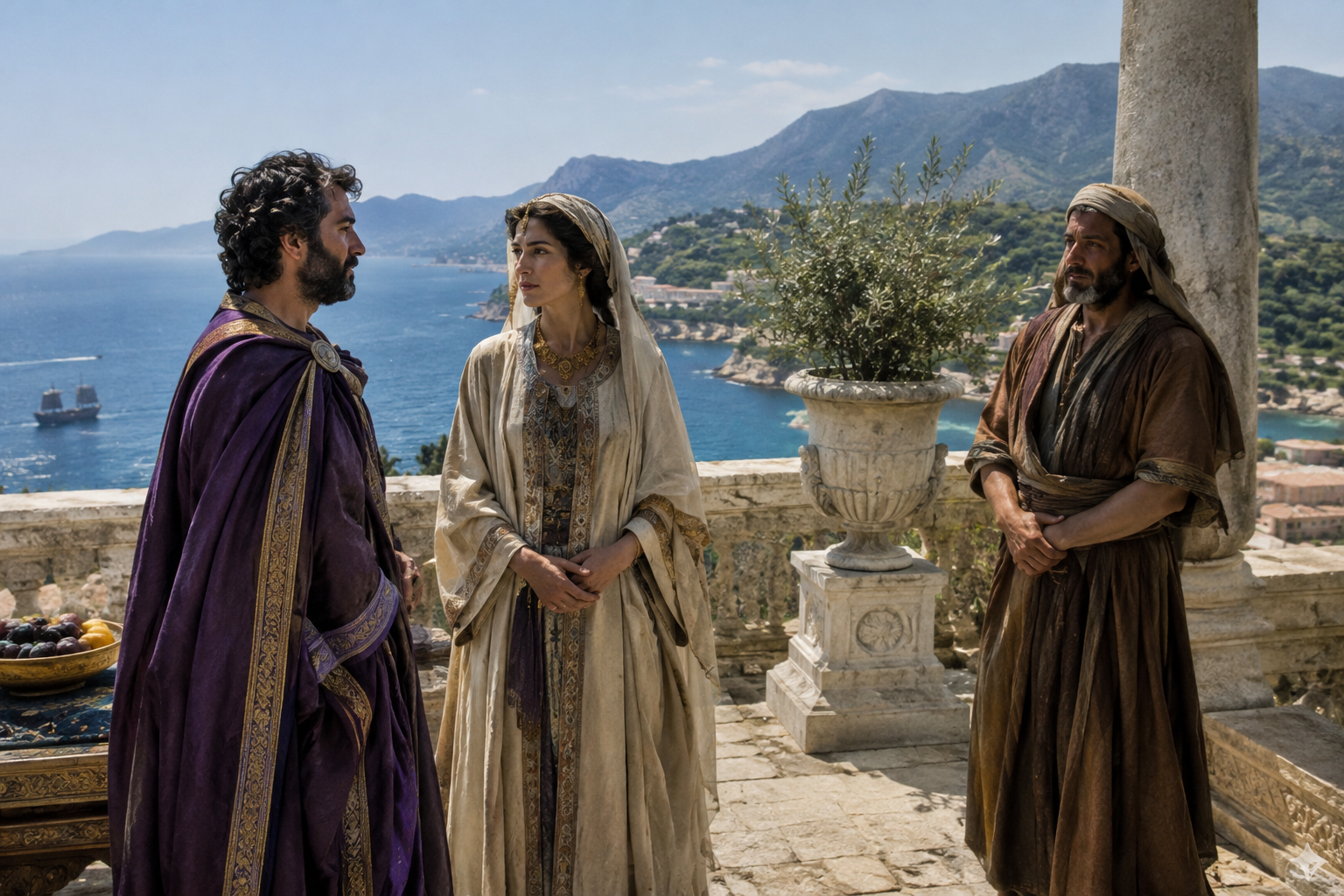
In around AD 604, on the Aegean coast of Anatolia, one man buried in Byzantine Caria left behind a small but striking clue to the long history of paternal descent. His identifier is I20266, and he has been associated with the Y-DNA haplogroup R1b1a1b2a2. That label looks forbidding at first glance, but the human setting is easier to grasp: a man living in western Asia Minor during the centuries when the eastern Roman Empire still held the coastline, Greek-speaking cities remained active, and older local populations were folded into Byzantine rule.
What makes I20266 interesting is not that he can be turned into a grand historical mascot. Quite the opposite. He is useful because he anchors this haplogroup in a real archaeological context: a Byzantine-era individual from Caria, near one of the most connected maritime zones in the medieval Mediterranean. A Y-chromosome lineage tracks one direct paternal line only, not a person's whole ancestry, but even that single thread can be revealing when it appears in a region shaped by trade, empire, migration, and long local continuity.
Caria was an old historical landscape in southwestern Anatolia, facing the islands and sea-lanes of the Aegean. By the early 7th century AD, it belonged to the Byzantine world, yet its population was hardly something newly created by imperial decree. This was a region with deep roots reaching back through Hellenistic and Roman centuries, and further still into the Anatolian past.
That is why I20266 matters. A sample like this does not merely place R1b1a1b2a2 on a modern map; it places it in a lived historical environment. Here was a paternal line present in a coastal Byzantine population at a time when the eastern Mediterranean was still densely interconnected, even as the political world around it was becoming more unstable.
A large ancient DNA study of the Mediterranean and adjacent regions, published in Science, helped show just how mixed and historically layered these populations could be. Western Anatolia in late antiquity and the early medieval period was not an isolated backwater. It sat at the hinge of the Balkans, the Aegean, inland Anatolia, and the wider Roman East.
The broader R1b family is one of the major Y-DNA lineages in western Eurasia, but that fact alone is not enough to explain this article's branch. The more precise designation R1b1a1b2a2 is a narrower paternal subclade within that wider tree, and it should not simply be treated as if it carried the whole story of R1b with it. A broad parent lineage may span enormous distances and many millennia; a specific downstream branch belongs to a much more particular history.
For that reason, the safest reading of I20266 is modest and useful. It shows that a paternal line classified with this branch was present in Byzantine-era Caria. It does not by itself prove where that line first formed, what language its bearers spoke generations earlier, or whether it arrived recently in the region or had been there for centuries.
That caution is not a weakness. In archaeology, the point is often to resist the temptation to turn one chromosome into an entire people. The real interest lies in how such a lineage appears within a coastal Anatolian setting where identities could be Roman, local, Greek-speaking, Christian, provincial, and familial all at once.
It is easy to imagine the Aegean as a dividing line between Europe and Asia. Historically, it was more often a corridor. Ships, soldiers, merchants, clerics, and families crossed it constantly. Caria, with its harbours and inland connections, belonged to that world of movement.
So when a Byzantine-era individual from this coastline carries a branch such as R1b1a1b2a2, the historical significance lies in context rather than spectacle. Western Anatolia was one of those regions where local continuities and outside connections could exist at the same time. A paternal line found there might reflect long-settled communities shaped by the Roman Empire, earlier movements in the eastern Mediterranean, or more local demographic survival through political change.
This is one reason ancient DNA has changed the discussion so dramatically. Instead of imagining neat blocks of population replacing one another on cue, we keep finding mixed communities and regional persistence. That pattern is familiar from other MyTrueAncestry coverage of Mediterranean populations, including work on Grecia Salentina's Greek-speaking community, where language, history, and ancestry do not collapse into a single simple story.
The man I20266 lived in a period often described as "Byzantine", but that label can mislead if we imagine a sharply new population appearing with a new name. By the 6th and early 7th centuries AD, coastal Anatolia had already absorbed many centuries of demographic change under Achaemenid, Hellenistic, Roman, and then eastern Roman rule. Its communities could preserve older local ancestry while also showing ties to the wider Mediterranean.
That makes a great difference to how one reads a haplogroup result. If a modern tester belongs to R1b1a1b2a2, the presence of I20266 suggests that this paternal branch participated in the human landscape of Byzantine western Anatolia. It does not reduce the branch to "Byzantine" in origin, but it does provide a historically grounded waypoint: by about AD 604, this lineage was present on the Carian coast.
In other words, the sample helps with chronology as much as geography. Ancient Y-DNA results are often most powerful when they tell us not merely where a lineage exists today, but when we can securely place it in a past society. Here, the relevant society is neither prehistoric nor vaguely "Mediterranean" in the abstract, but the very specific world of early medieval Caria.
For family historians, western Anatolia can seem frustratingly difficult. The region's historical names changed, its political masters changed, and its populations were repeatedly drawn into bigger imperial stories. Yet ancient DNA is beginning to show that these places are not blank spaces at all. They are reservoirs of continuity as well as zones of contact.
I20266 is therefore valuable precisely because he is ordinary in the best archaeological sense. He is not a king, not a literary celebrity, and not a made-for-television conqueror. He is a documented ancient individual whose Y-chromosome links the branch R1b1a1b2a2 to a real Byzantine-era setting on the Anatolian Aegean coast.
That also fits a broader pattern seen in studies of Roman and post-Roman populations around the Mediterranean: lineages and ancestries did not respect the tidy boxes later historians preferred. Readers interested in how genetic diversity persisted in complex historical societies may also enjoy the article on medieval Sicily, another region where mobility and local continuity sat side by side.
One ancient sample cannot stand for all men in Caria, still less for all carriers of R1b1a1b2a2. But it does something more concrete than grand myth-making: it places this paternal branch within the documented human geography of the Byzantine Aegean. That is a serious piece of evidence.
For someone researching this haplogroup today, the most responsible takeaway is that R1b1a1b2a2 was part of the population history of western Anatolia by the early 7th century AD, in a region shaped by both deep local roots and Mediterranean movement. That does not hand you a ready-made ethnic label. It gives you something better: a real ancient person, at a real place and time, standing in the long chain of paternal descent.
To place that one man in a wider early medieval setting, it is also worth comparing other mixed frontier and post-Roman populations, such as those discussed in MyTrueAncestry's piece on 7th-century Madrid, where genetics likewise complicates any neat historical stereotype.






Comments