Haplogroup R1b1a1b1b3a1a1

– 5 min read


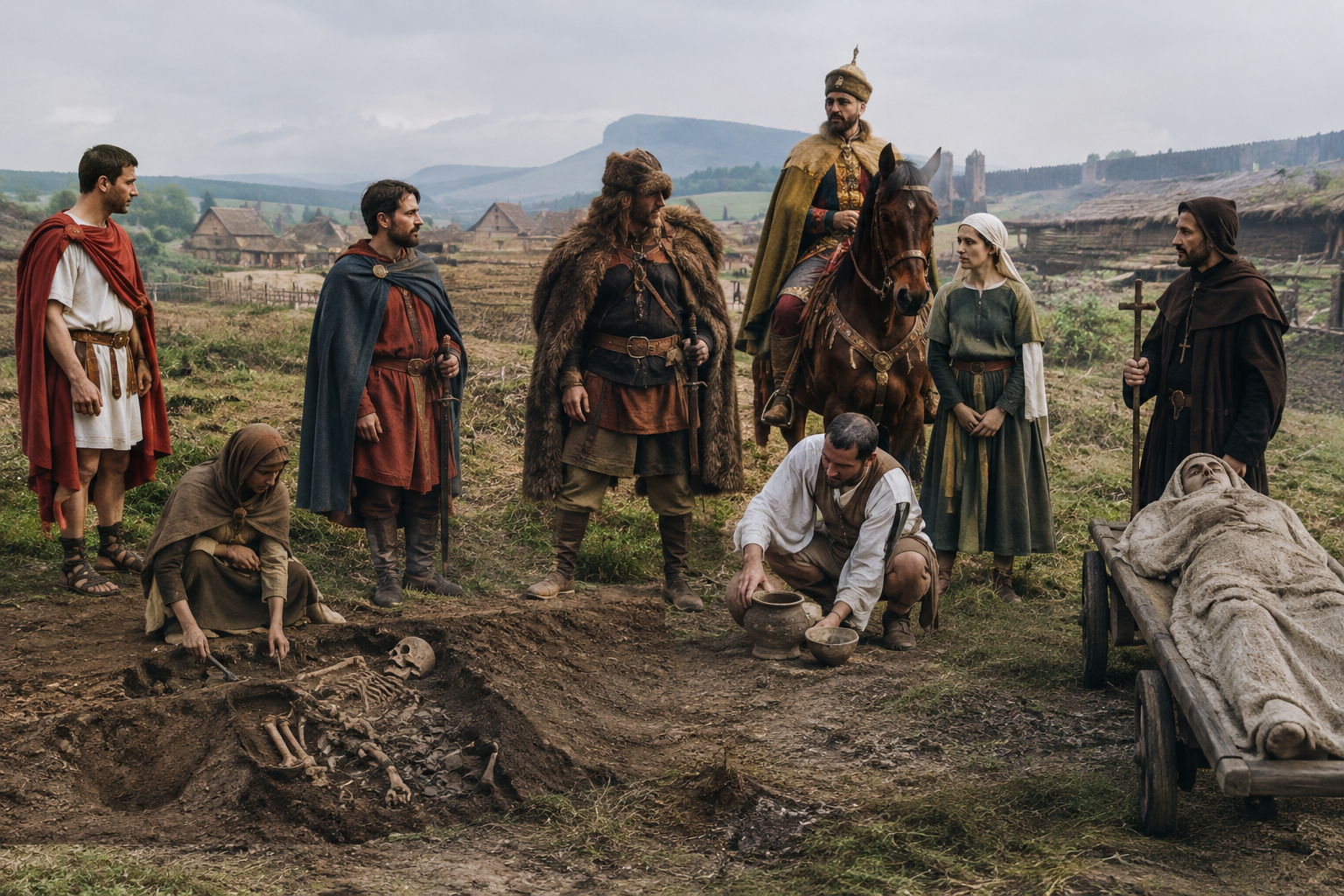
At Vicars Farm near Cambridge, one man buried in the Roman era around AD 200 has become an unexpectedly useful signpost for the Y-DNA haplogroup R1b1a1b1b3a1a1. He is recorded as sample VIC004, and on his own he would tell us very little. But set beside later individuals from Burgundy, the German Rhineland, Hungary, and an early modern plague cemetery, he begins to show something rather interesting: this paternal line appears in a string of communities tied to the Roman world and its aftermath, not in one neat "tribal" block but across a landscape of movement, settlement, and political change.
That is exactly the sort of pattern ancient DNA is good at revealing. Y-DNA traces one direct paternal line only, not a person's whole ancestry, language, or identity. Even so, when the same branch turns up in several archaeological settings over more than a thousand years, it can illuminate where one male line was present and how ordinary and elite populations were being reshaped.
VIC004 comes from Roman-era Vicars Farm, a site in Cambridgeshire that belongs to the long centuries when Britain was part of the Roman Empire. The value of this sample is not that it proves some dramatic migration on its own, but that it places this paternal branch within the lived population of Roman Britain. That matters because Roman Britain was never genetically or culturally static. Towns, villas, roadside settlements, farms, soldiers, traders, and families all formed part of a connected provincial world.
A wider ancient DNA study of Roman and early medieval Britain has shown just how varied that world could be, and how its population history did not simply stop when imperial administration collapsed. In that context, a lineage such as R1b1a1b1b3a1a1 appearing in a Roman-period Cambridgeshire individual is best understood as part of a broader northwestern European paternal landscape that continued through changing historical regimes rather than as a badge of any single ethnic identity. See also the broader discussion in Genomic History and Natural Selection in Roman and Early Medieval Britain.
Roman and Early Medieval Britain
Two later finds push the story into the post-Roman centuries. One is CGG023657 from Camp du Chateau in Burgundy, dated around AD 849. The other is IND014 from Alt-Inden in North Rhine-Westphalia, dated around AD 600 and described as a Merovingian grave. These are not the same place, nor quite the same political world, but both sit within the complicated reordering of western Europe after Rome.
The Merovingian period in particular is full of lazy stereotypes about "Franks" simply replacing "Romans". Archaeology and genetics paint a more tangled picture. Cemeteries in what is now western Germany and eastern France often preserve communities with mixed local roots, varying degrees of mobility, and social identities that cannot be read straight off a chromosome. A paternal lineage turning up in both a Merovingian burial in the Rhineland and an early medieval individual in Burgundy fits that pattern of continuity mixed with movement.
The Burgundian sample is useful for another reason. By the ninth century, this was a Carolingian world, long after the first collapse of Roman power in the west. So the line is not just appearing in a Migration Period setting and then vanishing; it continues into established medieval society. That kind of persistence is often more historically revealing than a single eye-catching burial.
For a related look at how early medieval western European populations could be surprisingly diverse at the cemetery level, the Madrid case study is worth comparing: Ancient DNA reveals diverse origins at a 7th-century Madrid burial site.
If the British and Frankish-era finds show continuity in the old western provinces, the Hungarian samples show something more mobile and politically charged. Here the haplogroup is associated with several individuals from different early medieval contexts: CSB-3 from Csongrad-Berzsenyi utca in Hungary, dated around AD 400 and described as linked to a Gothic context; I16752 from Visonta Nagycsapas in North Hungary, around AD 750; and I16759, an Avar elite individual from early medieval Hungary, around AD 775.
Now, one must be careful here. "Gothic", "Avar", and "elite" are archaeological or historical labels, not genetic ones. They tell us about burial context, chronology, and political environment. They do not mean that a Y-DNA branch was uniquely Gothic or uniquely Avar. In fact, one of the great lessons of recent work on late antique and early medieval Europe is that these societies were often genetically mixed even when their material culture seemed sharply distinctive.
That is why the Hungarian evidence is so valuable. The same paternal branch is turning up across communities associated with very different power structures: late antique groups often called Gothic, then later populations inside the Avar Khaganate and its successor landscapes. Research on post-Roman Central Europe has repeatedly shown that the Carpathian Basin was a zone of encounter rather than a sealed ethnic container. Lineages could persist locally, move with incoming groups, or become folded into new ruling structures over generations.
An ancient DNA study examining the post-Roman peoples of the region helps frame this broader setting without reducing it to a single migration story: https://www.sciencedirect.com/science/article/pii/S0960982222007321#app2. For readers wanting a fuller MyTrueAncestry discussion of this same historical zone, there is a good companion piece on post-Roman society in the Little Hungarian Plain.
So what does R1b1a1b1b3a1a1 seem to represent in this evidence? Not a royal dynasty, not a single migration event, and not a tidy ethnic label. What the samples actually show is a paternal line present in a series of European populations connected by the Roman world, the Migration Period, and the medieval societies that followed.
Chronologically, the pattern begins here with Roman Britain, appears again in late antique Hungary, continues in Merovingian Germany and early medieval Burgundy, and is still visible much later in ELW028, a post-medieval plague victim from Ellwangen in Germany dated around AD 1550. That last sample is easy to overlook, but it is a salutary reminder that many lineages survive not through kings and chronicles but through ordinary townspeople, villagers, soldiers, craftsmen, and plague dead.
The result is less glamorous than a dynasty and more useful historically. This branch looks like part of the durable male-line fabric of Europe north of the Alps, especially in regions deeply involved in late Roman and post-Roman transformations. That fits well with the broader genetic picture from frontier provinces and successor kingdoms, where continuity and admixture usually matter more than legends of pure descent. A related perspective on those blended frontier worlds can be found in Roman-"Barbarian" Blending on the German Frontier, 400-700 CE.
For someone researching a modern paternal line assigned to R1b1a1b1b3a1a1, the most defensible takeaway is not a claim to one named tribe or medieval house. It is something subtler and, frankly, more historical: this line appears across a chain of communities shaped by Roman provincial life, frontier mobility, and the remaking of Europe after empire. From Cambridgeshire to Burgundy, from the Rhineland to the Hungarian plain, it belongs to the sort of male lineage that endured through upheaval because people endured through upheaval.






Comments