Haplogroup R1b1a1b1b3a1a

– 6 min read


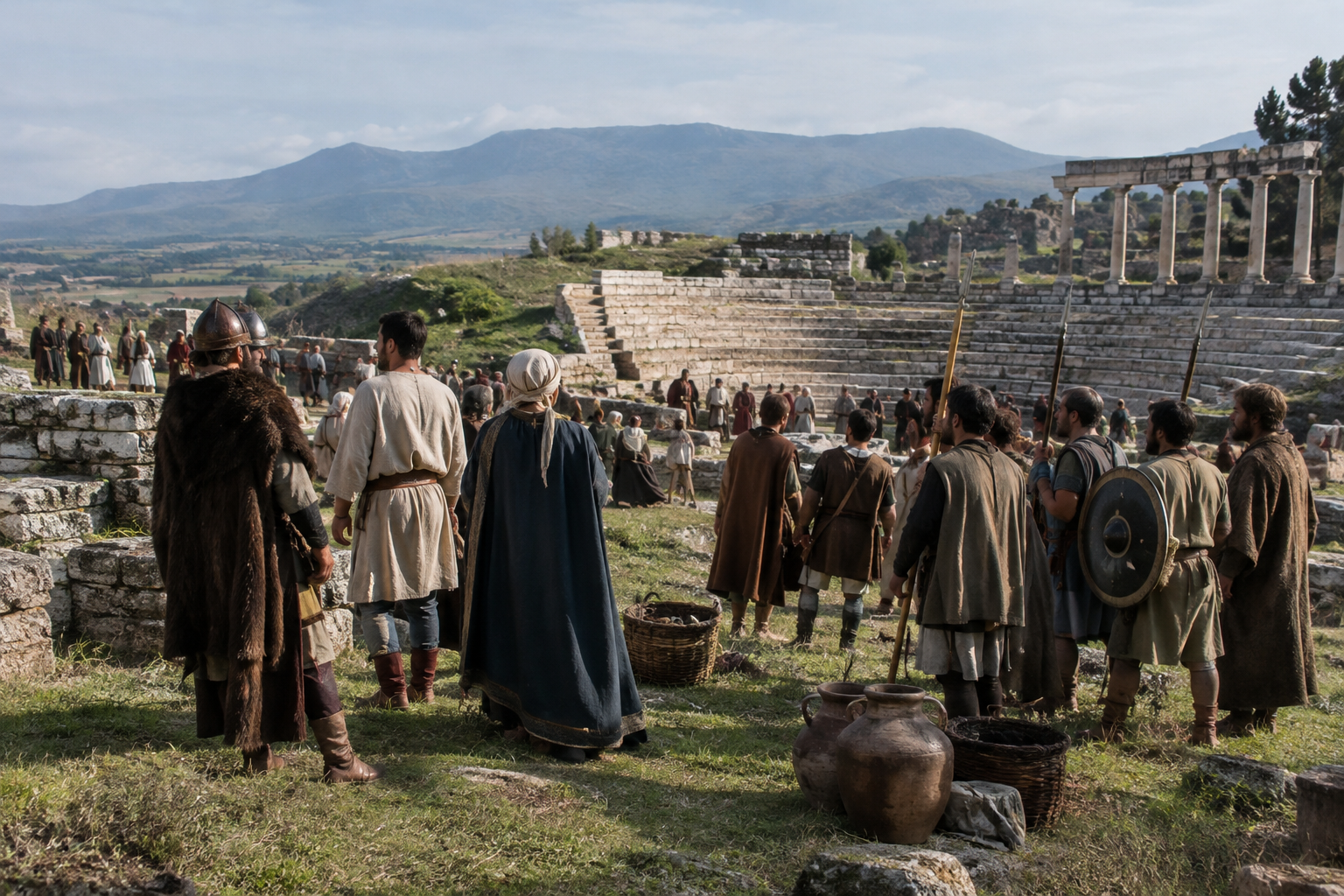
There is something wonderfully sobering about a Y-chromosome lineage with a name like R1b1a1b1b3a1a. It does not sound romantic. It sounds like an archive reference, or a shelf mark in a basement full of bones and broken pottery. And that, in a way, is exactly the point. Behind that dry string of letters and numbers lies a very human story about fathers and sons, movement and settlement, frontiers and lordships, and the long persistence of male lines through some of the busiest corridors in European history.
Like all Y-DNA haplogroups, R1b1a1b1b3a1a traces only one line of ancestry: the direct paternal line. It is not a summary of a person's whole heritage, culture, or identity. Still, paternal lineages can be historically revealing. This branch sits within the wider R1b family, one of the major Y-chromosome groupings found across much of western Eurasia and especially important in the story of later prehistoric and historic Europe. For a narrow subclade like this one, caution matters: we should not simply pour the entire history of broad R1b into it. But the ancient DNA evidence supplied here suggests a lineage with deep roots in the steppe-connected Bronze Age world, and later appearances across central, southern, and western Europe.
The earliest clues in this dataset point east and southeast, toward the great belt of prehistoric mobility stretching from the Eurasian steppe into the Balkans and the Carpathian Basin. Among the most striking samples are I0231, from Early Bronze Age Russia Samara Yamnaya dated to 2900 BC, and I0231a, from Neolithic Pre-Ural Steppe Yamnaya Ekaterinovka dated to 2875 BC. Alongside them stands I2762 from Early Bronze Age Hungary Yamnaya Devavanya-Barcehalom dated to 2881 BC.
Those are not just dots on a map. They belong to the world usually associated with steppe pastoralists and the enormous demographic changes of the late Neolithic and Bronze Age. It is well established that branches of R1b were important in these populations, though the exact history of this very specific subclade must be treated with care. What these samples do show is that the paternal line represented by R1b1a1b1b3a1a, or a very close relationship to it, was already part of the human traffic linking the Volga region, the Pontic-Caspian steppe, and the Carpathian Basin.
By the early Bronze Age the picture broadens further. BOY009 from Early Bronze Age Bulgaria Boyanovo dated to 2697 BC hints at movement into the Balkans, while I23209 from Bronze Age Maros Ostojicevo Serbia dated to 1950 BC and I23207 from Early Bronze Age Kikinda Mokrin Serbia dated to 1800 BC place related paternal lines in the middle Danube world. This is not proof of one neat migration in a single direction, still less of a single people marching about Europe in tidy formation. It is, rather, evidence that this paternal branch belonged to the broad and messy reshaping of Europe after steppe-related expansions.
Explore Steppe and Black Sea Migrations
Once we move into the Iron Age and Roman periods, this lineage becomes especially interesting because it turns up in places that remind us how connected Europe had become. Consider 3298s, from the Gallic Cenomani Tribe Italy Verona Seminario Vescovile dated to 300 BC. Here the lineage appears in an Iron Age context in northern Italy, among a population usually associated with Celtic-speaking groups in the Po Valley. That does not make the haplogroup "Celtic" in any simplistic sense, but it does place it within the human world of Iron Age mobility and regional integration.
The Roman centuries then scatter these paternal signatures across imperial landscapes. VIC004, from Roman Era Cambridge Vicars Farm dated to 200 AD, places the lineage in Roman Britain. R10478 from Late Roman Era Emona Slovenia dated to 325 AD, I26718 from Late Roman Trogir Dragulin Croatia dated to 350 AD, and I15552 from Late Imperial Roman Serbia Timacum Kuline Ravna Village dated to 380 AD show it across the Balkan provinces. On the Roman frontier in Germany, STRAZ_I_11 and STRAZ_I_14, both from Late Roman Frontier Straubing Azlburg Germany dated to 400 AD, add another frontier setting.
What does that tell us? Not that all these men were closely related in any genealogical sense. Rather, it suggests that closely related paternal branches could survive and recur in military zones, market towns, farmsteads, and provincial communities spread across the Roman world. Empires moved people: soldiers, settlers, traders, craftsmen, captives, and their descendants. Y-DNA lets us glimpse one narrow strand of that movement.
The post-Roman centuries continue the pattern. Mln43 from Merovingian Period Frankish Moemlingen Germany dated to 650 AD, IND014 from Merovingian Grave North Rhine-Westphalia Germany Alt-Inden dated to 600 AD, and BRC005x from Migration Period Roman Saxony-Anhalt Bruecken dated to 500 AD show the lineage in the world that emerged after Rome. It appears too in CSB-3 from Dark Ages Hungary Gothic Tribe Csongrad-Berzsenyi utca dated to 400 AD and RKF245 from Migration Period Outlier Hungary Rakoczifalva Szolnok dated to 500 AD, reminding us how mixed and mobile central Europe remained.
Read About the Roman-German Frontier
By the Middle Ages, the same paternal branch appears in a striking range of regions. In Iberia there is ldo263 from Medieval Northern Spain Las Gobas dated to 1000 AD. In Sicily there are SGBN22 and SGBN22x, both from Medieval Sicily Teatro di Segesta dated to 1220 AD. In southern Italy, VK535 from Medieval San Lorenzo Foggia Italy dated to 1240 AD adds another Mediterranean setting.
Meanwhile central and eastern Europe remain heavily represented: AHS07, AHS22, and AHS23 from Medieval Hungary Carolingian Empire Zalavar Varsziget dated to 850 AD; NTH-1 from Hungarian Conqueror Commoner Nagytarcsa-Homokbanya dated to 950 AD; VEM038 from Early Medieval Croatia Velim-Velistak dated to 750 AD; and I35014 from Medieval Croatia Gornji Kosinj Saint Ana dated to 1100 AD. There is also PCA0516 from Piast Dynasty Poland Santok Lubusz Province Gorzw Wielkopolski dated to 1100 AD.
The effect is less like a family tree and more like a map of durable male-line presence across medieval Europe. The lineage turns up in Spanish monastic or settlement landscapes, in Adriatic and Balkan communities, in Hungarian and Polish contexts, and in the cosmopolitan Mediterranean. That is precisely why ancient DNA is so useful: written genealogies usually begin with people important enough to be recorded, but Y-DNA sometimes reveals long continuities in ordinary populations as well as elite ones.
For readers interested in the Iberian side of this story, especially the wider genetic backdrop to samples like ldo263, the MyTrueAncestry article on Roman and post-Roman Iberia is a helpful companion.
Explore Roman Hispania's Genetic Legacy
So where do noble families enter this story? Carefully, and with the usual warning label attached. A historical association between a haplogroup and a family does not prove that every bearer of the surname, still less every cadet branch, carried the same Y-DNA. Nor does a shared broad haplogroup prove close kinship. But noble houses matter because they anchor paternal lines in place, memory, and stone.
At Berry Pomeroy Castle in Devon, the story begins with the Pomeroy family, who built the first stone castle there in the late 15th century on land held since the Norman Conquest. Later the estate passed to the House Seymour, one of Tudor England's great political families. The Seymours attempted something characteristically grand: they tried to transform the old fortress into an ambitious mansion within the medieval walls, but never finished it. By the 18th century the place was abandoned, and ruin did the rest. Broken towers, roofless halls, ghost stories, and a famously gloomy atmosphere followed.
Berry Pomeroy is interesting not because it proves anything genetically, but because it captures how male-line inheritance worked in historical Europe: estates, titles, claims, and memory were often organized through paternal descent, even while real families were shaped by marriage, illegitimacy, adoption, extinction, and political chance. A Y-DNA lineage like R1b1a1b1b3a1a belongs in that wider world of inheritance, lordship, and regional continuity, though not as a magical key that unlocks a castle gate.
If you want to follow the historical families themselves, the house articles on the Pomeroys and Seymours are the natural next stop.
What makes R1b1a1b1b3a1a historically fascinating is not a single grand claim, but its repeated appearance in meaningful places: Yamnaya-associated contexts on the steppe and in Hungary, Bronze Age sites in the Balkans, Iron Age Italy, Roman Britain and the Danubian provinces, Merovingian Germany, medieval Spain, Sicily, Croatia, Hungary, and Poland. It looks, in other words, like a paternal line at home in the long reshaping of Europe.
That does not mean everyone with this haplogroup descends from one famous tribe, one knightly house, or one medieval founder we can name. Ancient DNA rarely gives us that sort of tidy answer. What it does offer is something subtler and, to my mind, more interesting: a way of seeing how direct paternal lines can persist through changing cultures, languages, and political worlds. A man buried in Bronze Age Hungary, another on a Roman frontier, another in medieval Las Gobas, and a noble family associated with a Devon castle all belong to very different historical settings. Yet genetics lets us ask whether some of the same deeper paternal branches kept reappearing as Europe changed around them.
And if ruined castles are your thing, Berry Pomeroy has that extra charm of reminding us that lineage is never just biology. It is architecture, ambition, paperwork, landholding, gossip, ghosts, and half-finished building schemes as well.
Upload your DNA to MyTrueAncestry to explore whether your results show connections to ancient individuals like I0231, I2762, VIC004, or ldo263, and to see how your ancestry fits into the wider human story uncovered by archaeology and genetics. These matches do not by themselves prove direct descent from a particular ancient person or noble family, but they can offer a remarkable new perspective on your past.






Comments