Haplogroup R1b1a1b1a1a2c1b1a

– 6 min read


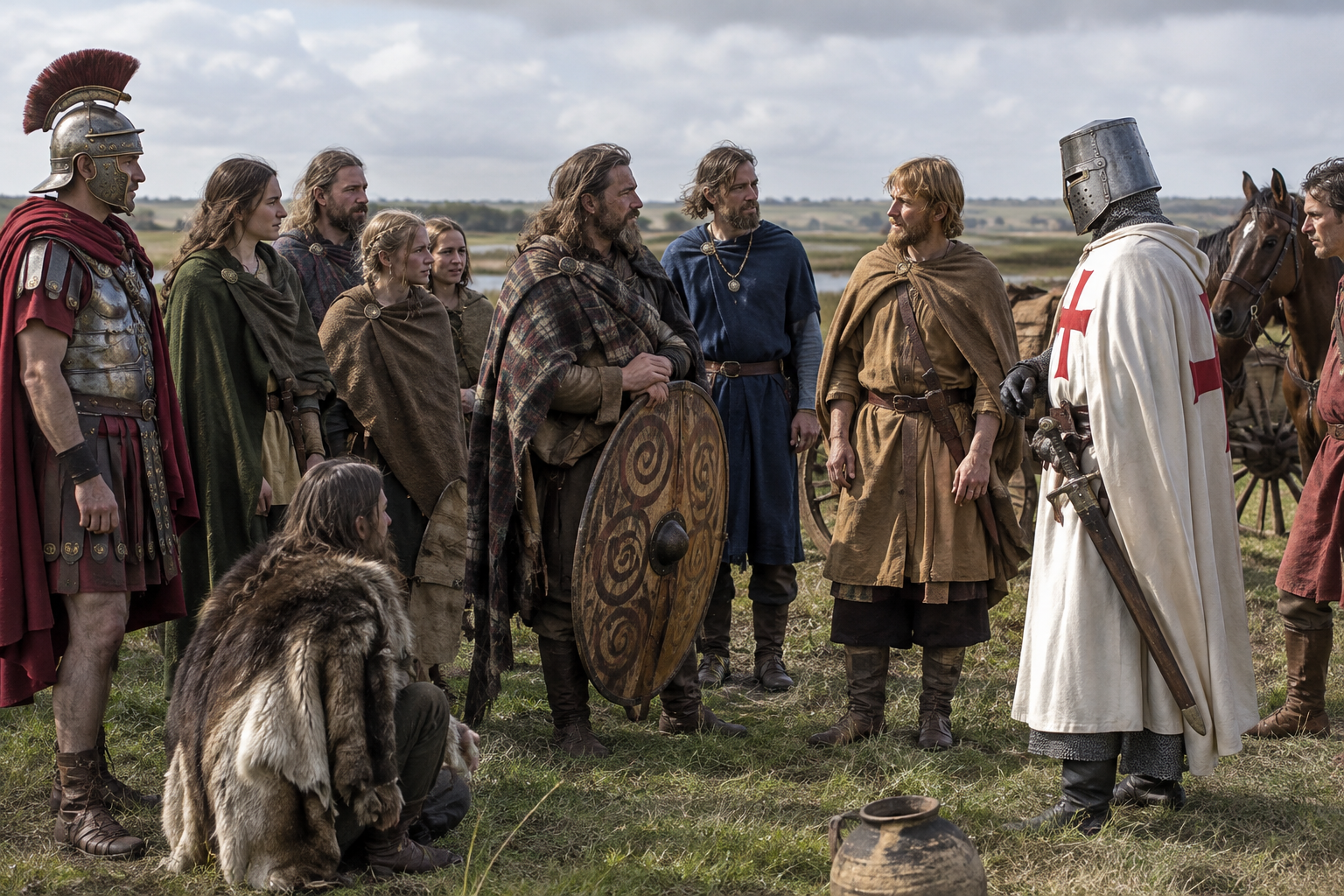
Some Y-chromosome lineages are easy to place in the historical imagination. They turn up in one famous dynasty, one celebrated migration, one neat map. Haplogroup R1b1a1b1a1a2c1b1a is more interesting precisely because it resists that kind of tidy storytelling. It belongs within the wider R1b family, a major branch of western Eurasian paternal ancestry, but this very specific subclade has to be approached with care. Its importance lies not in grand slogans, but in the way ancient DNA lets us watch a paternal line appear across different times, places, and social settings.
That matters because Y-DNA tracks only one line of descent: father to son to son. It is powerful evidence for direct paternal ancestry, but it does not describe a person's total ancestry, identity, culture, or nationality. Still, when a lineage turns up in Bronze Age England, Iron Age Yorkshire, Roman Cambridgeshire, and even in a Crusader-period burial in the eastern Mediterranean, it gives us something wonderfully concrete: not a legend, but a trail.
R1b is one of the best-known Y-chromosome macro-lineages in Europe today, and ancient DNA has shown that different branches of it spread in different ways over time. For a narrow branch such as R1b1a1b1a1a2c1b1a, it is important not to borrow the whole history of every upstream R1b expansion and pretend it applies automatically in full. What we can say, more responsibly, is that this lineage belongs to a paternal family with deep roots in western Eurasia and that the samples supplied here place it firmly in a long British and northwestern European historical setting, with one later appearance in the Crusader world.
The broad pattern suggested by the evidence is one of continuity mixed with mobility. This is not unusual. Paternal lines can remain in a region for many centuries while particular men, households, warbands, or elite connections move over long distances. That combination of local persistence and sudden mobility is exactly what makes Y-DNA so useful to archaeologists.
Explore Celtic origins through ancient DNA
The earliest anchors in this dataset come from Bronze Age England. Sample I13714, from East Kent and dated to 1417 BC, places this paternal branch in southeastern Britain well before the Roman period and long before medieval clan histories. Another early case, I2448 from Yarnton, Oxfordshire, dated to 1200 BC, shows the lineage again in later Bronze Age England, but in a different landscape entirely: not the Channel-facing corner of Kent, but the Thames valley world of central southern Britain.
That pair alone is revealing. It suggests that men carrying this branch, or a closely related part of it, were not confined to one isolated pocket. They were present in more than one region of Bronze Age England. We should not leap from that to claims about tribe, language, or social rank. But it does hint that this paternal line belonged to communities already well established in Britain before the better-documented Iron Age societies emerged.
For readers interested in the longer background to such prehistoric population change, the community article The Neolithic Expansion: A Genetic and Archaeological Journey Through Ancient Europe offers useful wider context for how later European paternal landscapes were built over millennia.
If the Bronze Age samples provide the early footholds, the Iron Age evidence is where the story becomes properly vivid. Several supplied individuals come from Wetwang Slack in East Yorkshire, all dated to 225 BC: I36888, I36875, I36809, I31507, and I36904. These are associated with the Celtic Parisi, one of the most archaeologically distinctive groups in Iron Age Britain.
Wetwang Slack is famous because it belongs to the chariot-burial zone of East Yorkshire, a region whose funerary customs have fascinated archaeologists for generations. The presence of this haplogroup in multiple individuals from the same broad cultural setting is more informative than a lone discovery. It points toward a paternal lineage established within that regional population rather than a one-off arrival.
The nearby Pocklington discoveries strengthen that impression. Sample I14107, described as a Celtic Briton from Pocklington, Yorkshire, England, also dates to 225 BC. So does I5511, the famous Elite Charioteer Briton from Pocklington. Here the archaeology does some of the storytelling for us. Chariots, burial display, and elite treatment belong to a world of rank and public memory. The Y-chromosome cannot tell us whether these men were chiefs, retainers, or kin in any precise social sense, but it does show this paternal branch embedded in the very milieu that made Iron Age East Yorkshire so distinctive.
Read more on Iron Age Britain and ancient DNA
One of the most attractive things about this lineage is that it does not vanish when the Romans arrive. Sample DUX019, from Roman Era Cambridgeshire Duxford and dated to 112 AD, shows it still present in Britain under imperial rule. That matters because Roman Britain was not genetically static. Soldiers, traders, enslaved people, administrators, and families moved through the province in large numbers. Some lineages disappeared locally; others persisted.
DUX019 therefore sits at an important junction. He is neither simply "Iron Age" nor obviously an immigrant from afar. Rather, he belongs to a Roman-period landscape in which local British ancestry and empire-wide mobility overlapped. If you want to pursue that bigger question of continuity and change under Roman rule, see Genomic History and Natural Selection in Roman and Early Medieval Britain.
And then there is the outlier that is not really an outlier at all. Sample SI-53, a Crusader Knight Tuscan / Lebanon dated to 1250 AD, reminds us that medieval paternal lines could travel astonishing distances. One should not force a direct line from Yorkshire charioteers to a knight in the Levant. That would be fantasy. But the appearance of the same haplogroup branch in a Crusader-era setting is a sharp illustration of how lineages rooted in western Europe could reappear in the eastern Mediterranean through warfare, pilgrimage, lordship, and colonial settlement.
The noble associations supplied with this haplogroup draw us north into Scotland, and here caution is particularly important. A historical association between a haplogroup and a clan does not prove that every man of that clan carried that lineage, nor that any one ancient sample is a documented ancestor of a later family. What it does offer is a geographic and historical frame in which the paternal story can be imagined more concretely.
Clan MacAlister is represented here through Kennox House in South Lanarkshire, an 18th century mansion built around 1759 for the merchant Alexander Murdoch on the site of an older estate called Whitehill. It is a useful reminder that lineage memory does not survive only in medieval towers. Sometimes it survives in later country houses, in the reuse of older estates, and in the persistence of local family names in the landscape.
Clan Lennox appears through Lennox Castle near Lennoxtown in East Dunbartonshire. This was an early 1840s Scottish baronial house built for John Lennox Kincaid, later sold, institutionalized, used for military purposes during the Second World War, and left a ruin after a serious fire in 2008. There is something almost too apt about that melancholy shell. Family prestige, like genetic continuity, survives unevenly. Names endure; buildings decay; records fragment.
Clan MacFarlane takes us to Inveruglas Castle on the west side of Loch Lomond near the mouth of the River Douglas, close to modern Arrochar. This was a stronghold in a harder, older sense: guarding a route through the glens, tied to Highland feuds, civil wars, boats, cattle raiding, and kin politics. Little survives now beyond traces, but the site still evokes a region where paternal descent, territorial control, and martial obligation mattered intensely.
Discover the history of Clan MacAlister
What, then, do these Scottish castles have to do with an ancient Y-line found in Bronze Age and Iron Age England? Not proof of descent, certainly. The connection is broader and more historical than that. Ancient DNA gives us a paternal line present in Britain over a very long span. Clan and castle history show how later societies organized memory, status, and territory around family identity. Genetics and documents are doing different jobs, but they can still illuminate the same landscapes.
In that sense, Inveruglas Castle and Lennox Castle are not evidence for the haplogroup. They are evidence for the enduring importance of named male lineages in British and Scottish history. The archaeology tells us that paternal continuity could last for centuries. The castles remind us that later societies built institutions, loyalties, and stories around exactly that idea.
Readers who want to stay with that Scottish dimension may enjoy the companion material on Clan Lennox and Clan MacFarlane, where the regional histories of these families come into sharper focus.
Explore Clan MacFarlane and Inveruglas
R1b1a1b1a1a2c1b1a is a good example of why narrow Y-DNA branches are worth studying carefully. In the evidence supplied here, it appears in Bronze Age England, among Iron Age Yorkshire communities including elite chariot burials, in Roman-era Cambridgeshire, and later in a Crusader-period context linked to Tuscany and Lebanon. That is not a simple tale of one people marching across a map. It is a more human story of persistence, regional continuity, and occasional long-distance movement.
For MyTrueAncestry users, that is the real fascination. A Y-line can place your direct paternal ancestry into a deep historical frame, but it does not hand you a ready-made identity or certify descent from a noble house. What it can do is connect your results with real archaeological individuals such as I13714, I2448, I5511, or DUX019, and with the regions where later clans and castles kept older ideas of lineage alive.
If you want to see whether your DNA shows links to ancient individuals, historic populations, or paternal lines like this one, MyTrueAncestry can open that door. The comparisons are historical clues rather than proofs of direct descent, but they can transform an abstract haplogroup into a much more grounded past.






Comments